SBA Capability Statement Template: How To Write One Fast

If you're a healthcare company chasing government contracts, whether you provide DME, home health, NEMT, or health IT services, you need a capability statement before anyone at an agency will take your call. An SBA capability statement template gives you a proven structure to build one without starting from a blank page or hiring a consultant.
The problem is that most templates floating around online are generic. They don't account for the specifics that federal health agencies actually look for, like compliance credentials, technical differentiators, or EHR integration capabilities. If your company uses platforms like SoFaaS to connect with EHR systems and streamline healthcare data workflows, that's exactly the kind of competitive advantage a capability statement should highlight.
This guide gives you a ready-to-use template and a step-by-step walkthrough for writing a capability statement that meets SBA and federal contracting standards. You'll learn what to include, what to skip, and how to position your healthcare business to stand out in a crowded field of bidders.
What an SBA capability statement is
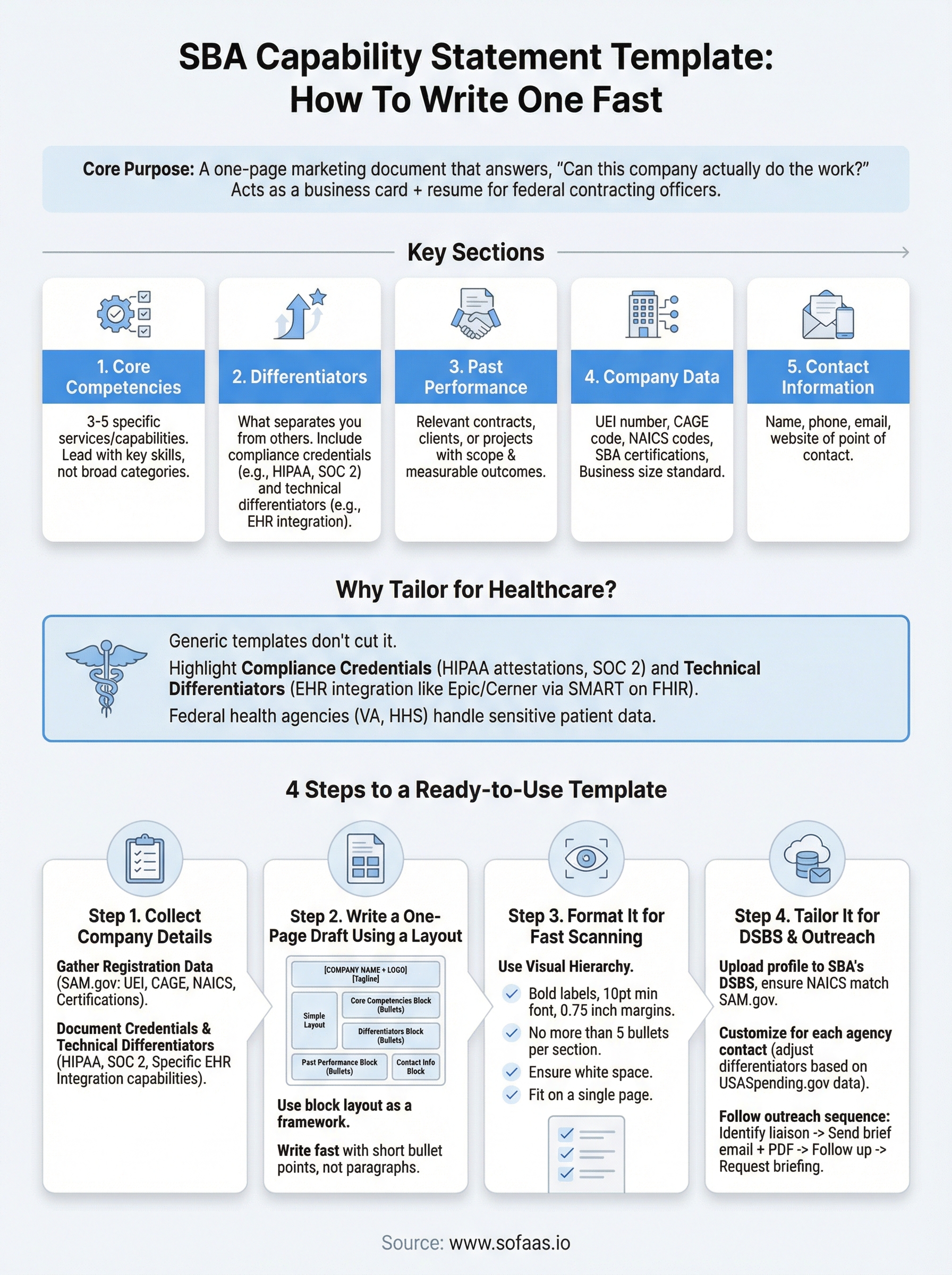
A capability statement is a one-page marketing document that introduces your company to a federal contracting officer or agency buyer. Think of it as a business card combined with a resume: it tells a government buyer who you are, what you do, and why you're qualified to win a contract. The Small Business Administration uses these documents as a standard tool for helping small businesses compete in the federal marketplace, and most procurement offices expect to receive one before any serious conversation about contract opportunities begins.
The core purpose of a capability statement
Your capability statement exists to answer one question in the contracting officer's mind: "Can this company actually do the work?" It's not a proposal, and it's not a brochure. A well-built SBA capability statement template gives you a repeatable format to answer that question quickly and credibly. For healthcare suppliers, this means showing up-front that you hold the right certifications, serve the right patient populations, and operate within federal compliance standards.
A capability statement that leads with your core competencies and NAICS codes gets read. One that leads with your company story gets skipped.
The key sections every statement includes
Federal buyers scan capability statements fast, so the structure matters as much as the content. Every statement needs to cover five core areas, and skipping any one of them signals inexperience to the reader.
| Section | What to include |
|---|---|
| Core Competencies | 3 to 5 specific services or capabilities you provide |
| Differentiators | What separates you from other vendors in your space |
| Past Performance | Relevant contracts, clients, or projects you've completed |
| Company Data | DUNS/UEI number, CAGE code, NAICS codes, SBA certifications |
| Contact Information | Name, phone, email, and website of the right point of contact |
Why healthcare companies need a tailored version
A generic template won't cut it if you operate in a regulated healthcare environment. Your compliance credentials such as HIPAA attestations, EHR integration capabilities, or SOC 2 certifications are the exact details that differentiate you from non-healthcare IT vendors. Federal health agencies like the VA and HHS deal with sensitive patient data, so listing those qualifications directly on your capability statement signals that you understand the stakes and removes doubt before a meeting even happens.
Step 1. Collect the required company details
Before you open any SBA capability statement template, gather the raw information you'll need to fill it in. Trying to write and research at the same time slows you down and leads to gaps that make your statement look incomplete to a contracting officer. Set aside 30 minutes to pull every piece of required data before you touch the template.
The registration data you need first
Every federal buyer will verify your SAM.gov registration before moving forward, so pull this data first. If you haven't registered yet, create an account at SAM.gov before continuing with this step.
- UEI number (replaced the DUNS number in 2022)
- CAGE code
- Primary and secondary NAICS codes that match your healthcare services
- SBA certifications such as 8(a), HUBZone, WOSB, or SDVOSB
- Business size standard tied to your primary NAICS code
If your NAICS codes don't match the solicitation, a contracting officer will move on regardless of how strong the rest of your statement looks.
Your credentials and technical differentiators
Once you have your registration data, document the compliance credentials and technical capabilities that make your company a credible healthcare vendor. For health IT companies, this includes HIPAA attestations, SOC 2 Type II certifications, and EHR integration capabilities your platform supports.
Write out three to five specific differentiators you can defend in a follow-up conversation. Vague claims like "industry-leading solutions" waste valuable space on a one-page document. Specific claims like "connects to Epic and Cerner via SMART on FHIR in under 72 hours" give the contracting officer something concrete to evaluate and remember.
Step 2. Write a one-page draft using a layout
With your data collected, open your SBA capability statement template and fill in each section in order. Don't write full paragraphs yet. Use short bullet points at this stage so you can see everything at once and move things around without wasting time on polish.
A simple layout that works
Most contracting officers expect the same general layout, so follow a structure that matches their mental model. Use this block layout as your starting framework:

[COMPANY NAME + LOGO]          [Core Competencies]
[Tagline: one sentence max]    - Competency 1
                               - Competency 2
[Company Data]                 - Competency 3
UEI: XXXXXXXXX
CAGE: XXXXX                    [Differentiators]
NAICS: 621610, 541512          - Differentiator 1
Certifications: HIPAA,         - Differentiator 2
SOC 2 Type II, WOSB
                               [Past Performance]
[Contact Information]          - Client/Contract 1
Name, Phone, Email, URL        - Client/Contract 2
Keeping your layout consistent with what contracting officers already expect makes your statement easier to scan and harder to set aside.
Writing each section fast
Start with your core competencies block because it anchors everything else. Write three to five bullet points describing specific services you deliver, not broad categories. For a healthcare IT company, that means writing "SMART on FHIR EHR integration for Epic and Cerner" rather than "healthcare software services."
Move to past performance last, even though it appears mid-page. This section trips up most companies because they try to list too much. Pick two or three relevant engagements that match the type of work you're targeting and include the agency name or client type, the scope, and any measurable outcome you can state clearly.
Step 3. Format it for fast scanning
A contracting officer might spend ten seconds looking at your statement before deciding whether to keep reading or move on. That means visual formatting carries as much weight as the words themselves. Once your draft is written, shift focus entirely to layout and make sure a reader can absorb your key points without reading every line.
A cluttered capability statement loses the reader before your core competencies ever register.
Use visual hierarchy to guide the reader's eye
Your most important information should land in the top-left quadrant of the page, since that's where eyes go first. Use bold labels to introduce each section so a contracting officer can jump directly to what they need. Avoid full paragraphs anywhere on the page and stick to bullets of no more than two lines each.

Use this formatting checklist before you finalize your SBA capability statement template:
- Font size: 10pt minimum for body text, 14pt for your company name
- Margins: 0.75 inches on all sides to maximize usable space
- Section headers: bold and slightly larger than body text
- Bullet points: no more than 5 per section
- White space: at least one clear gap between each section block
Check spacing and density before you send
Print your statement or view it at 100% zoom before sending it anywhere. If any section looks like a wall of text, cut it down until each block breathes on its own. A reader should be able to identify your NAICS codes, certifications, and top competency within five seconds of looking at the page.
Your final document should fit on a single page with no scrolling required. If it runs long, cut your past performance section first since that's the easiest block to trim without losing credibility.
Step 4. Tailor it for DSBS and outreach
A finished SBA capability statement template is only useful if the right people see it. Two distribution channels matter most for small businesses: the SBA's Dynamic Small Business Search (DSBS) database and direct outreach to contracting officers at your target agencies.
Upload your profile to DSBS
DSBS is the public-facing database that federal buyers search when they need small business vendors. Your SAM.gov profile feeds directly into it, so keeping that profile current ensures your company appears in relevant searches. Log in to SAM.gov and verify that your NAICS codes, certifications, and capabilities description match exactly what appears on your capability statement. Inconsistencies between the two documents create doubt for contracting officers who cross-reference them.
Contracting officers search DSBS by NAICS code first, so your code selection directly controls whether you appear at all.
Customize for each agency contact
Sending one generic version to every agency reduces your response rate. Pull the agency-specific contract history from USASpending.gov before you reach out, then adjust your differentiators block to reflect the types of services that agency has already purchased. For a VA outreach version, you would lead with patient data security and EHR integration credentials. For an HHS contact, you would emphasize compliance infrastructure and HIPAA documentation.
Use this outreach sequence once your tailored statement is ready:
- Identify the small business liaison officer at your target agency
- Send a brief two-sentence email with your statement attached as a PDF
- Follow up once after seven business days if you receive no reply
- Request a capability briefing to move the relationship forward
Ready to send your capability statement
You now have everything you need to build, format, and distribute a professional capability statement that meets federal contracting standards. Follow the four steps in order, keep the document to one page, and lead every section with specific, verifiable details rather than general claims.
Your SBA capability statement template is only as strong as the differentiators you put in it. If your healthcare company integrates with EHR systems like Epic or Cerner, say so clearly and back it up with credentials like HIPAA attestations and SOC 2 Type II certification. Those specifics are what separate a statement that gets filed from one that generates a follow-up call.
If your team is still building the underlying integration infrastructure that powers those differentiators, launch your SMART on FHIR app faster with SoFaaS so your capability statement reflects what your platform can actually deliver today.
The Future of Patient Logistics
Exploring the future of all things related to patient logistics, technology and how AI is going to re-shape the way we deliver care.
Thank you! Your submission has been received!
Oops! Something went wrong while submitting the form.