Capability Statement Definition: What It Is and How to Write

A capability statement definition is straightforward: it's a concise document, usually one page, that summarizes what your business does, how it delivers, and why it's qualified. Think of it as a business resume built for winning contracts, particularly in government and B2B settings where decision-makers need to evaluate vendors quickly.
If you're a healthcare supplier, a health tech company, or any organization pursuing contracts with hospitals, health systems, or government agencies, a strong capability statement isn't optional, it's expected. At SoFaaS, we work with healthcare innovators who integrate with EHR systems to build and scale their products. Many of them are competing for partnerships and contracts where a well-crafted capability statement is the first document a procurement team reviews. Without one, you often don't make it past the initial screening.
Yet despite how critical this document is, most businesses either skip it entirely or produce something generic that fails to communicate real value. This article breaks down exactly what a capability statement is, what belongs in it, and how to write one that actually gets read. Whether you're a DME provider responding to an RFP, a health tech startup pursuing your first hospital contract, or an established company refreshing outdated materials, you'll walk away with a clear framework to build a capability statement that positions your business as a credible, qualified partner.
What a capability statement is and is not
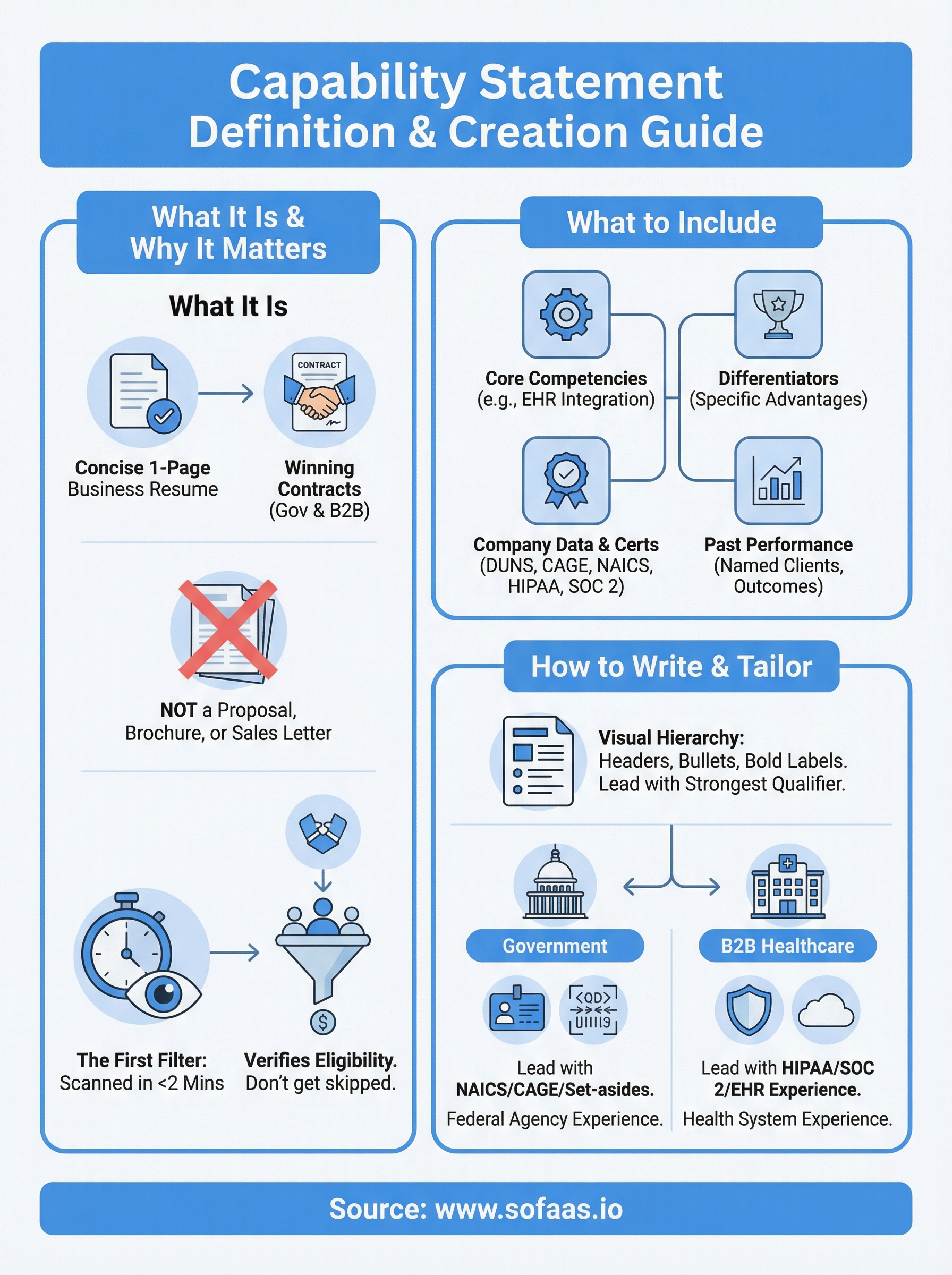
The full capability statement definition centers on one idea: it's a structured, one-page business profile that tells a potential buyer exactly what you do, what you've done, and why you're qualified. It exists to answer procurement officers' most immediate question: "Can this vendor deliver what we need?" in 60 seconds or less. Unlike a proposal or a pitch deck, it doesn't ask for anything or walk through a lengthy argument. It simply presents your credentials in a tight, scannable format that fits government contracting norms and B2B vendor screening processes.
What a capability statement actually is
A capability statement is a formatted document that functions as your business's proof of qualification. It typically runs one page and combines a few essential elements: your core competencies, past performance, differentiators, and company data. For healthcare suppliers and health tech companies, this document appears in response to Sources Sought notices, Request for Information (RFI) responses, or initial vendor qualification packets that hospital procurement teams and government agencies send out.
A well-built capability statement doesn't just describe your company. It gives the reader enough confidence to move you forward in a selection process.
The document is purposefully brief because the people reading it are screening dozens of vendors at once. Procurement officers at agencies covered by the Federal Acquisition Regulation, for instance, often review capability statements in under two minutes. Your goal is to make the relevant information impossible to miss.
What a capability statement is not
A capability statement is not a proposal, a brochure, or a sales letter. These are common mistakes. Proposals answer a specific scope of work with pricing. Brochures promote general brand awareness. Sales letters persuade through narrative. A capability statement does none of those things. It presents facts: what you do, who you've served, your certifications, and your identifiers.
It's also not a static document you produce once and reuse forever. The businesses that get results from capability statements treat them as living assets they adjust for each opportunity. If you're pursuing a contract with a hospital system that runs Epic, your statement should reflect your EHR integration experience directly. Generic capability statements get filed and forgotten.
Why capability statements matter in contracting
When a procurement officer receives a pile of vendor responses, the capability statement is often the first filter they apply. It signals whether your company meets the basic threshold before anyone reads a full proposal or schedules a call. In both government and B2B healthcare contracting, the document does real screening work on your behalf when you aren't in the room.
The role of a capability statement in vendor screening
Government agencies operating under federal procurement rules, and hospital systems running formal vendor qualification processes, both rely on structured documents to compare vendors consistently. A capability statement gives them a standardized way to evaluate your qualifications against defined criteria, such as relevant experience, certifications, and business classifications. Without that structure, your company's strengths get buried or missed entirely.
A capability statement doesn't close a contract, but it determines whether you stay in the running long enough to compete for one.
Your certifications, NAICS codes, and past performance all carry weight in this process. Buyers use them to verify eligibility and relevance before investing time in deeper evaluation.
What happens without one
If you don't have a capability statement ready, you create unnecessary friction in the procurement process. Buyers who have to dig for basic information about your qualifications will often move to the next vendor instead. The full capability statement definition implies readiness, and showing up without one signals the opposite.
For healthcare suppliers and health tech companies, this matters even more because your buyers manage high compliance and accountability standards and can't afford to work with unvetted vendors.
What to include in a capability statement
Every capability statement definition you'll find points to the same core components. Buyers expect a consistent structure, so deviating from it creates confusion and raises doubt about your professionalism. Your goal is to give decision-makers every qualifying data point they need in a single, organized page.
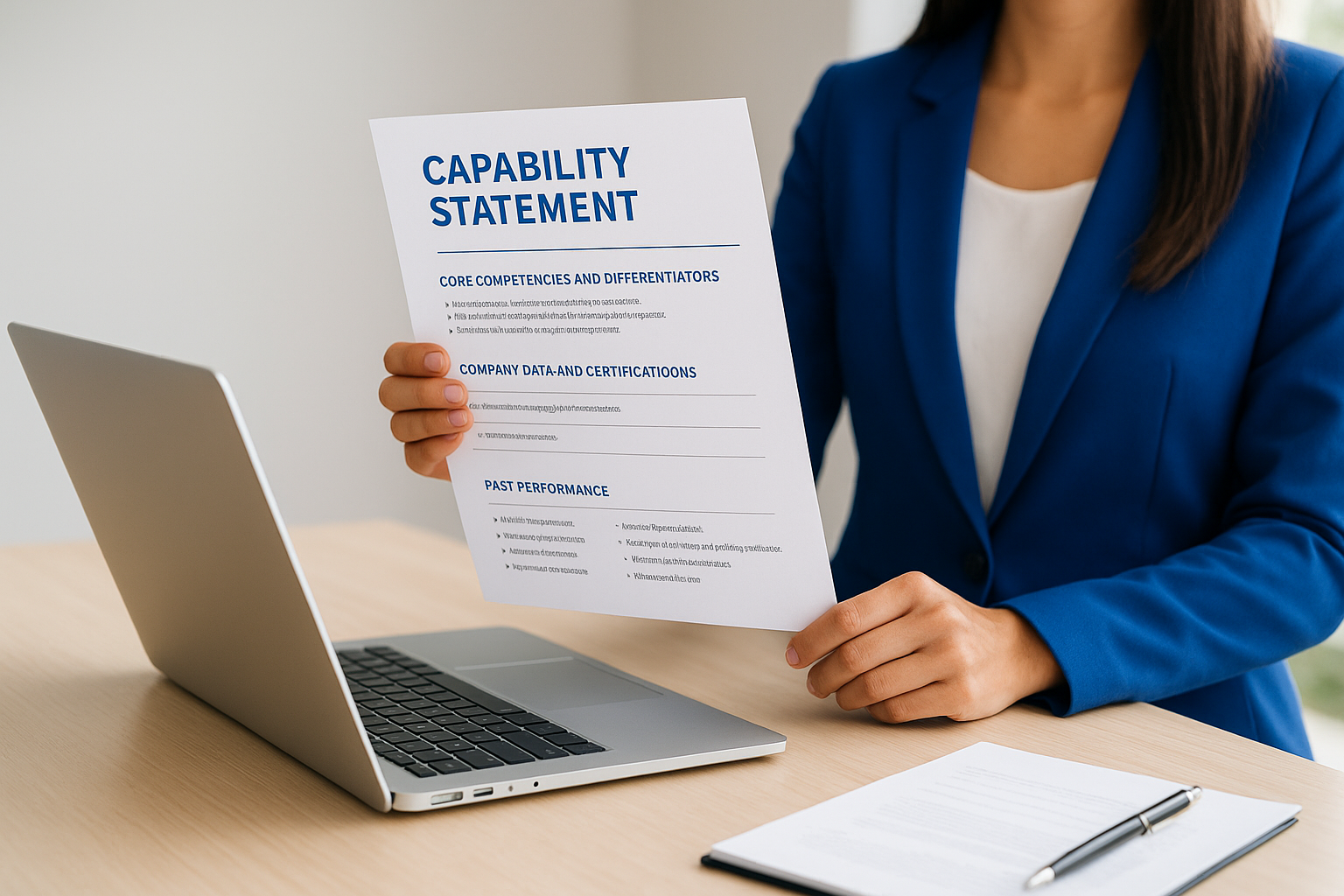
Core competencies and differentiators
Your core competencies are the services or capabilities your company reliably delivers, stated plainly and specifically. If you provide EHR integration, list the systems you support. If you handle HIPAA-compliant data exchange, say so directly. Under that, your differentiators explain why you deliver those services better than the next vendor. This is not a place for vague claims like "customer-focused." It's a place for specific advantages: faster deployment timelines, pre-built connectors, or certifications your competitors don't hold.
Buyers skim competencies to check fit and read differentiators to decide whether to keep your company in the pile.
Company data and certifications
Include your DUNS number, CAGE code, NAICS codes, and any relevant small business certifications such as SDVOSB, 8(a), or WOSB if you pursue federal contracts. For B2B healthcare buyers, list your HIPAA compliance status, SOC 2 certification, or any EHR-specific credentials. This data lets procurement teams verify eligibility without chasing you for follow-up documents.
Past performance
Your past performance section shows buyers that real organizations have trusted you with work similar to what they need. List two to four clients, the scope of work, and measurable outcomes where possible. For healthcare companies, named health systems, payers, or government agency contracts carry the most weight because they signal that you've already passed rigorous vendor qualification processes.
How to write one that buyers can scan fast
Formatting is the part most businesses get wrong. You can have strong credentials and still lose a buyer's attention if your layout forces them to hunt for information. Procurement officers don't read capability statements the way they read a report. They scan, and your document needs to reward that behavior within the first few seconds.
Lead with your strongest qualifier
Put your most compelling differentiator or certification at the top, directly below your company name and logo. Buyers decide within the first few lines whether a vendor is worth their attention. If your most relevant credential sits halfway down the page, they may never reach it. For healthcare companies, this means surfacing your HIPAA compliance, SOC 2 status, or named EHR partnerships before anything else.
The top third of your capability statement carries the most weight because that's where scanners stop if nothing grabs them.
Use visual hierarchy to guide the eye
Section headers, short bullet points, and bold labels do more work than paragraphs in this format. Each section of your document should have a clear label so a buyer can locate company data, past performance, and certifications without reading every line. Keep body text tight, with sentences under 20 words where possible, and replace any narrative explanations with direct, factual statements.

Your full capability statement definition lives on one page. That constraint is a feature, not a limitation. It forces you to prioritize only what's most relevant to the buyer in front of you, which makes every element on the page carry real weight.
How to tailor for government and B2B buyers
One capability statement definition does not fit every audience. Government procurement officers and B2B healthcare buyers evaluate vendors through different lenses, so sending the same document to both groups leaves value on the table. Tailoring your statement to match each buyer's specific priorities takes less effort than most businesses expect, and it dramatically improves your chances of advancing in a selection process.
Adapting for government procurement
Government buyers evaluate vendors against specific regulatory and classification criteria before anything else. Your statement for a federal audience must prominently display your NAICS codes, CAGE code, and any small business set-aside certifications such as 8(a) or SDVOSB. These identifiers help contracting officers verify eligibility quickly. Lead with them so the buyer confirms your qualification before reading a single word about your services. Government buyers also favor past performance with named federal agencies or prime contractors, so surface those references directly in your past performance section rather than grouping them with commercial clients.
Removing irrelevant commercial clients from a government-facing statement tightens your profile and signals that you understand the audience.
Adapting for B2B healthcare buyers
Hospital systems, health plans, and healthcare suppliers focus less on government codes and more on compliance credentials and integration experience. Your B2B-facing statement should lead with HIPAA compliance status, SOC 2 Type II certification, and any named EHR systems you support. If you connect applications to Epic or Cerner, list those partnerships explicitly. B2B buyers in healthcare also weigh risk very heavily, so your past performance should name recognizable health systems and describe outcomes that reduced operational or compliance risk for those clients.
Next steps for your capability statement
You now have a complete capability statement definition and a clear framework to build one that moves buyers to act. The next step is straightforward: draft your one-page document using the structure outlined above, then build two versions, one for government procurement audiences and one for B2B healthcare buyers. Review it against the questions buyers actually ask: Does it surface your certifications immediately? Does past performance name recognizable clients? Can someone scan it in under two minutes and know whether you qualify?
Once your statement is ready, match it to the opportunities you're actively pursuing. If your pipeline includes hospital systems or health plans that require EHR integration capabilities, your technology stack becomes a differentiator worth naming explicitly. SoFaaS gives healthcare companies the integration credentials that belong in a strong capability statement. If you're building or scaling a healthcare application, launch your SMART on FHIR integration and give buyers a reason to keep your company in the running.
The Future of Patient Logistics
Exploring the future of all things related to patient logistics, technology and how AI is going to re-shape the way we deliver care.
Thank you! Your submission has been received!
Oops! Something went wrong while submitting the form.