What Is Healthcare Data Analytics? Types, Uses, Careers

Every patient interaction, lab result, prescription, and clinical note generates data. Hospitals, clinics, and health systems sit on enormous volumes of it. But raw data alone doesn't improve outcomes or cut costs, turning it into actionable insight does. That's exactly what healthcare data analytics is about: applying statistical methods, algorithms, and technology to health-related data so organizations can make smarter clinical and operational decisions.
Analytics only works when the underlying data is accessible, standardized, and flowing where it needs to go. This is where platforms like SoFaaS come in. By simplifying EHR integration through SMART on FHIR, SoFaaS helps healthcare application teams get clean, real-time patient data out of systems like Epic and Cerner, the kind of data that powers meaningful analytics in the first place.
This article breaks down what healthcare data analytics actually means, the different types used across the industry, how it impacts patient care and operations, and what career paths exist if you want to work in the field. Whether you're a product leader exploring a health tech solution or a developer trying to understand where analytics fits into the bigger picture, you'll walk away with a solid, practical understanding of the subject.
What healthcare data analytics covers
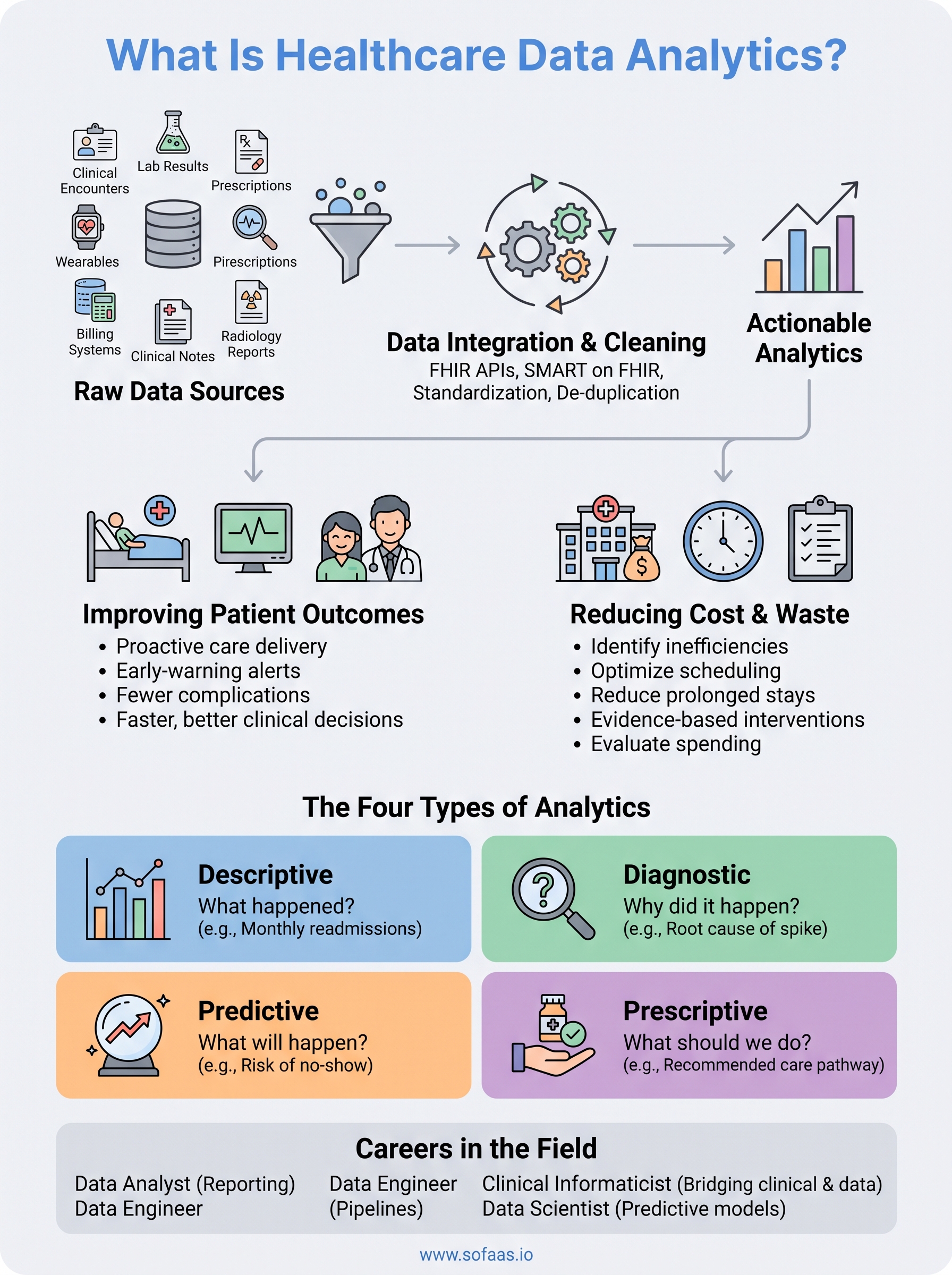
When you ask what is healthcare data analytics, you're really asking how health systems extract value from data they already collect. Healthcare organizations gather information from dozens of sources every day: clinical encounters, medical devices, billing systems, wearables, and patient-reported outcomes. Analytics is the discipline that connects those sources and converts them into decisions, whether that's identifying a deteriorating patient earlier or pinpointing which procedures drive the most readmissions.
The data sources involved
Healthcare analytics pulls from a wide range of structured and unstructured data. Structured data includes lab results, diagnosis codes, medication records, and claims data stored in formats that databases can query directly. Unstructured data covers clinical notes, radiology reports, and discharge summaries written in plain text. Both types matter, and most modern analytics platforms work with both to give a complete picture.
The most significant source for clinical analytics is the Electronic Health Record (EHR), which centralizes patient history, orders, results, and documentation in one system. EHRs like Epic and Cerner hold decades of longitudinal patient data, but accessing that data programmatically requires standard interfaces. FHIR-based APIs are now the primary mechanism for extracting structured clinical data from EHRs in a format that analytics tools can actually use.
The quality of your analytics output depends entirely on the quality and completeness of the data you feed into it.
What the analytics process actually involves
Getting from raw data to a usable insight involves several steps. First, data must be extracted from source systems like EHRs, billing platforms, and monitoring devices. Then it gets cleaned, de-duplicated, and normalized into a consistent format. A lab result expressed in different units across two hospitals, for example, will break any downstream comparison if you don't standardize it first.
Once the data is clean, analysts and data scientists apply statistical models, machine learning algorithms, or straightforward reporting queries depending on the goal. A hospital tracking average length of stay might only need descriptive statistics. A health system trying to predict which patients will miss a follow-up appointment needs something closer to a predictive model trained on historical behavior patterns. The complexity of the analysis scales with the question being asked, which is why healthcare analytics spans everything from simple dashboards to advanced decision support tools that alert clinicians in real time.
Why healthcare data analytics matters
Understanding what is healthcare data analytics is one thing; understanding why it matters in practice is another. Health systems that act on data consistently outperform those that rely on intuition or anecdotal evidence alone. Analytics shortens the gap between a clinical observation and a concrete decision, whether that means catching a deteriorating patient before they reach a critical threshold or reducing the time it takes to discharge a patient safely.
Improving patient outcomes
Healthcare data analytics directly improves patient safety and care quality by surfacing patterns that no individual clinician could identify across thousands of cases. A hospital tracking sepsis indicators across its ICU population, for example, can trigger early-warning alerts before a patient's condition becomes life-threatening. This shift from reactive to proactive care delivery is one of the most significant advantages analytics brings to clinical operations.
When analytics is embedded into clinical workflows, it becomes a tool for prevention, not just retrospective reporting.
Systems that use data to guide care protocols also see measurable reductions in preventable complications and hospital-acquired conditions. Data-driven care teams consistently make faster and better-supported decisions than those working without structured insight.
Reducing cost and operational waste
On the operational side, analytics helps your organization identify inefficiencies that are otherwise invisible to leadership. Scheduling bottlenecks, redundant testing, and prolonged lengths of stay all carry real financial costs. When you quantify those patterns, you can target specific, evidence-based interventions rather than making broad cuts that affect care quality.
Payers and providers both rely on claims data and utilization analytics to evaluate where spending is disproportionate. For health tech companies building on top of EHR data, demonstrating that your solution reduces cost or improves a measurable outcome is often the deciding factor in procurement and adoption decisions.
The four types of healthcare data analytics
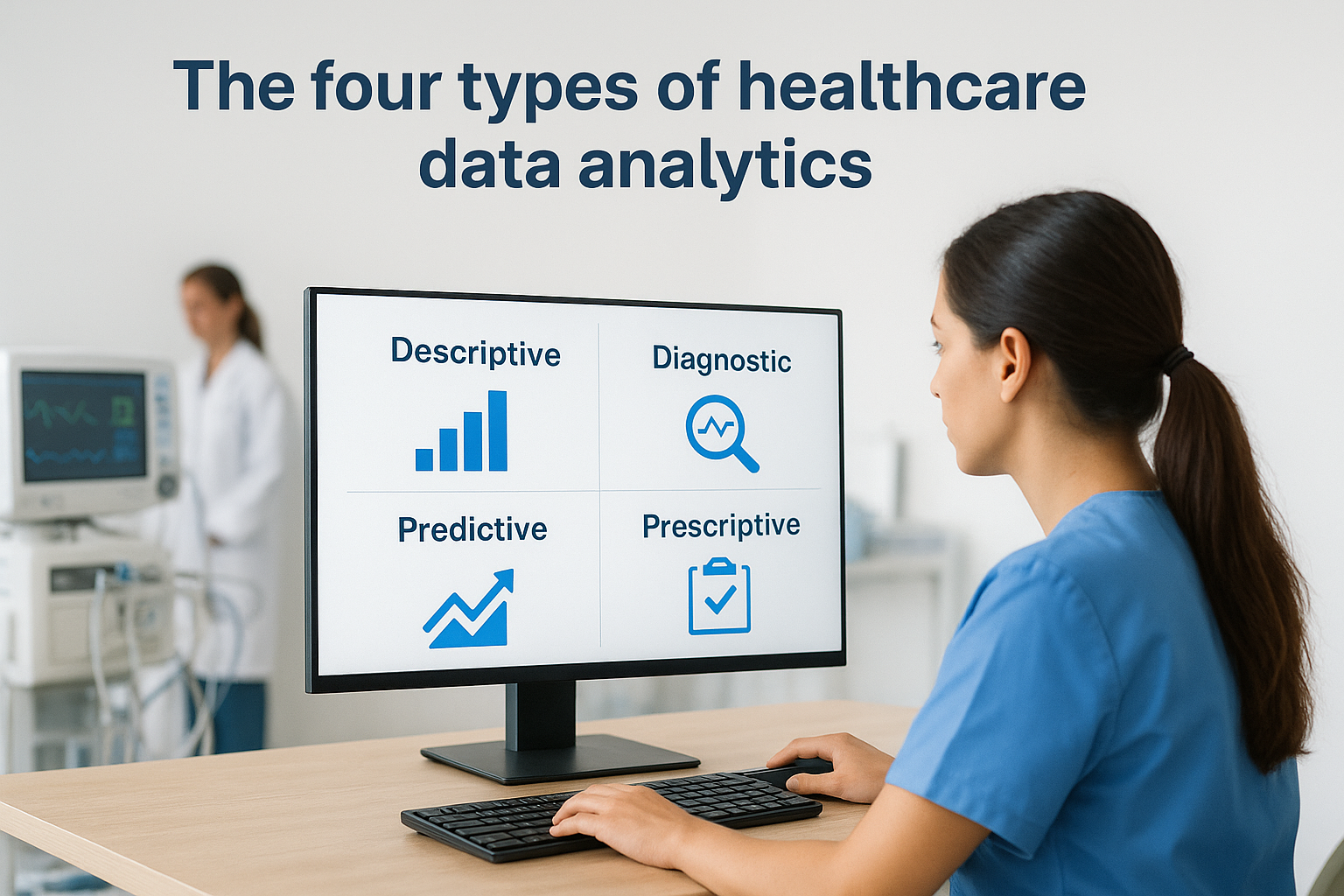
When you dig into what is healthcare data analytics, you quickly find that not all analytics ask the same question. The field breaks into four distinct types, each serving a different purpose and requiring a different level of sophistication. Understanding where each type fits helps you decide which approach your specific use case actually needs.
| Type | Core Question | Example Use |
|---|---|---|
| Descriptive | What happened? | Monthly readmission rates by unit |
| Diagnostic | Why did it happen? | Root cause of a readmission spike |
| Predictive | What will happen? | Patients at risk for deterioration |
| Prescriptive | What should we do? | Recommended care pathway for high-risk patients |
Descriptive and diagnostic analytics
Descriptive analytics gives you a historical picture of performance by summarizing data that already exists. Think average length of stay, patient volumes by department, or medication error rates over the past year. It answers "what happened" and forms the baseline that every more advanced analysis builds on.
Diagnostic analytics takes that baseline and asks why. When your readmission rate spikes in a specific unit, diagnostic tools drill into the contributing factors, whether that's a care coordination gap, a discharge timing issue, or a specific patient population. You use this type to move from noticing a problem to understanding its cause.
Most organizations start with descriptive analytics and add diagnostic capability as their data infrastructure matures.
Predictive and prescriptive analytics
Predictive analytics applies statistical models and machine learning to historical data to forecast what is likely to happen next. A health system might use it to flag patients at high risk of no-show appointments or hospital-acquired infections before those events occur.
Prescriptive analytics goes one step further by recommending a specific action based on the prediction. Instead of just telling you a patient is at risk, it suggests an intervention, giving your care team a concrete next step based on everything the data shows.
How healthcare analytics works in real systems
Understanding what is healthcare data analytics in theory is useful, but seeing how it functions inside an actual health system clarifies why data infrastructure matters as much as the analytics itself. Every insight you generate starts with data moving reliably between source systems and the tools that analyze it. If that pipeline is broken or inconsistent, your analytics output reflects those gaps.
Getting data out of EHRs
The biggest practical challenge in healthcare analytics is extracting usable data from EHR systems like Epic and Cerner. These platforms store enormous amounts of clinical information, but they aren't designed to hand it over freely. Organizations use FHIR APIs and SMART on FHIR authorization flows to access structured patient data in a standardized format that analytics platforms can actually process.

The quality of your analytics depends on how reliably your EHR integration delivers complete, normalized data.
Without a consistent data pipeline, your team spends more time fixing data quality issues than building models. Platforms like SoFaaS address this directly by handling the OAuth flows, token management, and EHR-specific configurations that would otherwise require months of custom engineering work.
Where the analysis happens
Once clean data reaches your analytics layer, your team applies the appropriate method based on the question. Operational dashboards use descriptive queries to surface performance metrics in near real time. Risk stratification tools use predictive models trained on historical encounter data to flag patients before adverse events occur.
Health systems increasingly embed these tools directly into clinical workflows, so a care coordinator sees a patient risk score inside the same interface they use to document care. This integration keeps analytics from being a separate reporting exercise and turns it into a live decision-support layer that clinicians actually use.
Careers in healthcare data analytics
If you're thinking about working in this space, the career options span both clinical and technical disciplines. Understanding what is healthcare data analytics helps you identify which role aligns with your background. Organizations across hospitals, health tech companies, payers, and government agencies all hire professionals who can manage, interpret, and act on health data.
Common roles in the field
The most in-demand positions include data analysts, data engineers, and clinical informaticists. A healthcare data analyst spends most of their time building reports, identifying trends in patient or operational data, and presenting findings to clinical or administrative leadership. A data engineer focuses on building and maintaining the pipelines that move data from EHRs and other source systems into analytics platforms.
Clinical informaticists sit at the intersection of medicine and data, translating clinical needs into data requirements and helping teams build tools that actually fit how care teams work.
Health tech companies also hire machine learning engineers and data scientists to develop predictive models for risk stratification and population health tools that support value-based care programs.
What skills you need to get started
Technical skills matter, but you don't need a computer science degree to enter the field. SQL, Python, and familiarity with healthcare data standards like HL7 and FHIR give you a strong foundation. If you're coming from a clinical background, pairing your domain knowledge with basic data skills makes you a highly competitive candidate in most hiring markets.
On the non-technical side, clear communication and problem-framing separate strong analysts from merely capable ones. Health system leaders need someone who can turn a complex dataset into a concrete recommendation. Experience working with EHR data or FHIR-based APIs is increasingly listed as a preferred qualification across job postings in this field.
Key takeaways and next steps
Understanding what is healthcare data analytics comes down to one core idea: health organizations collect massive amounts of clinical and operational data, and analytics is the discipline that turns that data into decisions that actually improve care and reduce waste. The four types of analytics, descriptive, diagnostic, predictive, and prescriptive, each address a different question, and the right one depends entirely on what you're trying to solve.
None of it works without clean, reliable data flowing out of your EHR systems. If your integration layer is fragile or incomplete, every model and dashboard downstream inherits those gaps. For healthcare application teams that need standardized, real-time patient data without spending months on custom EHR engineering, the fastest path forward is a managed integration platform built for exactly this problem.
If you're ready to stop wrestling with EHR connections and start building, launch your SMART on FHIR app in a couple of steps.
The Future of Patient Logistics
Exploring the future of all things related to patient logistics, technology and how AI is going to re-shape the way we deliver care.
Thank you! Your submission has been received!
Oops! Something went wrong while submitting the form.