How To Write A Capability Statement For Federal Buyers Fast

How To Write A Capability Statement For Federal Buyers Fast
If you sell healthcare technology or services, whether you're a DME supplier, a home health agency, or a health IT company building EHR integrations, federal agencies like the VA, DoD, and CMS represent massive contract opportunities. But before any contracting officer takes your call, they want a one-page document that proves you belong at the table. That document is a capability statement, and knowing how to write a capability statement that actually lands is the difference between getting shortlisted and getting ignored.
A capability statement is your company's résumé for government and B2B buyers. It covers who you are, what you do, who you've done it for, and why you're qualified, all compressed into a single, skimmable page. Most companies either skip it entirely or throw together something generic that says nothing. Both approaches cost real revenue.
At SoFaaS, we work with healthcare innovators and suppliers who integrate with EHR systems to deliver solutions across the care continuum. Many of our partners and customers pursue federal and enterprise contracts where a sharp capability statement is table stakes. We built this guide because we've seen firsthand how a strong one opens doors, and how a weak one keeps them shut.
This guide walks you through every section of a capability statement, from core competencies to past performance, with formatting tips, real examples, and a structure you can follow to get yours done fast.
What federal buyers expect from a capability statement
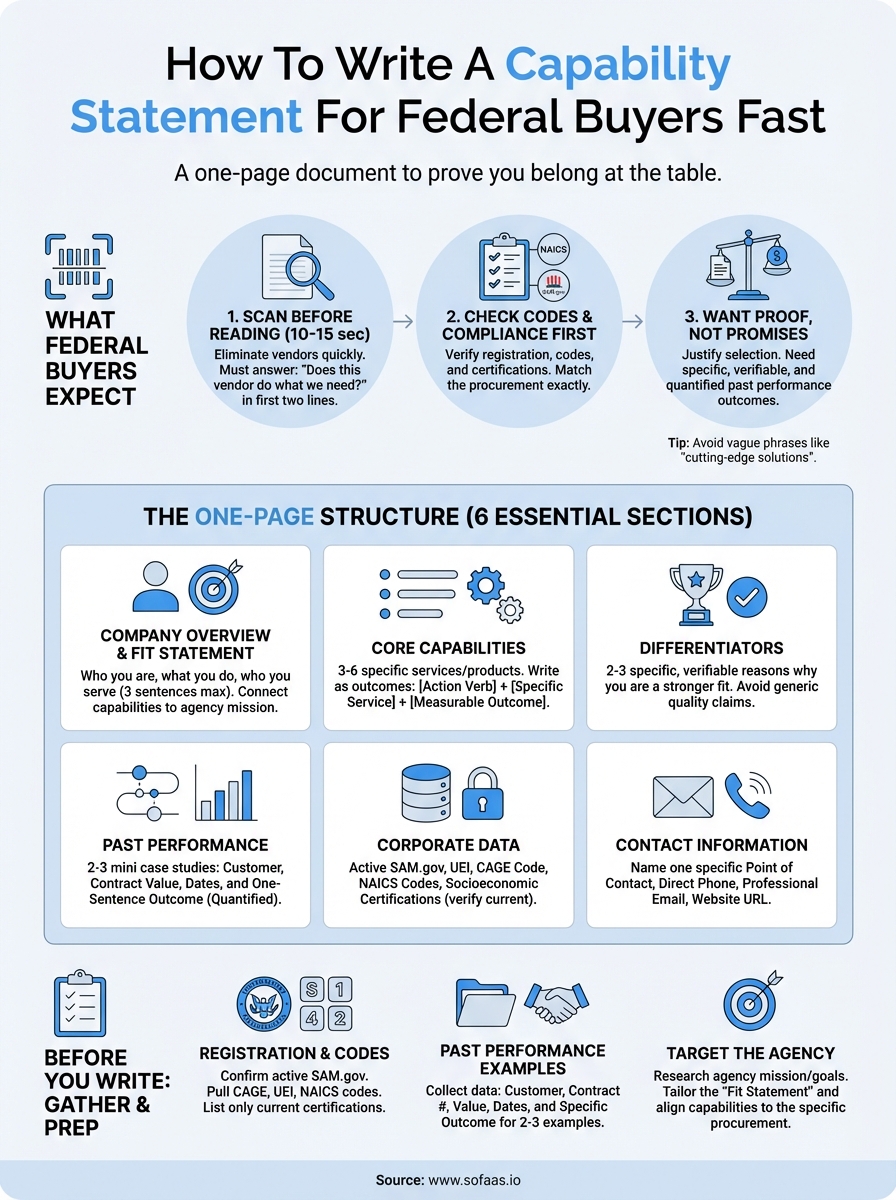
Federal contracting officers review dozens of vendors for any single procurement. They don't have time to read marketing copy, and they won't ask follow-up questions if your document leaves gaps. Their job is to eliminate vendors quickly, not to champion you internally. Understanding what they actually look for when they receive a capability statement changes how you write one from the ground up.

Before you learn how to write a capability statement, you need to know who reads it and what they do with it.
They scan before they read
A contracting officer's first pass takes roughly 10 to 15 seconds. They're not reading your company history. They're asking one question: does this vendor do what we need? Your capability statement must answer that question in the first two lines, or it goes in the discard pile. Use clear section headers, a clean single-column or two-column layout, and no decorative text that makes the document feel like a brochure.
Federal buyers also share capability statements with program managers and small business officers. Each of those readers brings a different lens, so your document needs to communicate your value clearly to a non-technical reader without losing the specificity a technical evaluator needs. Bullet points, short paragraphs, and bold labels on each section are not stylistic choices; they are functional requirements.
They check codes and compliance first
Before a contracting officer considers your capabilities, they verify your NAICS codes and SAM.gov registration. If those don't match the procurement, or if your registration has lapsed, the rest of your document doesn't matter. Federal buyers use these codes to confirm your business is legally eligible and categorized correctly for the contract in question.
For healthcare IT and services companies, the most relevant codes often fall under 541512 (Computer Systems Design Services) or 621 series codes for health services. Listing the wrong code, or listing too many irrelevant codes, signals that your company doesn't understand how federal procurement works. Include only the codes that directly match what the buyer is purchasing.
They want proof, not promises
Federal buyers are required to justify vendor selections in writing. That means every claim you make in your capability statement needs to be verifiable and specific. Phrases like "cutting-edge solutions" or "industry-leading quality" carry zero weight. What carries weight is a contract number, an agency name, a dollar amount, and a one-sentence outcome.
Your past performance section is where most capability statements fail. Companies list clients without context, or worse, they list internal projects as if they were real contracts. Federal evaluators want to see that you have delivered comparable work at comparable scale for a real customer. One strong, specific example beats five vague ones every time. When you think about how to write a capability statement that survives a real review, start with your single best performance example and build the rest of the document around it.
Before you write, gather the right company details
Most companies sit down to write a capability statement and stall immediately because they don't have the right information in front of them. Before you open a blank document, spend 20 minutes pulling together the specific data points every federal buyer will look for. Writing without this prep leads to vague, placeholder text that you'll have to rewrite anyway.
Your registration, codes, and business classifications
Open your SAM.gov registration and confirm it is active and current. Federal buyers will not consider vendors with expired registrations, and no amount of good writing fixes a compliance gap. Pull your CAGE code, DUNS or UEI number, and your NAICS codes from that record and keep them visible while you draft.
If you're unsure which NAICS codes apply to your work, search the U.S. Census Bureau's NAICS lookup tool to find the codes that match your actual service descriptions, not the broadest categories available.
Also confirm your socioeconomic status certifications, such as Small Business, 8(a), SDVOSB, HUBZone, or WOSB. These designations directly affect which set-aside contracts you qualify for, and federal buyers filter by them. List only the certifications you currently hold and can verify.
Your past performance details
This is where most preparation falls short. For each relevant contract you plan to reference, gather the following before you write a single word:
| Data Point | Example |
|---|---|
| Customer name | Department of Veterans Affairs |
| Contract number or award | VA-123-456-78 |
| Contract value | $1.2M |
| Period of performance | Jan 2023 to Dec 2024 |
| One-sentence outcome | Reduced prior auth processing time by 40% across 12 VA facilities |
Collect two to three examples in this format. You won't use all of them in the final document, but having them ready means you can pick the strongest match for each procurement you target. When you understand how to write a capability statement that earns a second look, you recognize that specific, quantified outcomes are the raw material the rest of the document is built from.
Step 1. Build a one-page capability statement structure
Structure is the foundation of a capability statement that works. Federal buyers scan documents in a predictable pattern, and your layout either matches that pattern or fights it. A one-page format is not a suggestion; it is the standard expectation for initial vendor outreach, and anything longer signals that you don't understand the procurement process. Get the structure right first, and the content you fill in later will land far more effectively.
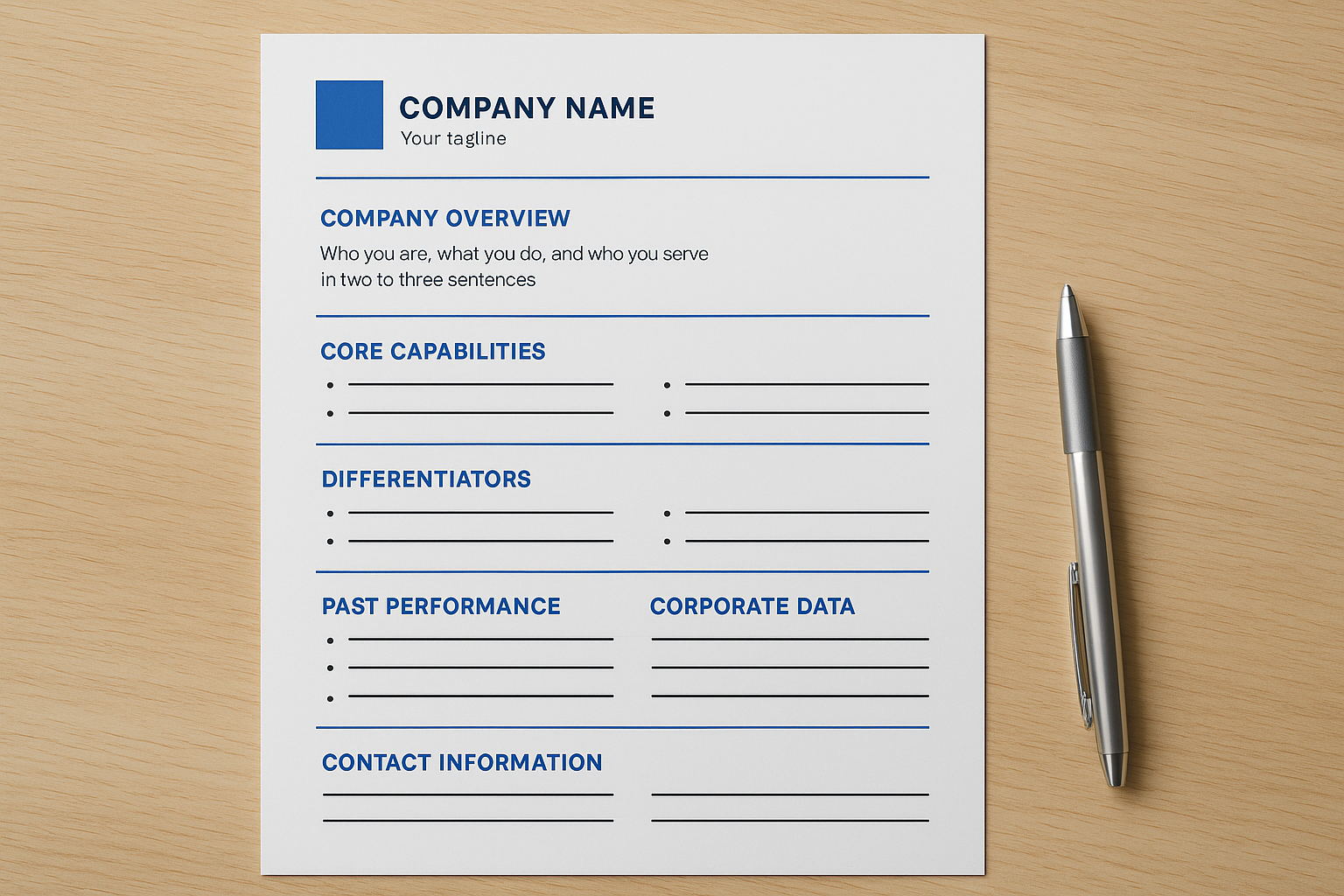
Treat your capability statement like a billboard, not a brochure. The structure does the selling before the words do.
The six sections every capability statement needs
Your document needs six clearly labeled sections, and each one must occupy its own visible block on the page. Do not combine sections or hide required information inside long paragraphs. Federal buyers look for specific elements in specific places, and missing even one section is enough to get your document set aside before anyone reads your qualifications.
Here is the standard structure for how to write a capability statement that federal buyers recognize immediately:
| Section | What It Contains |
|---|---|
| Company Overview | Who you are, what you do, and who you serve in two to three sentences |
| Core Capabilities | Three to six bullet points describing specific services or products |
| Differentiators | Two to three reasons you are a stronger fit than comparable vendors |
| Past Performance | Two to three client examples with outcomes, contract values, and dates |
| Corporate Data | CAGE code, UEI, NAICS codes, and business certifications |
| Contact Information | Name, title, phone, email, and website of your primary point of contact |
Layout rules that keep readers on the page
Font size should not drop below 10 points, and section headers should sit at 12 to 14 points so they stand out at a glance. Use one or two colors maximum, ideally your brand colors, so the document looks intentional without becoming cluttered. White space is a functional tool here; crowded pages force evaluators to work harder, and they simply will not.
Your company logo belongs in the top-left or top-center, with your company name and a short tagline immediately below it. Keep the tagline under ten words. Everything else flows in clearly labeled sections beneath that header block, either in a single column or a clean two-column layout that keeps corporate data visually separate from your capabilities.
Step 2. Write a sharp company overview and fit statement
Your company overview is the first section a contracting officer reads after they confirm your codes. It needs to answer who you are and what problem you solve in no more than three sentences. Most companies write an overview that sounds like a press release, full of vague language and no specifics. A federal buyer has no patience for that, so your overview needs to lead with your primary service, your target customer, and your delivery model in plain language.
Keep your overview under three sentences
Three sentences is the ceiling, not a suggestion. The first sentence names your company and your primary offering. The second sentence identifies who you serve. The third sentence states your delivery model or a key differentiator. Here is a template you can adapt directly:
"[Company Name] provides [specific service or product] to [target customer type]. We serve [agency type or industry vertical] through [delivery method or platform]. Our solutions are [key credential or certification]-compliant and deployed by teams with [relevant experience or specialization]."
Apply that template with real specifics before you move on. A healthcare IT company might write: "SoFaaS provides managed SMART on FHIR integration services to healthcare application developers and suppliers." That one sentence tells a contracting officer exactly what the company does without requiring them to decode marketing language.
Write a fit statement that ties you to the buyer
A fit statement is a single sentence you add below your overview when targeting a specific agency or procurement. It connects your capabilities to the buyer's stated mission or need, and it signals that you did your homework. Generic capability statements skip this entirely, which is a missed opportunity because federal buyers respond to vendors who demonstrate awareness of the agency's goals.
Your fit statement should reference the agency's published mission or a specific program area. For example: "SoFaaS supports VA interoperability initiatives by accelerating EHR integration for digital health vendors serving veteran care." When you know how to write a capability statement with a targeted fit statement, you move from a generic vendor list to a shortlist in one sentence. Swap the fit statement out for each procurement rather than leaving a generic version in place.
Step 3. List core capabilities and codes that matter
Your core capabilities section is the body of your document, and it carries more weight than most vendors realize. Federal buyers use this section to match your services against their requirement before they read anything else. Write capabilities as specific, deliverable services, not department names or skill categories. If your capabilities list could apply to any company in your industry, rewrite it until it couldn't.
Write capabilities as outcomes, not job titles
Most companies list capabilities that describe what their team does internally rather than what value the buyer receives. A federal contracting officer does not care that you have a "dedicated integration team." They care that you can "deploy SMART on FHIR EHR connections in under 30 days with full HIPAA-compliant audit logging." That shift from internal description to buyer-facing outcome is what separates a capabilities list that gets read from one that gets skipped.
When you learn how to write a capability statement that converts, you realize every capability bullet should answer: "So what does this mean for the buyer?"
Use three to six bullet points maximum. Each bullet should follow this pattern:
- [Action verb] + [specific service] + [measurable outcome or standard met]
Here are examples formatted correctly:
| Weak Version | Strong Version |
|---|---|
| Healthcare IT integration | Deploy FHIR-compliant EHR integrations for federal health programs |
| Security and compliance | Deliver SOC 2 Type II and HIPAA-compliant data infrastructure |
| API development | Build unified APIs that connect to Epic, Cerner, and Allscripts in days |
Match your NAICS codes to the procurement
Your NAICS codes are not decorative. Federal systems filter vendors by code before a human ever sees your document, so listing codes that don't match the procurement removes you from consideration automatically. Pull the specific codes listed in the solicitation or sources-sought notice you're responding to and confirm your SAM.gov registration includes an exact match.
For healthcare IT vendors, the most commonly applicable codes include 541512 for computer systems design and 541519 for IT consulting services. Health service suppliers often fall under 621 series codes. List no more than three to five codes, and place them directly in your corporate data section so evaluators find them without searching.
Step 4. Prove past performance and differentiators fast
Past performance is the section where federal buyers decide whether you're worth a follow-up conversation. Generic client lists with no context do nothing for you. What works is a structured, scannable entry for each reference that gives the evaluator exactly what they need to verify your claim and move on. When you think about how to write a capability statement that survives a competitive review, this section determines whether you make the shortlist.
Format past performance as mini case studies
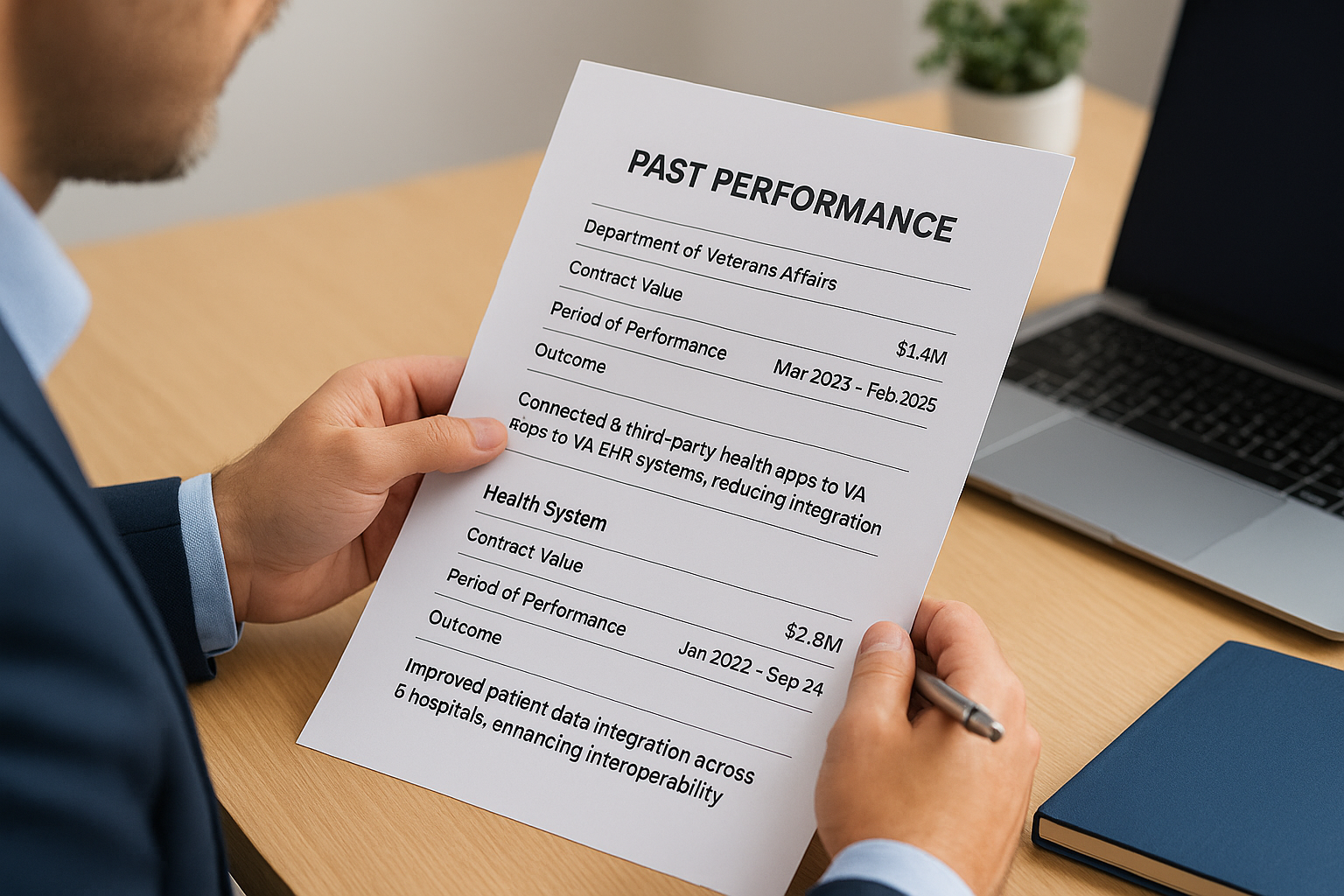
Each past performance entry needs to pack contract specifics, a named customer, and a measurable outcome into two to three lines. Evaluators do not want a paragraph; they want data points they can scan in under five seconds. Use a consistent format across every entry so the section reads cleanly.
One specific, quantified outcome outperforms five vague client name-drops every time.
Here is a template you can apply directly to each reference:
| Field | Example |
|---|---|
| Customer | Department of Veterans Affairs |
| Contract Value | $1.4M |
| Period of Performance | Mar 2023 to Feb 2025 |
| Outcome | Connected 8 third-party health apps to VA EHR systems, reducing integration time by 60% per deployment |
Fill in two to three entries using that structure. If you lack federal contract experience, enterprise health system contracts and large B2B agreements work in early-stage capability statements, provided you include a real outcome with a number attached.
State your differentiators in one line each
Your differentiators section is not a place for features. It exists to answer one question: why you over the next vendor on the list. Each differentiator should be a single, direct sentence that names something verifiable and specific to your company. If the sentence could describe any competitor, cut it and rewrite.
Use two to three bullets maximum, and lead each one with your strongest proof point rather than a vague quality claim. For example:
- SOC 2 Type II and HIPAA-compliant infrastructure, verified annually by independent audit
- Pre-built connectors to Epic, Cerner, and Allscripts reduce federal deployment timelines from months to days
- Healthcare integration team with 15+ years of combined VA and DoD program experience
Step 5. Add corporate data, contacts, and compliance notes
Corporate data is the last section most vendors think about, but federal buyers check it first. Your registration numbers, certifications, and contact details need to be accurate, current, and easy to find on the page. This section is where you confirm that your company is legally eligible and reachable, and one outdated field can disqualify you before anyone evaluates your qualifications. Treat this section as the administrative backbone of how to write a capability statement that clears compliance checks without friction.
Include every required registration field
Federal buyers cross-reference your capability statement against SAM.gov and the System for Award Management database, so every number you list must match your active registration exactly. Inconsistencies, even minor formatting differences, create verification delays that cost you the opportunity.
Your corporate data section should be readable in under 10 seconds, because that is all the time an evaluator will spend on it.
Use a clean block layout or a compact table to present your registration data:
| Field | Example |
|---|---|
| Legal Business Name | SoFaaS, Inc. |
| UEI Number | XYZ123456789 |
| CAGE Code | 7AB12 |
| NAICS Codes | 541512, 541519 |
| Business Certifications | Small Business, SDVOSB |
| State of Incorporation | Delaware |
List only certifications you currently hold and can verify. Listing expired or pending certifications exposes you to compliance risk and damages your credibility with contracting officers.
Name a single point of contact and make them easy to reach
Federal buyers will not hunt through your website to find the right person to call. Your contact block must name one specific individual with a direct phone number, a professional email address, and your company's primary website URL. Do not list a general info inbox or a sales team phone number.
Use this format directly in your document:
Point of Contact: [Full Name], [Title] Phone: [Direct number] Email: [name@company.com] Website: [www.yourcompany.com]
Your contact should be someone with authority to answer procurement questions, typically a business development lead or a senior operations contact, not an entry-level coordinator. Contracting officers move quickly, and they need to reach a decision-maker on the first call.
Next steps
You now have a complete framework for how to write a capability statement that federal buyers will actually read. Each section covered here serves a specific purpose: your overview qualifies you fast, your capabilities match the procurement, your past performance proves you deliver, and your corporate data clears compliance checks. The biggest mistake you can make now is waiting until a solicitation drops to start building this document. Put it together today using real data, and update it every time you close a contract or earn a new certification.
For healthcare IT companies and healthcare suppliers pursuing federal or enterprise opportunities, your capability statement needs to reflect your ability to integrate with EHR systems reliably and compliantly. If your integration infrastructure isn't ready to support that claim, that's the gap to close first. Launch your SMART on FHIR app in days, not months, and give your capability statement the technical proof it needs to stand up to federal scrutiny.
The Future of Patient Logistics
Exploring the future of all things related to patient logistics, technology and how AI is going to re-shape the way we deliver care.
Thank you! Your submission has been received!
Oops! Something went wrong while submitting the form.