Healthcare Software Development Services: What To Expect

Hiring a team to build clinical-grade software is not the same as hiring a team to build a SaaS product or a mobile app. Healthcare software development services cover a specific category of work, building applications that handle protected health information, connect to hospital systems, and meet regulatory standards like HIPAA. If you're evaluating vendors or considering a build-vs-buy decision, knowing what these services actually include saves you from costly misalignments down the road.
What makes this space different is the sheer weight of compliance, interoperability, and security requirements. A development partner working in healthcare needs to understand EHR integration protocols like SMART on FHIR, manage OAuth authorization flows, handle audit logging, and build infrastructure that satisfies SOC 2 Type II and HIPAA mandates. These aren't optional add-ons, they're table stakes. And they're exactly the kind of work that buries teams in months of integration effort before a single patient-facing feature ships.
That's the problem we built SoFaaS to solve. As a managed SMART on FHIR platform by VectorCare, SoFaaS handles the EHR connectivity, compliance infrastructure, and authorization management that typically consume the bulk of a healthcare development project's budget and timeline. Whether you're building in-house or working with a development partner, understanding where platforms like ours fit into the stack changes how you scope and evaluate these services. This article breaks down what healthcare software development services actually deliver, what to expect from qualified providers, and how to make smarter decisions about the build ahead.
Why healthcare software development services matter
The stakes in healthcare software are fundamentally different from any other industry. When a bug ships in a consumer app, users get a frustrating experience. When a bug ships in a clinical application, patient safety is at risk, and your organization faces potential legal liability, regulatory action, and loss of hospital contracts. This isn't a hypothetical concern. Poorly architected healthcare software has contributed to medication errors, data breaches exposing millions of patient records, and organizations paying multimillion-dollar settlements under HIPAA. The margin for error is thin, and the consequences of cutting corners appear faster than most teams expect.
The cost of getting it wrong
Most teams severely underestimate what it actually takes to ship secure, compliant healthcare software without the right expertise in the room. A HIPAA-compliant infrastructure requires audit logging, role-based access controls, encryption at rest and in transit, and documented risk analysis. Meeting those standards demands deliberate architectural decisions from day one, not patches applied after you've already gone live. If you're integrating with an EHR system like Epic or Cerner, you also need to navigate credentialing processes, sandbox environments, and compliance reviews that can stretch your timeline by months before you write a single line of production code.
Skipping compliance steps early never saves time. It moves the cost to a later phase where it's far more expensive and disruptive to fix.
The financial exposure compounds when you factor in breach risk. The average cost of a healthcare data breach in the United States reached $9.77 million in 2024, according to IBM's annual Cost of a Data Breach report, making healthcare the most expensive sector for over a decade running. That figure covers investigation, notification, legal fees, and remediation, but it doesn't capture the reputational damage with health systems and provider networks that can end a startup's growth trajectory entirely. Building on a solid technical and compliance foundation the first time is significantly cheaper than recovering from a breach or a failed audit two years into production.
The market reality driving demand
Healthcare software demand isn't slowing. The shift toward value-based care, the expansion of telehealth, and the federal push for interoperability through regulations like the 21st Century Cures Act have all created a surge in applications that need to connect with EHRs and handle patient data at scale. Healthcare innovators, from DME providers to home health agencies to digital therapeutics companies, are building tools that need to fit into existing clinical workflows without disrupting them. That pressure puts serious strain on development timelines that most in-house teams aren't equipped to absorb without outside help.
Specialized healthcare software development services exist precisely because this work requires a different skill set than standard software engineering. FHIR-based API design, OAuth flows for patient authorization, and the operational demands of managing a HIPAA Business Associate Agreement aren't things a generalist development shop handles by default. When you bring in a team that understands this domain, you compress your learning curve, reduce compliance risk, and ship faster because you aren't inventing solutions to problems that already have established answers in standards and managed platforms.
Why the right infrastructure partner changes the equation
Your development partner's choices about underlying infrastructure directly affect your compliance posture, your integration speed, and your ongoing maintenance burden. A team building on a managed SMART on FHIR platform like SoFaaS can skip the months of EHR connector work and focus engineering effort on the features that differentiate your product. That shift isn't just about speed. It's about reducing the surface area for compliance risk by relying on infrastructure that's already been built, audited, and validated against the standards health systems expect. The partner you choose shapes what's possible from the first sprint forward.
What healthcare software development services include
Healthcare software development services cover a wider scope than most clients initially expect. The work goes well beyond writing application code. A qualified vendor handles architecture, compliance infrastructure, EHR connectivity, security controls, and ongoing maintenance as part of a single engagement. Understanding each component up front helps you evaluate proposals accurately and spot gaps before they become problems during delivery.
Core application development
Most engagements start with custom software design and build work: clinical portals, patient-facing mobile apps, care coordination tools, billing integrations, or workflow automation for providers. The specific type of application varies, but the baseline requirements remain consistent. Every piece of software that touches protected health information (PHI) needs role-based access controls, encrypted data storage, audit trails, and a documented risk analysis to satisfy HIPAA standards.
The application layer is just the visible surface. The compliance and security work underneath it represents the majority of the technical effort in most healthcare builds.
A competent development team also handles API design and data modeling aligned to healthcare standards. That means structuring your data around FHIR resources, designing endpoints that communicate with EHR systems, and ensuring your data model doesn't create downstream interoperability problems when health systems want to exchange records.
EHR integration and interoperability
Connecting your application to EHR systems like Epic, Cerner, or Allscripts is one of the most resource-intensive parts of any healthcare software project. Each EHR has its own credentialing process, sandbox environment, and approval workflow before you can access production data. Development teams working in this space handle the OAuth authorization flows, manage SMART on FHIR launch contexts, and build the connectors that translate raw FHIR responses into usable application data.
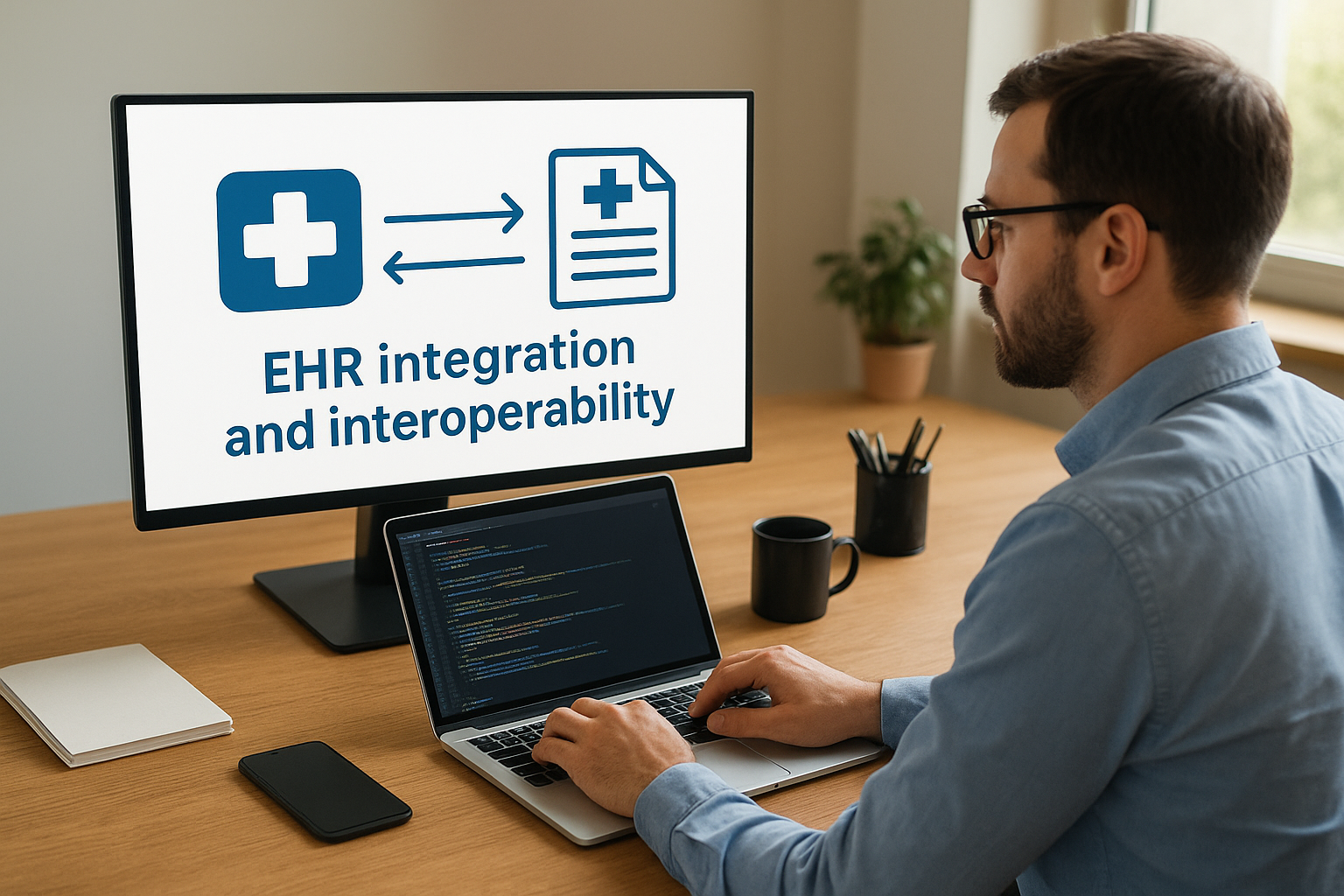
Managed platforms like SoFaaS accelerate this layer significantly by providing pre-built EHR connectors and a unified API that abstracts the differences between systems. Whether your development partner builds this from scratch or integrates a managed service, you should expect EHR connectivity work to be explicitly scoped and resourced in any serious proposal.
Support, maintenance, and compliance monitoring
Healthcare software doesn't ship once and stay static. Regulatory requirements evolve, EHR vendors release API updates, and your user base creates edge cases your initial build didn't anticipate. Ongoing maintenance contracts should include security patching, audit log review, and version updates tied to FHIR specification changes or EHR API deprecations. Make sure your vendor specifies what post-launch support covers before you sign.
A solid post-launch support scope typically covers:
- Security patch deployment and vulnerability remediation
- EHR API version updates and connector maintenance
- Audit log review and compliance reporting
- Performance monitoring and uptime management
How a typical project runs from discovery to launch
Most healthcare software development services engagements follow a predictable sequence regardless of application type. Understanding that sequence helps you allocate budget across phases, set realistic expectations with stakeholders, and catch scope gaps before they become schedule problems. Each phase builds directly on the one before it, and compressing or skipping steps to move faster almost always creates rework that costs more than the time you thought you saved.
Discovery and scoping
Discovery is where a qualified vendor earns its value before writing a single line of code. Your development partner conducts stakeholder interviews, workflow analysis, and compliance requirements mapping to produce a detailed technical specification. That document defines the data model, integration touchpoints, user roles, and regulatory obligations your application must satisfy. Expect this phase to take two to four weeks depending on application complexity, and treat any vendor that skips it as a red flag worth taking seriously.
Architecture and compliance setup
With a specification confirmed, the team moves into system architecture design and environment provisioning. This phase establishes the infrastructure decisions that shape your long-term compliance posture: where data lives, how audit logs are captured, and how your application handles PHI in transit. Teams targeting EHR connections also initiate the credentialing and sandbox access process with systems like Epic or Cerner during this phase, since that review cycle runs in parallel with development and cannot be rushed.

Starting the EHR credentialing process late is one of the most common reasons healthcare software projects miss their launch dates.
Build and integration
The build phase is where your application takes shape across the frontend, backend, and integration layers. API development, FHIR resource mapping, and OAuth authorization flows all happen here alongside the product features your users will interact with daily. Development teams working with a managed platform like SoFaaS replace weeks of EHR connector work with configuration and validation against pre-built integrations, which frees engineering capacity for the differentiating features that actually define your product.
Testing, validation, and staged launch
Healthcare applications require a structured quality assurance cycle that covers functional testing, security validation, and compliance verification before anything reaches production. This includes penetration testing, user acceptance testing with clinical stakeholders, and documentation that supports your HIPAA risk analysis. Launch itself should be staged, starting with a limited user cohort before full production rollout, giving your team a controlled window to surface edge cases without exposing your entire user base at once.
Compliance and regulatory expectations in the US
When you work with healthcare software development services in the United States, compliance is not a checklist you complete at the end of the project. Regulatory requirements shape architectural decisions from day one, and understanding which rules apply to your application helps you hold your development partner accountable for meeting them before a single line of production code ships.
HIPAA as the baseline requirement
HIPAA (Health Insurance Portability and Accountability Act) is the foundational regulatory framework for any application that handles protected health information. It establishes rules across three areas: the Privacy Rule, which governs how PHI can be used and disclosed; the Security Rule, which sets technical safeguards for electronic PHI; and the Breach Notification Rule, which specifies what you must do when data is compromised. If your application touches patient data in any form, HIPAA applies to you.

Your development partner must sign a Business Associate Agreement before accessing any PHI. Without one, you carry direct liability for their handling of patient data.
Meeting the Security Rule requires documented risk analysis, access controls, audit logging, and encryption at rest and in transit. Your vendor should produce a formal risk analysis document as a deliverable, not simply assert that their infrastructure is HIPAA-compliant without written evidence to support that claim.
The 21st Century Cures Act and interoperability mandates
The 21st Century Cures Act introduced binding interoperability requirements that directly affect how your application exchanges data with EHRs and health systems. Under rules enforced by the Office of the National Coordinator for Health Information Technology, certified EHR vendors must provide standardized FHIR-based API access, and health IT developers face information blocking prohibitions that carry civil monetary penalties. If your product connects to EHR data or exchanges clinical records between parties, these rules apply to your software and your business practices, not just the EHR vendors you integrate with.
State-level regulations and additional frameworks
Federal law sets the floor, but several states impose stricter requirements on top of HIPAA. California's Confidentiality of Medical Information Act and New York's SHIELD Act both extend protections beyond federal minimums. Your development partner should conduct a jurisdiction-specific compliance review based on where your users and covered entities operate. Depending on your application type, you may also need to address FDA guidance for software as a medical device if your product supports clinical decision-making. Scoping these obligations during discovery prevents expensive rework later in the build.
Security, privacy, and data governance you should demand
Security in healthcare software is not a feature you add to a finished product. Every architectural decision your development team makes carries security implications, and the cost of correcting poor decisions compounds the longer they sit in production. When you're evaluating healthcare software development services, treating security requirements as negotiable is one of the most expensive mistakes you can make before your product ever reaches a patient.
Demand written documentation of every security control your vendor implements. Verbal assurances don't satisfy HIPAA auditors or health system security review committees.
Technical safeguards and encryption standards
Your vendor must implement encryption for all PHI at rest and in transit without exception. At rest, that means AES-256 encryption across your databases and storage layers. In transit, that means enforced TLS 1.2 or higher on every API connection your application makes. These aren't advanced requirements; they're the technical baseline that any health system your product integrates with will verify before approving a production connection. If your development partner can't produce documented evidence of these controls, treat that as a disqualifying gap, not a minor oversight.
Beyond encryption, your infrastructure should run on a platform that carries SOC 2 Type II certification, which means an independent auditor has reviewed your security controls over a sustained period and confirmed they operate as designed. Point-in-time certifications like SOC 2 Type I offer significantly weaker assurance and should not satisfy your compliance requirements if you plan to sell into enterprise health systems.
Access controls and audit logging
Role-based access control limits what each user in your system can read, write, or modify based on their defined role. Clinicians, billing staff, and administrators should never share the same permission set, and your vendor should configure these boundaries before launch rather than treating them as post-deployment configuration tasks.
Comprehensive audit logging captures every interaction with PHI: who accessed it, when, from which IP address, and what action they took. These logs must be tamper-evident, retained for a minimum of six years under HIPAA requirements, and reviewable on demand during a compliance audit or breach investigation.
Data governance and vendor accountability
Data governance defines how PHI flows through your system, who owns it, and what rules govern its retention and deletion. Your development partner should produce a data flow diagram as a formal project deliverable, mapping every point where PHI enters, moves through, or exits your application. That document becomes foundational evidence in any HIPAA risk analysis and gives you a clear baseline for managing data lifecycle obligations as your product scales.
Interoperability and EHR integration with FHIR and HL7
Interoperability is the core technical challenge that separates healthcare software from every other category of application. Your product needs to read, write, and exchange patient data with external EHR systems in a format those systems recognize and accept. If your development partner doesn't have hands-on experience with the standards governing that exchange, your integration timeline will stretch far beyond what any project plan assumes.
Understanding FHIR and HL7 as integration standards
HL7 (Health Level Seven) is the older messaging standard that health systems have used for decades to exchange clinical data between internal systems. It works, but it's complex, inconsistently implemented across vendors, and requires specialized parsing logic to handle reliably. FHIR (Fast Healthcare Interoperability Resources) is the modern replacement, built on REST API principles that software engineers already understand. The 21st Century Cures Act made FHIR-based API access a requirement for certified EHR vendors, which means FHIR is now the primary standard any healthcare software development services engagement needs to support.
Understanding which standard your target EHR system uses, and which version of FHIR it has implemented, determines the entire shape of your integration architecture before development starts.
Both standards matter in practice. Older enterprise systems still exchange HL7 v2 messages for lab results and ADT notifications, while newer API connections run on FHIR R4. Your development partner should handle both message formats without treating HL7 as a legacy problem and FHIR as the only priority.
What EHR integration work actually involves
Connecting to an EHR like Epic or Cerner requires more than writing API calls. Each system runs its own credentialing review, which means your organization must complete registration, documentation, and a formal approval process before accessing production data. That review cycle runs independently of your build schedule and can easily add six to twelve weeks to your project timeline if you don't initiate it early.
Beyond credentialing, your team must manage SMART on FHIR OAuth authorization flows, map raw FHIR resource responses to your application's data model, and handle the inconsistencies individual EHR vendors introduce in their implementations of the standard.
How managed platforms change the integration equation
A managed platform like SoFaaS eliminates the bulk of this low-level connector work by providing pre-built integrations for major EHR systems through a single unified API. Your development team configures the connection rather than building it from scratch, which compresses the integration phase from months to days. That time savings directly reduces your project budget and your path to a production-ready product.
Quality assurance, validation, and testing in healthcare
Testing a healthcare application is fundamentally different from testing a standard software product. Every defect in a clinical workflow carries patient safety implications, and healthcare software development services must account for that reality in how they structure QA from the start. A development partner that treats testing as a final-phase activity rather than an ongoing process will consistently ship builds that fail under real clinical conditions.
Functional and clinical validation
Functional testing verifies that your application behaves as specified across every user role and workflow. In healthcare, that scope extends beyond standard use cases to include edge cases that arise in clinical environments, such as incomplete patient records, concurrent data updates from multiple systems, and time-sensitive workflows where delays carry direct care consequences. Your QA team should conduct structured testing sessions with actual clinical stakeholders, not just internal developers, to surface the gaps that only emerge when real users interact with real workflows.
Clinical validation with actual end users is not optional. It's the step that separates applications that work in development from applications that work in practice.
Security testing and penetration testing
Penetration testing simulates an external attack against your application to identify vulnerabilities before malicious actors do. Any qualified healthcare development partner runs penetration testing before launch as a standard deliverable, not an add-on service you need to request separately. Your security validation process should cover at minimum:
- Authentication and session management vulnerabilities
- API endpoint authorization checks across all user roles
- Injection attacks targeting your data layer
- Encryption verification for PHI at rest and in transit
- Audit log integrity and tamper-resistance testing
Static code analysis runs alongside penetration testing to catch security issues in the codebase itself, flagging patterns that create vulnerability exposure before they reach a deployed environment.
Documentation and test evidence
Test documentation is not bureaucratic overhead in healthcare. It's the evidence your organization produces to satisfy HIPAA risk analysis requirements and to pass the security review processes that health systems run before approving production connections. Your development partner should deliver formal test plans, test case results, and defect resolution records as project deliverables, not informal notes stored in a project management tool.
Health systems evaluating your product will ask for this documentation during vendor review. Organizations that can't produce it reliably get removed from consideration regardless of how well the application performs in a demo. Treating test evidence as a core deliverable from the start keeps that door open when your enterprise deals depend on it.
Cost, timeline, and maintenance planning
Healthcare software projects carry a wider cost range than most clients anticipate because the compliance and integration work sits underneath the visible application layer. When you evaluate proposals from healthcare software development services vendors, the base build cost is only part of the financial picture. EHR credentialing, compliance infrastructure setup, and security testing all add to the total budget, and teams that don't account for them at the scoping stage consistently run over on both cost and timeline.
Get a line-item breakdown of every cost component before you sign a contract. Proposals that bundle everything into a single project fee make it nearly impossible to identify scope gaps until they surface mid-build.
What drives cost in healthcare software projects
The primary cost drivers in any healthcare software engagement are complexity of EHR integration, the number of user roles your application requires, and the compliance documentation burden your regulatory context imposes. A basic patient portal connecting to a single EHR via a managed platform like SoFaaS costs substantially less than a multi-system integration with custom HL7 parsing and FDA-regulated clinical decision support features. Understanding where your project falls on that spectrum helps you validate whether vendor estimates are realistic before you commit.
Your team's choices about underlying infrastructure also affect cost significantly. Building EHR connectors from scratch adds months of engineering time compared to configuring a pre-built managed integration layer. That difference shows up directly in labor costs and in your time-to-market, both of which carry financial implications that extend well beyond the initial project budget.
Timeline expectations by project type
Most well-scoped healthcare software projects run between four and twelve months from discovery to production launch, depending on application complexity and EHR integration requirements. Simple applications with a single EHR connection and limited user roles land toward the lower end. Enterprise-grade tools with multi-system integrations, complex authorization workflows, and extensive clinical validation cycles push toward the upper range.

EHR credentialing timelines run independently of your build schedule and must be treated as a parallel workstream, not a sequential step you start after development is complete. Factoring that parallel track into your project plan from day one is the single most effective way to protect your launch date.
Budgeting for ongoing maintenance
Post-launch costs are where many organizations underestimate their total investment. Security patching, EHR API version updates, and compliance monitoring are recurring obligations that don't pause after launch. Budget a minimum of 15 to 20 percent of your initial build cost annually for maintenance and compliance upkeep, and scale that figure upward if your application integrates with multiple EHR systems or operates under additional state-level regulatory requirements.
How to choose the right development partner
Choosing a vendor for healthcare software development services is one of the highest-stakes decisions in your project. The wrong partner adds months to your timeline, drains budget on rework, and leaves your organization exposed to compliance failures that health system partners will discover during their vendor review process. Evaluating candidates against specific, documented criteria before you commit is the only way to make a confident choice.
Evaluate domain-specific healthcare experience
General software development firms can build applications, but healthcare requires specialized knowledge of FHIR standards, EHR credentialing processes, and HIPAA compliance obligations that most generalists don't carry. Ask every candidate to walk you through a past healthcare integration project in detail, including which EHR systems they connected, how they handled OAuth authorization flows, and what compliance documentation they delivered as project artifacts.
A vendor that cannot describe their HIPAA risk analysis process in specific terms has almost certainly never completed one properly.
Look for teams that have worked directly with the major EHR vendors your product needs to connect with. Prior credentialing experience with Epic or Cerner reduces the risk of unexpected delays during the approval cycle that sits outside your control once the project starts. Vendors who have navigated that process before know exactly which documentation to prepare and when to submit it.
Assess their infrastructure and compliance posture
Your development partner's underlying infrastructure choices directly determine your compliance posture from day one. Ask whether they build on SOC 2 Type II certified environments, how they handle audit logging, and whether they use managed platforms like SoFaaS that provide pre-built FHIR connectors. A team that builds every integration layer from scratch will cost more and take longer than one that relies on validated, purpose-built tooling for components that don't differentiate your product.
Demand written evidence of Business Associate Agreement (BAA) readiness before you share any patient data during the engagement. This is non-negotiable regardless of how established the vendor appears.
Check references from healthcare clients specifically
General client references tell you very little about a vendor's performance in a regulated environment. Ask specifically for references from healthcare organizations that have shipped HIPAA-covered applications and completed health system security reviews. Contact those references directly, and ask whether the vendor delivered compliance documentation on time and how they handled EHR credentialing delays.
These conversations surface information that no proposal document will ever volunteer, and they take less than an hour to conduct.

What to do next
You now have a clear picture of what healthcare software development services actually involve, from compliance architecture and EHR integration to QA documentation and vendor selection. The gap between a healthcare application that passes health system security reviews and one that doesn't comes down to the decisions your team makes before development starts, not after. Choosing the right infrastructure, the right partner, and the right integration approach from day one determines whether your project ships on time or stalls in credentialing delays and compliance rework.
If EHR integration is on your roadmap, the fastest way to compress that timeline is to eliminate the low-level connector work entirely. SoFaaS gives your team pre-built FHIR integrations, automated OAuth management, and HIPAA-compliant infrastructure so you can focus engineering effort on the features that differentiate your product. Start connecting to EHRs in days, not months and see exactly what that looks like for your build.
The Future of Patient Logistics
Exploring the future of all things related to patient logistics, technology and how AI is going to re-shape the way we deliver care.
Thank you! Your submission has been received!
Oops! Something went wrong while submitting the form.