6 Best Healthcare Data Integration Services In 2026

If you're evaluating healthcare data integration services right now, you already know the problem: connecting your application to Epic, Cerner, or Allscripts isn't a weekend project. It's months of OAuth debugging, compliance paperwork, and hunting for engineers who actually understand FHIR resource models. Picking the wrong vendor means blown timelines and a security audit that stalls your launch.
This article gives you a straight answer to "who should I use?" We compared six platforms on EHR coverage, integration speed, API design, and how much compliance work they actually take off your plate versus how much they leave for your team to figure out. Some are built for enterprise health systems, others for lean product teams that need to ship a pilot in weeks, not quarters.
We built SoFaaS specifically because we hit these same walls integrating with EHRs for healthcare suppliers, so we know what separates a real turnkey solution from a toolkit that just hands you more work. Below, you'll find pricing models, technical tradeoffs, and which service fits your stack, your team size, and your 2026 launch date.
1. SoFaaS by VectorCare
SoFaaS is a managed SMART on FHIR platform built by VectorCare, a company that spent years connecting healthcare suppliers like DME providers, home health agencies, and NEMT operators directly to EHRs. That background shows up in the product: instead of handing you a FHIR spec and wishing you luck, SoFaaS gives you pre-built connectors and a unified API that abstracts away the quirks of Epic, Cerner, and Allscripts so your team writes integration code once, not three times.

How it works
You connect your application to SoFaaS through a single API layer, and the platform handles the OAuth handshakes, token refreshes, and patient consent flows behind the scenes. Rather than building custom logic for every EHR's authorization quirks, your developers work against one consistent interface while SoFaaS translates requests to whichever backend system holds the patient data. Real-time sync runs through webhooks and polling, so your app reflects EHR updates without you managing the plumbing.
The whole point of SoFaaS is that your team ships features instead of maintaining EHR infrastructure.
Who it's for
SoFaaS fits healthcare innovators and suppliers who need production-grade EHR connectivity fast: startups building patient-facing apps, DME and home health companies automating referrals, and product teams under pressure to launch a pilot in weeks. If your engineers know general web development but haven't touched FHIR resource models before, this is built for exactly that gap.
Key features
- Pre-built connectors for Epic, Cerner, Allscripts, and other major EHRs
- Unified API across all connected systems
- Automated OAuth and patient authorization management
- HIPAA-compliant infrastructure with audit logging and encryption
- SOC 2 Type II certified environment
- No-code setup workflow with integration in days, not months
- 99.9% uptime SLA
Pricing
SoFaaS uses a usage-based pricing model tied to connection volume and data throughput rather than a flat enterprise license, so early-stage teams aren't paying for capacity they don't need yet. Pricing scales as you add EHR connections or patient volume, and VectorCare works with you directly to size a plan against your roadmap. You'll want to request a quote for specifics, but the structure is built so a pilot doesn't require the same budget as a nationwide rollout.
2. Telliant Systems
Telliant Systems has been doing healthcare interoperability work since long before FHIR became the industry standard, and that legacy shows in how broad their service catalog is. Rather than a single self-serve product, Telliant operates more like a consulting shop that builds and maintains custom integration pipelines for hospitals, labs, and health information exchanges that need HL7, X12, and FHIR data flowing between systems that were never designed to talk to each other.
How it works
Telliant's team scopes your integration needs, then builds interface engines and data mappings tailored to your specific EHR and legacy systems. Their engineers handle the HL7v2-to-FHIR translation work and manage ongoing interface maintenance, so you get a hands-on delivery model rather than an API you self-integrate.
Telliant works best when you need custom engineering, not a plug-and-play connector.
Who it's for
This service suits hospital IT departments and health information exchanges with complex legacy systems, multiple data formats, and no interest in managing integration code themselves. It's less fitting if you're a lean product team needing a fast, self-service API.
Key features
- Custom HL7, X12, and FHIR interface development
- Legacy system modernization support
- Managed interface engine hosting
- Dedicated integration engineering team
Pricing
Telliant doesn't publish rates. Expect a project-based quote scaled to system complexity, with costs closer to enterprise consulting engagements than SaaS subscriptions.
3. Harmony Healthcare IT
Harmony Healthcare IT built its reputation on legacy data archiving long before interoperability became a buzzword, and that history shapes its current integration offering. Rather than focusing purely on live EHR-to-app connections, Harmony specializes in pulling data out of retiring systems and making it accessible through modern FHIR-based access, which matters a lot when a hospital merger leaves you with three legacy EHRs nobody wants to keep paying to license.

How it works
Organizations feed patient records from decommissioned or legacy systems into Harmony's HealthData Archiver platform, which normalizes the data and exposes it through FHIR APIs and clinician-facing viewers. Instead of a real-time connector model, you're looking at a structured migration process where data gets extracted, validated, and archived in a format that stays queryable for compliance and continuity of care.
Harmony Healthcare IT solves the problem of stranded data in systems you're shutting down, not the problem of live app-to-EHR sync.
Who it's for
This service fits hospital systems and health networks consolidating after mergers, acquisitions, or EHR replacements, where legacy data needs to survive the transition without keeping old servers running.
Key features
- Legacy EHR data archiving and extraction
- FHIR-enabled access to archived records
- Compliance-focused data retention tools
- Clinician viewer for retired system data
Pricing
Harmony prices engagements based on data volume and system count, quoted per project. There's no public rate card, so budget for a custom enterprise quote similar to other archiving vendors.
4. Hart, Inc.
Hart, Inc. has spent decades in healthcare data conversion and integration, working mostly behind the scenes for hospital systems that need data moved, mapped, and validated during EHR replacements. Founded by engineers who cut their teeth on early clinical data warehouses, Hart built a reputation for handling messy, high-stakes migrations rather than shipping a polished self-serve API.
How it works
Engagements typically start with a data mapping audit, where Hart's team catalogs every source system, field, and format before writing a single line of conversion logic. From there, they build custom ETL pipelines that translate legacy HL7 and proprietary formats into FHIR or whatever target schema your new EHR requires, then validate the output against clinical accuracy checks before go-live.
Hart fits organizations replacing an EHR outright, not teams building a new app on top of one.
Who it's for
This service suits large hospital systems and health networks mid-way through an EHR replacement or consolidation project, where data integrity during migration matters more than integration speed. It's a poor fit for startups needing a live, ongoing API connection.
Key features
- Custom ETL pipeline development for EHR-to-EHR migrations
- Clinical data validation and accuracy auditing
- Legacy format translation to FHIR
- Project management for large-scale conversion timelines
Pricing
Hart quotes projects individually based on data volume and system complexity, following a consulting engagement model rather than a subscription. Expect proposals scoped in the tens of thousands of dollars for mid-size conversions, with no published rate card available.
5. Edenlab
Edenlab built its name engineering national-scale eHealth infrastructure, including interoperability platforms used by government health systems, rather than selling a packaged connector product to individual startups. The company works as a software engineering partner, building custom FHIR and openEHR-based integration layers for organizations that need data flowing across an entire health system, not just one app talking to one EHR.
How it works
Your team brings Edenlab in as an engineering partner, and their developers design and build integration architecture from scratch, often combining FHIR APIs with openEHR data models for clinical data that needs long-term structural flexibility. This isn't a self-serve dashboard; it's custom software development where Edenlab's engineers embed with your technical team for the length of the build.
Edenlab suits organizations that need bespoke interoperability architecture built by hand, not a connector they can activate in an afternoon.
Who it's for
This fits government health agencies and national health system operators building interoperability infrastructure from the ground up, along with health tech companies that need custom FHIR or openEHR engineering beyond what off-the-shelf connectors offer.
Key features
- Custom FHIR and openEHR system architecture
- National eHealth system development experience
- Dedicated engineering teams for long-term builds
- Interoperability consulting for large-scale health networks
Pricing
Edenlab operates on a custom development contract model, with costs tied to project scope, team size, and build duration rather than any published rate. Expect engagement terms closer to a long-term software development partnership than a subscription, with pricing discussed directly during scoping.
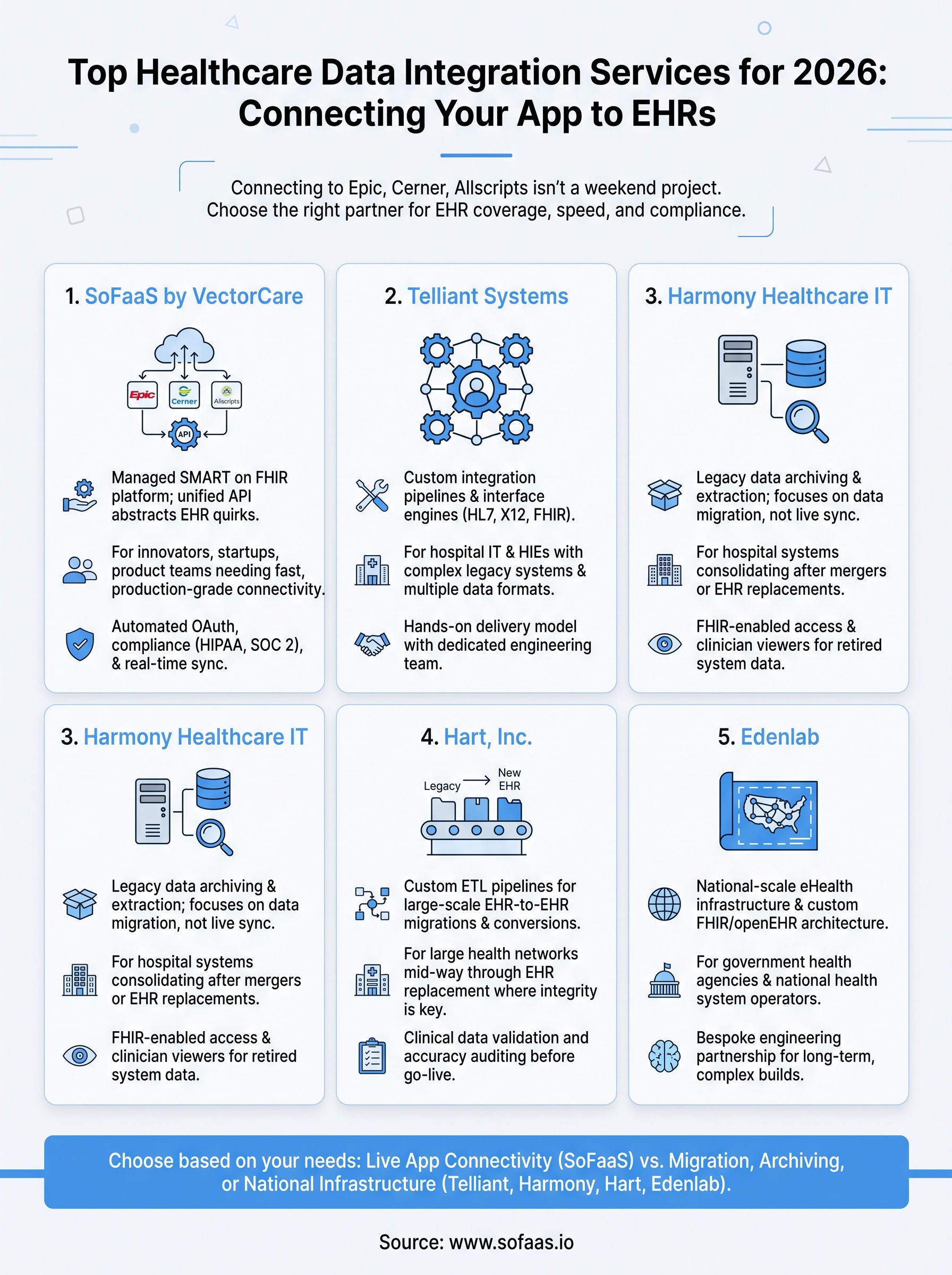
Choosing the right fit for your organization
Most of the vendors on this list solve a real problem, but only one of them fits both patterns: teams building live apps and suppliers needing fast EHR connectivity. Telliant, Harmony, Hart, and Edenlab are strong choices when you're mid-migration, archiving legacy data, or building national infrastructure from scratch, but those are consulting engagements measured in months, not self-serve APIs.
If you're building a product that needs to talk to Epic, Cerner, or Allscripts starting this quarter, that distinction matters. You don't need a custom engineering team embedded for a year. You need a unified API, working OAuth flows, and compliance handled so your developers write features instead of interface engines.
That's the gap SoFaaS was built to close. If your 2026 roadmap includes a live EHR connection, launch your SMART on FHIR app in a couple of steps and see how fast a real pilot can move.
The Future of Patient Logistics
Exploring the future of all things related to patient logistics, technology and how AI is going to re-shape the way we deliver care.
Thank you! Your submission has been received!
Oops! Something went wrong while submitting the form.