10 Best Healthcare App Development Services In The US, 2026

Building a healthcare application means navigating a maze of compliance requirements, security protocols, and clinical workflows that most software teams aren't equipped to handle alone. That's why demand for specialized healthcare app development services has surged, companies need partners who understand both the technical and regulatory sides of healthcare IT. Choosing the wrong one can cost you months of rework, failed compliance audits, and missed market opportunities.
The right development partner will do more than write clean code. They'll architect solutions that are HIPAA-compliant from day one, handle sensitive patient data responsibly, and build integrations with the EHR systems (Epic, Cerner, Allscripts) that your users actually depend on. That EHR integration piece, in particular, is where many projects stall, it's specialized, time-consuming work that requires deep familiarity with standards like SMART on FHIR.
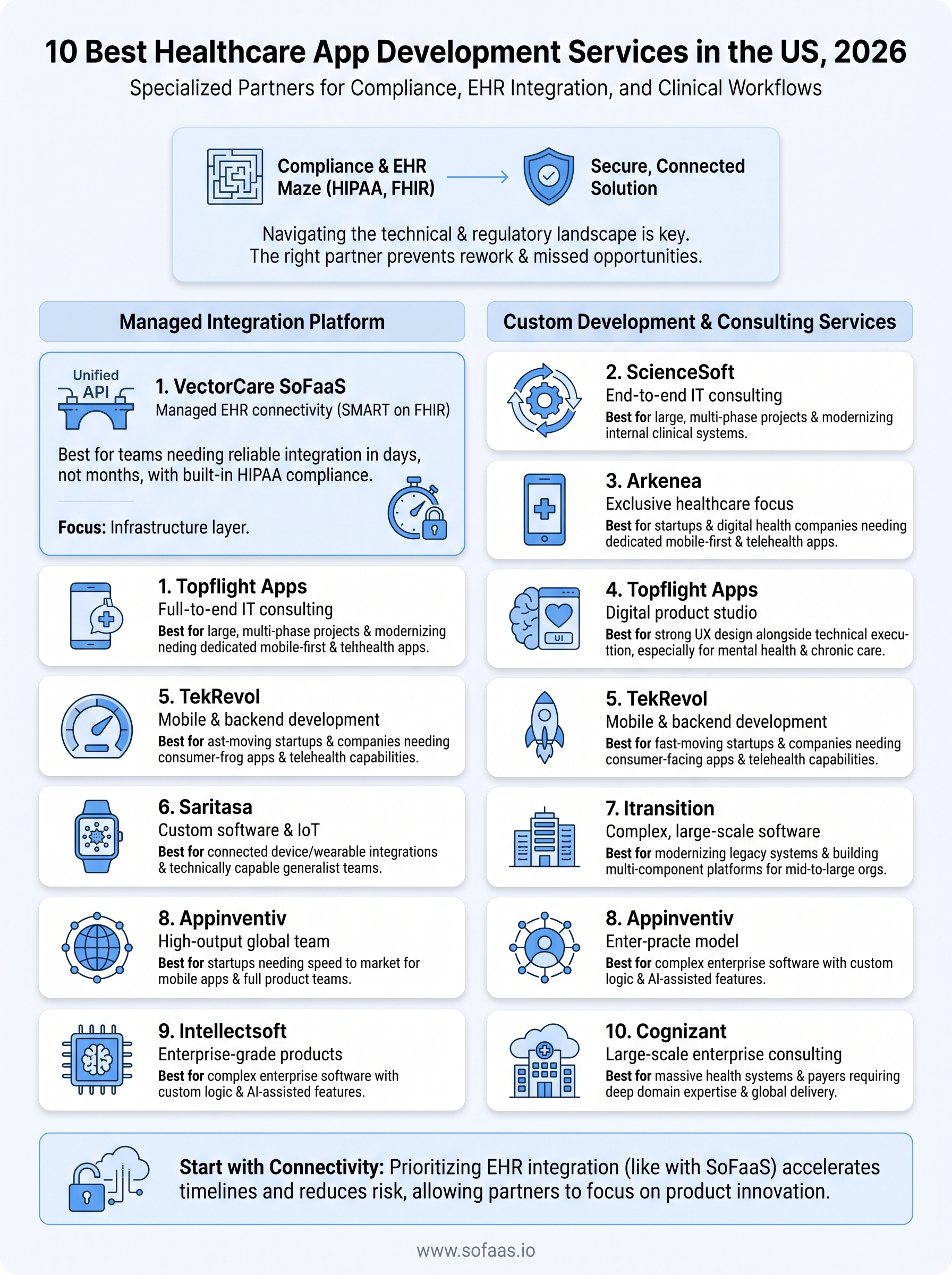
That's exactly the problem we solve at SoFaaS. Our managed platform handles the heavy lifting of EHR connectivity, giving development teams a unified API, pre-built connectors, and built-in compliance so they can ship healthcare apps in days instead of months. We've seen firsthand which development agencies build with integration and scalability in mind, and which ones don't. That perspective shaped this list. Below, you'll find 10 of the best healthcare app development services in the US for 2026, evaluated on technical depth, healthcare expertise, compliance capabilities, and real-world track record.
1. VectorCare SoFaaS
VectorCare SoFaaS (SMART on FHIR as a Service) is a managed integration platform built specifically for teams that need reliable EHR connectivity without the months of custom engineering that typically comes with it. Rather than functioning as a traditional development agency, SoFaaS sits at the infrastructure layer, giving your development team the foundation it needs to build healthcare apps faster and with far less compliance risk.
What it is and how it supports app development
SoFaaS provides a unified API that connects your application to major EHR systems, including Epic, Cerner, and Allscripts, through a single integration point. Instead of building and maintaining separate connectors for each EHR, your team calls one consistent interface and SoFaaS handles the translation, authentication, and data normalization on the back end.
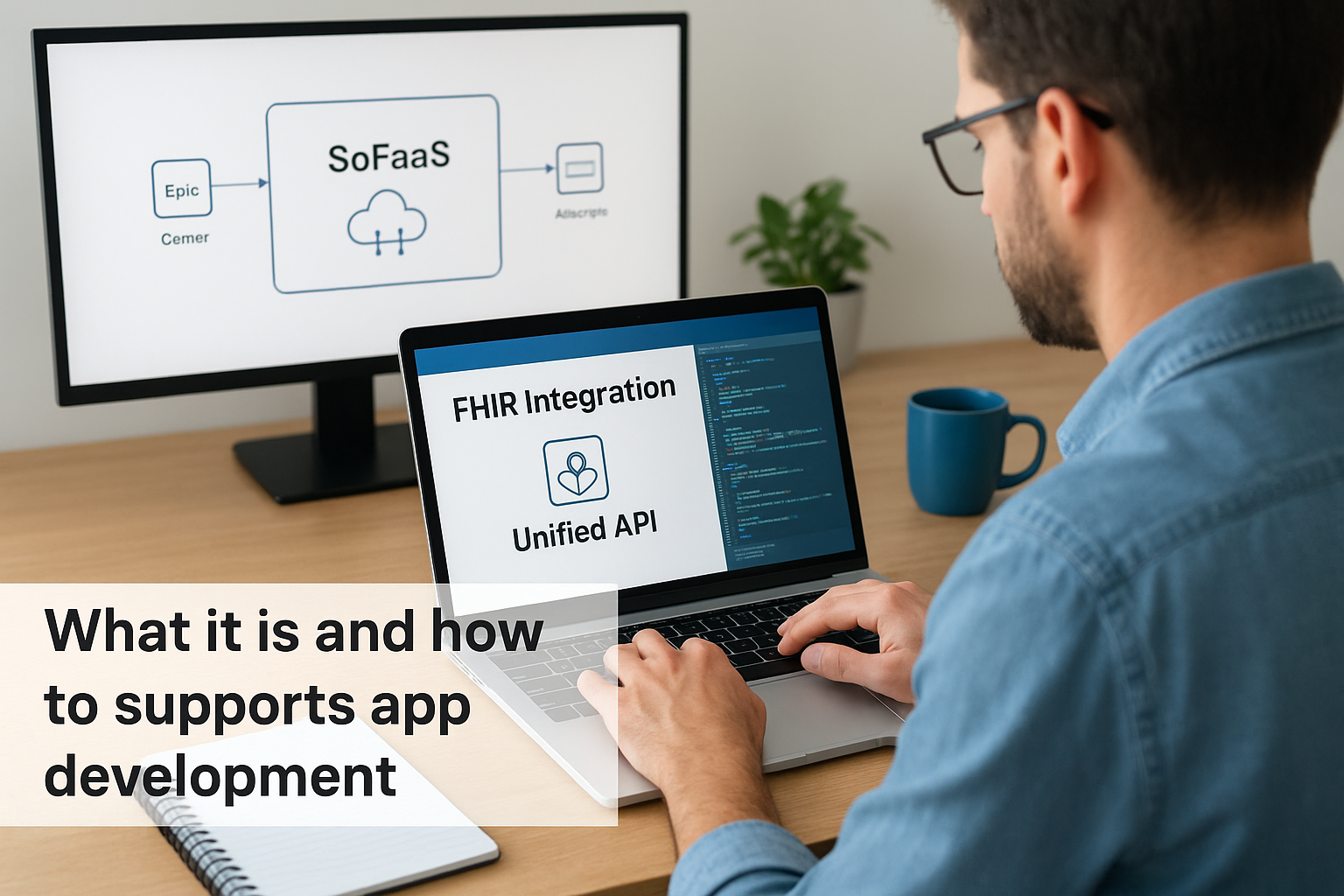
This architecture directly changes how fast your team can move. The pre-built connectors and automated OAuth and token management eliminate the need to hire specialists in FHIR authorization flows. Developers who understand standard REST APIs can get productive immediately, even without prior healthcare integration experience. That's a meaningful advantage when you're evaluating healthcare app development services for a product that lives or dies by its EHR integration reliability.
Teams using SoFaaS have gone from zero to a functioning EHR integration in days, a timeline that typically takes months with a custom-built approach.
Best fit use cases
SoFaaS is the right fit when EHR connectivity is central to your product's value, not a secondary feature. It works especially well for:
- DME providers, home health agencies, and NEMT providers that need to pull structured patient data from hospital EHRs to manage referrals and authorizations
- Health tech startups building patient-facing apps that require SMART on FHIR OAuth flows and real-time data access
- Established healthcare companies that want to add EHR integration to an existing product without rebuilding their entire data layer
- Development teams that already have strong engineering capability but lack specific healthcare integration expertise
If you're building a scheduling tool, a remote monitoring platform, or a clinical decision support app, and your core workflow requires reading or writing data to an EHR, SoFaaS handles that layer so your team can stay focused on the product itself.
Security, compliance, and EHR integration approach
SoFaaS is built on HIPAA-compliant infrastructure with SOC 2 Type II certification, end-to-end encryption, and comprehensive audit logging. These aren't features you configure yourself; they come built into the platform. Every data request that passes through SoFaaS is logged, encrypted in transit and at rest, and tied to a valid patient authorization event.
The patient consent and authorization management layer is another area where SoFaaS removes significant complexity. Managing consent flows in SMART on FHIR requires careful handling of token scopes, refresh cycles, and patient-specific permissions. SoFaaS automates that entire process, reducing both the engineering burden and the risk of authorization errors that could create compliance exposure for your product.
Pricing and engagement model
SoFaaS operates on a managed service model, which means you get ongoing platform support, uptime guarantees (99.9% SLA), and infrastructure maintenance included rather than billing for those separately. Pricing scales with your integration usage, so early-stage teams working on a pilot project pay differently than an enterprise deploying across multiple health systems.
You engage with SoFaaS directly through VectorCare, and the no-code workflow setup means your team can connect to a supported EHR without a lengthy onboarding engagement. For teams that need custom connector work or dedicated support, VectorCare offers enterprise arrangements built around your specific deployment requirements.
2. ScienceSoft
ScienceSoft is a McKinney, Texas-based IT consulting firm with over 35 years in the industry and a dedicated healthcare practice that spans both clinical and administrative software development. They offer end-to-end healthcare app development services, from initial consulting through post-launch maintenance, making them a strong option for organizations that want a single vendor to manage the full project lifecycle.
What they build in healthcare
ScienceSoft's healthcare team develops a wide range of applications including patient portals, telemedicine platforms, remote patient monitoring tools, and hospital information systems. They work across both payer and provider segments, so their experience isn't limited to one corner of the healthcare market. That range matters when you're building a product that needs to fit into complex clinical or administrative environments.
Their portfolio also includes healthcare data analytics platforms and AI-assisted clinical tools, which positions them well for organizations that want to add intelligence to existing workflows rather than just build transactional software from scratch.
Best fit use cases
ScienceSoft works best when you need a vendor capable of handling large, multi-phase healthcare projects with structured delivery processes and dedicated long-term teams. They're particularly strong for:
- Mid-to-large healthcare organizations building or modernizing internal clinical systems
- Health tech companies that need custom EHR development alongside a patient-facing product
- Organizations that prefer fixed-scope engagements with documented delivery milestones over flexible staff augmentation
Security, compliance, and EHR integration approach
ScienceSoft builds to HIPAA compliance standards across all healthcare engagements, incorporating security architecture reviews, access controls, and audit trail requirements directly into their development process. They also hold ISO 27001 certification, which reflects a structured, organization-wide approach to information security rather than project-level add-ons.
Their EHR integration work covers HL7, FHIR, and proprietary EHR APIs, with documented experience connecting to Epic, Cerner, and other major systems. These integrations are built custom on a per-project basis, which gives you flexibility but also adds timeline and budget compared to teams that use a managed integration platform.
If your project requires heavily customized EHR integration logic and you have the timeline and budget for a full custom build, ScienceSoft has the technical depth to see it through.
Pricing and engagement model
ScienceSoft offers both time-and-materials and fixed-price contracts, depending on how clearly scoped your project is at the start. Their rates position them in the mid-to-upper range for US-based IT consulting firms, and most engagements begin with a paid discovery phase before development work kicks off.
3. Arkenea
Arkenea is a San Jose-based firm that has worked exclusively in healthcare software development since 2012. Unlike generalist agencies that treat healthcare as one vertical among many, Arkenea focuses entirely on digital health, which means the people working on your project have built similar products before and won't need time to get up to speed on clinical workflows or regulatory requirements.
What they build in healthcare
Arkenea's team builds patient engagement apps, telemedicine platforms, EHR software, and healthcare marketplace solutions. They cover both web and mobile delivery, so if your product needs a clinician-facing dashboard alongside a patient-facing mobile app, they can handle both within the same engagement. Their portfolio includes work for hospital systems, digital health startups, and medical device companies, giving them exposure to a wide range of clinical and operational contexts.
Best fit use cases
Arkenea fits best when you need a dedicated healthcare development partner who can own product work from concept through launch without requiring heavy technical oversight from your side. They work well for:
- Health tech startups building a first product and lacking in-house healthcare engineering experience
- Digital health companies that need to move quickly on a mobile-first patient application
- Organizations building telehealth or chronic care management tools that need a team with prior experience in those specific workflows
Security, compliance, and EHR integration approach
Arkenea builds HIPAA compliance into their development process rather than treating it as a documentation exercise at the end of a project. Their team handles business associate agreements, encryption standards, access controls, and audit logging as baseline requirements on every healthcare engagement. When EHR integration is part of your scope, they work with HL7 and FHIR standards, with documented experience connecting applications to Epic and Cerner. These integrations are custom-built per project, so the timeline depends heavily on which EHR systems you need to connect to and how complex your data requirements are.
If you're evaluating healthcare app development services and need a team that has shipped products in your specific vertical before, Arkenea's focused portfolio is worth reviewing closely.
Pricing and engagement model
Arkenea operates on a project-based and dedicated team model, with engagements typically scoped after an initial discovery conversation. Their rates are competitive relative to other US-focused boutique healthcare firms, and they're transparent about project timelines upfront, which reduces the risk of scope creep derailing your budget mid-development.
4. Topflight Apps
Topflight Apps is a San Francisco-based digital product studio that has positioned itself specifically around complex, regulated industries, with healthcare representing a large portion of their client work. Their team spans product strategy, UX design, and engineering, which means they can take a product from early concept through a working application without requiring you to coordinate multiple specialized vendors throughout the process.

What they build in healthcare
Topflight Apps builds a range of digital health products including telemedicine applications, mental health platforms, chronic disease management tools, and health data dashboards. Their team covers both iOS and Android development alongside web applications, so if your product needs to work across multiple devices and clinical contexts, they have experience designing for those constraints. They've also worked with companies building AI-assisted health tools, which reflects growing demand for intelligent features inside regulated healthcare applications where explainability and data handling both matter.
Best fit use cases
Topflight Apps fits best when your product needs strong UX design work alongside solid technical execution. That combination is often what separates successful healthcare app development services engagements from ones that produce technically sound products nobody wants to use. They tend to work well for:
- Digital health startups building consumer-facing mobile applications in areas like mental health, fitness, or chronic care management
- Healthcare companies that need a full product team covering design, engineering, and QA under one roof
- Organizations building their first healthcare app and needing a partner that can guide product decisions alongside technical ones
Security, compliance, and EHR integration approach
Topflight Apps treats HIPAA compliance as a baseline requirement rather than a late-stage audit task, covering encryption standards, access controls, audit logging, and BAA documentation as standard elements on every healthcare engagement. Their team works with FHIR-based APIs when EHR connectivity is part of your scope, though their integration work is custom-built per project rather than delivered through a managed platform.
If your product requires connections to multiple EHR systems at once, pairing Topflight's development capabilities with a dedicated integration layer like SoFaaS will save significant time and reduce your compliance exposure.
Pricing and engagement model
Topflight Apps operates on a project-based model, with engagements typically starting with a paid discovery sprint before full development begins. Their pricing sits at the higher end for boutique US product studios, which reflects the design depth and product strategy they bring alongside engineering. For teams that need ongoing support after launch, they offer retainer arrangements as well.
5. TekRevol
TekRevol is a Houston-based software development company with a growing healthcare practice that covers mobile app development, custom software, and digital transformation projects for health-focused organizations. They bring experience across both startup and enterprise client work, which gives them flexibility in how they approach scoping and delivery depending on where your organization sits on that spectrum.
What they build in healthcare
TekRevol builds patient-facing mobile applications, hospital management systems, telehealth platforms, and wearable device integrations for healthcare clients. Their team covers iOS, Android, and cross-platform development alongside backend engineering, so if your product needs to deliver a consistent experience across multiple device types and operating environments, they can handle that without requiring you to bring in separate specialized vendors.
They've also worked on AI-powered health applications, including symptom checkers and health monitoring tools, reflecting increased demand from healthcare companies that want predictive or intelligent features built directly into their core products.
Best fit use cases
TekRevol works well for healthcare organizations that need a broad development team capable of handling both mobile and backend work within a single engagement. They're a reasonable fit for:
- Health tech startups that need a fast-moving team to build and iterate on a consumer-facing mobile app
- Healthcare companies adding telehealth or remote monitoring capabilities to an existing product or service line
- Organizations that want a vendor comfortable working across design, development, and QA without extensive internal oversight
Security, compliance, and EHR integration approach
TekRevol incorporates HIPAA compliance standards into their healthcare projects, covering data encryption, access control, and audit logging as part of their standard delivery process. They handle business associate agreements as part of their client onboarding, which keeps your compliance documentation in order from the start rather than as a retrofit.
If your product requires deep EHR integration alongside the mobile development work, clarify that scope early with TekRevol since their integration work is custom-built and adds meaningful time to your project timeline.
Their EHR integration experience includes HL7 and FHIR-based API connections, though this is not their primary differentiator the way it is for platforms built specifically around healthcare data connectivity.
Pricing and engagement model
TekRevol offers fixed-price and dedicated team engagement models, with pricing that tends to sit below the top-tier boutique US firms. This makes them a viable option when budget is a constraint but you still need a team with documented healthcare app development services experience and compliance awareness built into their process.
6. Saritasa
Saritasa is a Newport Beach, California-based custom software development firm with over 15 years of experience building web and mobile applications across multiple industries, including a dedicated focus on healthcare software. Their team handles the full development stack, which means you work with one vendor for product design, engineering, and quality assurance rather than coordinating separate specialized teams through each phase of your project.

What they build in healthcare
Saritasa builds custom patient-facing applications, clinical workflow tools, health tracking platforms, and connected device integrations for healthcare clients. Their team works across iOS, Android, and web, so if your product needs to function consistently across multiple device types and user environments, they have the cross-platform experience to handle that without introducing separate development tracks.
They've also worked on IoT-connected health applications, including tools that pull data from wearables and medical devices into a centralized platform. That experience with connected hardware alongside traditional app development makes them a practical option when your product involves more than just a standard mobile or web interface.
Best fit use cases
Saritasa works best for organizations that need a technically capable generalist team that has enough healthcare exposure to handle compliance requirements and clinical context without a steep learning curve. They tend to fit well for:
- Healthcare companies building connected device or wearable-integrated applications that require backend engineering alongside mobile development
- Mid-market health tech companies that need a reliable custom software development partner without enterprise-level pricing
- Organizations that already have a product vision and need a team to execute it rather than one that leads heavy product strategy work
Security, compliance, and EHR integration approach
Saritasa builds HIPAA-compliant applications as a standard requirement on healthcare engagements, covering data encryption, role-based access controls, audit logging, and BAA documentation throughout their delivery process. Their team incorporates security practices at the architecture level rather than layering them on after development completes.
If your project requires complex EHR connectivity alongside the application build, factor in additional timeline since their integration work is custom-built per engagement and doesn't leverage a pre-built managed platform.
Their EHR integration experience spans HL7 and FHIR-based API connections, which covers the foundational standards you'll encounter when building healthcare app development services that need to exchange data with clinical systems like Epic or Cerner.
Pricing and engagement model
Saritasa offers project-based and dedicated team engagements, with pricing that sits in the mid-range relative to other US-based custom development firms. Most engagements start with a scoping conversation and a defined project estimate before any development work begins, which gives your team a clear budget baseline from the start.
7. Itransition
Itransition is a Denver, Colorado-based software development company with over 25 years of experience delivering custom software across multiple industries. Their healthcare practice covers a broad range of digital health products, from clinical systems to patient-facing applications, making them a viable option when your project needs a team that can handle complex, multi-component healthcare software without requiring you to manage multiple specialized vendors in parallel.
What they build in healthcare
Their development team builds EHR and EMR systems, patient portal applications, healthcare data analytics platforms, and medical imaging solutions for healthcare clients. Itransition covers the full stack from backend systems integration through front-end delivery, and they have documented experience working across both payer and provider environments. That range means they're equipped to build internal clinical tools as well as consumer-facing applications that sit on top of existing healthcare infrastructure.
Beyond standard transactional apps, they've delivered clinical decision support tools and healthcare workflow automation software, which reflects the growing demand from healthcare organizations that want to reduce manual processes and surface actionable data within existing clinical environments.
Best fit use cases
Itransition fits well when you're building a large-scale healthcare application that requires strong backend architecture alongside front-end delivery. They work well for:
- Mid-to-large healthcare organizations modernizing legacy systems or building net-new clinical platforms
- Health tech companies that need a dedicated long-term development team for a complex, phased project
- Organizations that need both custom software development and data integration work handled within a single engagement
Security, compliance, and EHR integration approach
Itransition incorporates HIPAA compliance requirements into their development methodology as a baseline for every healthcare engagement, covering encryption, audit trails, access controls, and BAA documentation throughout the delivery process. Their security practices are embedded early rather than addressed as a late-stage review.
If your project requires connecting to multiple EHR systems, plan for additional timeline since Itransition builds these integrations custom per engagement rather than through a managed platform like SoFaaS.
Their EHR integration work spans HL7 v2, HL7 FHIR, and proprietary EHR APIs, giving them enough technical coverage to support most healthcare app development services that require structured data exchange with clinical systems including Epic and Cerner.
Pricing and engagement model
Itransition offers time-and-materials and dedicated team models, with pricing that reflects their global delivery model rather than fully US-based rates. Most engagements begin with a discovery and scoping phase before development starts, which helps align expectations on timeline and budget before your team commits to a full project.
8. Appinventiv
Appinventiv is a Dallas, Texas-based software development company with a large global delivery team and a healthcare practice that has produced over 50 digital health applications across mobile, web, and enterprise environments. They work with both early-stage startups and large healthcare enterprises, which gives their team exposure to the full range of product complexity you're likely to encounter when bringing a healthcare application to market.
What they build in healthcare
Appinventiv's healthcare team builds patient engagement platforms, telemedicine applications, pharmacy management systems, and AI-assisted clinical tools for clients across the provider, payer, and pharmaceutical segments. Their engineering team covers iOS, Android, and cross-platform development alongside backend architecture, so if your product needs to run consistently across mobile and web environments, they can handle both tracks within a single engagement.
They have delivered projects involving wearable device integrations and health data aggregation platforms, which puts them in a reasonable position when your product needs to pull data from multiple sources rather than a single clinical system.
Best fit use cases
Appinventiv tends to work well when you need a high-output development team that can move quickly across design, engineering, and QA without requiring heavy coordination from your side. They fit well for:
- Health tech startups building consumer-facing mobile applications where speed to market is a primary concern
- Healthcare companies that need a full product team capable of handling multiple parallel workstreams on a single engagement
- Organizations looking to add digital health features to an existing product without building out a large internal engineering function
Security, compliance, and EHR integration approach
Appinventiv builds HIPAA-compliant applications as a standard requirement on healthcare engagements, covering data encryption, role-based access controls, audit logging, and BAA documentation from the start of each project. Their security practices are incorporated at the architecture stage rather than addressed after development completes.
If your product requires connecting to multiple EHR systems as a core feature, pairing Appinventiv's development work with a managed integration platform like SoFaaS will reduce your timeline significantly compared to building those connectors from scratch.
Their EHR integration work uses HL7 and FHIR-based APIs, covering the standard data exchange protocols you'll encounter with major clinical systems including Epic and Cerner when building healthcare app development services that depend on live patient data.
Pricing and engagement model
Appinventiv offers fixed-price and dedicated team engagements, with pricing that reflects their global delivery model and sits below fully US-staffed boutique firms. Most projects begin with a scoping and estimation phase before development starts, giving your team a defined cost baseline before committing to a full build.
9. Intellectsoft
Intellectsoft is a Palo Alto, California-based software development company with over 15 years of experience building enterprise-grade digital products across multiple industries. Their healthcare practice covers the full product lifecycle, from initial architecture through post-launch support, giving you a single vendor capable of managing both the technical build and the ongoing maintenance without requiring a handoff to a separate team.

What they build in healthcare
Intellectsoft's healthcare team develops patient portal applications, remote patient monitoring platforms, clinical workflow automation tools, and healthcare data management systems for clients across provider, payer, and life sciences segments. Their engineering team works across mobile, web, and backend environments, so if your product needs to deliver a consistent experience across multiple platforms and user types, they can support that without splitting the work across separate vendors.
They have also delivered AI-powered diagnostic support tools and predictive analytics applications, which positions them well for organizations looking to add intelligent features to existing clinical workflows rather than building a standard transactional application.
Best fit use cases
Intellectsoft tends to be a strong fit when you need a team that can handle complex enterprise healthcare software with a high degree of custom logic and a long-term delivery roadmap. They work well for:
- Enterprise healthcare organizations that need dedicated long-term development teams for multi-phase platform builds
- Health tech companies adding AI-assisted features to existing products without building a separate internal data science function
- Organizations that want a vendor experienced in both mobile and enterprise backend development within a single healthcare engagement
Security, compliance, and EHR integration approach
Intellectsoft builds HIPAA-compliant infrastructure as a baseline requirement on every healthcare engagement, incorporating data encryption, role-based access controls, audit logging, and BAA documentation throughout each phase of their delivery process. Their security practices are built into the architecture from the start rather than added at the compliance review stage.
If your product requires connecting to multiple EHR systems as a core feature, pairing Intellectsoft's development work with a managed platform like SoFaaS will reduce your timeline compared to building those connectors from scratch within the engagement.
Their EHR integration work covers HL7 and FHIR-based APIs, giving them enough technical coverage to support healthcare app development services that require structured data exchange with major clinical systems including Epic and Cerner.
Pricing and engagement model
Intellectsoft offers dedicated team and project-based engagement models, with pricing that reflects their global delivery capability and sits below fully US-staffed boutique firms. Most projects begin with a scoping and discovery phase before development starts, which gives your team a defined budget baseline before committing to the full build.
10. Cognizant
Cognizant is a Teaneck, New Jersey-based global technology and consulting company with one of the largest dedicated healthcare and life sciences practices in the industry. They serve health systems, payers, pharmaceutical companies, and medical device manufacturers, giving their teams broad exposure to the full range of healthcare environments your product might need to operate within.
What they build in healthcare
Cognizant's healthcare engineering teams build enterprise clinical platforms, payer and provider workflow systems, population health management tools, and digital patient engagement applications. Their scope extends well beyond standard app development, covering data architecture, cloud migration, and AI-driven analytics for healthcare organizations managing large, complex data environments. When your project requires significant backend infrastructure alongside a front-end application, Cognizant has the technical depth to handle both within a single engagement.
Best fit use cases
Cognizant fits well when you're a large healthcare organization or enterprise health tech company with a complex, multi-phase project that requires a vendor with global delivery capacity and deep domain expertise. They work particularly well for:
- Large health systems and payers building or modernizing core operational platforms
- Pharmaceutical and life sciences companies that need data integration and analytics platforms alongside application development
- Enterprise organizations that need a vendor capable of managing multiple parallel workstreams across large internal teams
Security, compliance, and EHR integration approach
Cognizant builds to HIPAA compliance standards across all healthcare engagements and maintains a broad set of certifications, including SOC 2 and ISO 27001, reflecting enterprise-grade security practices embedded across their delivery organization. Their teams handle audit logging, data encryption, role-based access controls, and BAA documentation as standard deliverables on every healthcare engagement.
If your product requires connecting to multiple EHR systems at scale, pairing Cognizant's enterprise development capability with a managed platform like SoFaaS will reduce your timeline significantly compared to building those connectors from scratch within the engagement.
EHR integration work at Cognizant spans HL7, FHIR, and proprietary EHR APIs, with documented experience connecting large-scale platforms to Epic, Cerner, and other major clinical systems. That coverage makes them a viable option for healthcare app development services that require structured, high-volume data exchange across multiple health system partners.
Pricing and engagement model
Cognizant operates on enterprise contract structures, including time-and-materials, fixed-price, and managed services arrangements depending on your project scope. Their pricing reflects their scale and global delivery model, which positions them as a fit for large-budget, long-term engagements rather than early-stage startups or small product teams working within a limited development budget.
Where to start
Every firm on this list brings real healthcare app development services experience to the table, but the right choice depends on where your project's complexity actually lives. If you're building a product that needs to exchange data with Epic, Cerner, or Allscripts, the integration layer will define your timeline and your compliance posture more than anything else on your roadmap. Picking a strong development team solves only part of that equation.
That's why the most practical starting point for many teams is getting EHR connectivity working first, before a single line of product code is written. SoFaaS gives you pre-built connectors, automated OAuth management, and HIPAA-compliant infrastructure through a single API, so your development partner can focus entirely on building your product rather than rebuilding integration infrastructure from scratch. Connect your healthcare app to EHRs in days and skip the months of custom integration work that slows most teams down.
The Future of Patient Logistics
Exploring the future of all things related to patient logistics, technology and how AI is going to re-shape the way we deliver care.
Thank you! Your submission has been received!
Oops! Something went wrong while submitting the form.