What Is TEFCA? How It Enables Nationwide Data Exchange

What Is TEFCA? How It Enables Nationwide Data Exchange
Healthcare organizations have been exchanging patient data for decades, but doing so across different networks and systems has remained frustratingly complex. If you're asking what is TEFCA, you're likely trying to understand how the U.S. government plans to solve this fragmentation problem. The Trusted Exchange Framework and Common Agreement, TEFCA, represents a federal initiative designed to create a single, nationwide approach to health information exchange.
TEFCA establishes rules and technical requirements that allow different health information networks to communicate with each other seamlessly. Before TEFCA, organizations often needed to negotiate individual agreements with each network they wanted to connect to, a time-consuming and expensive process. Under TEFCA, participating networks agree to follow a common set of standards, enabling healthcare providers, payers, and public health agencies to exchange data far more efficiently.
For companies building healthcare applications, especially those using standards like SMART on FHIR to integrate with EHRs, understanding TEFCA is essential. At SoFaaS, we simplify the technical complexity of healthcare data integration, and TEFCA shapes the broader interoperability environment your applications will operate within. This guide explains how TEFCA works, who it affects, and what it means for your organization's data exchange strategy moving forward.
TEFCA basics: what it is and what it is not
When you research what is TEFCA, you'll find that the Office of the National Coordinator for Health Information Technology (ONC) created this framework to solve a coordination problem in healthcare data exchange. TEFCA consists of two core components: the Trusted Exchange Framework itself, which outlines principles for nationwide interoperability, and the Common Agreement, a legal contract that participating organizations must sign. Together, these components establish both the technical and legal foundation for different health information networks to connect with each other without negotiating separate agreements for every connection.
What TEFCA actually is
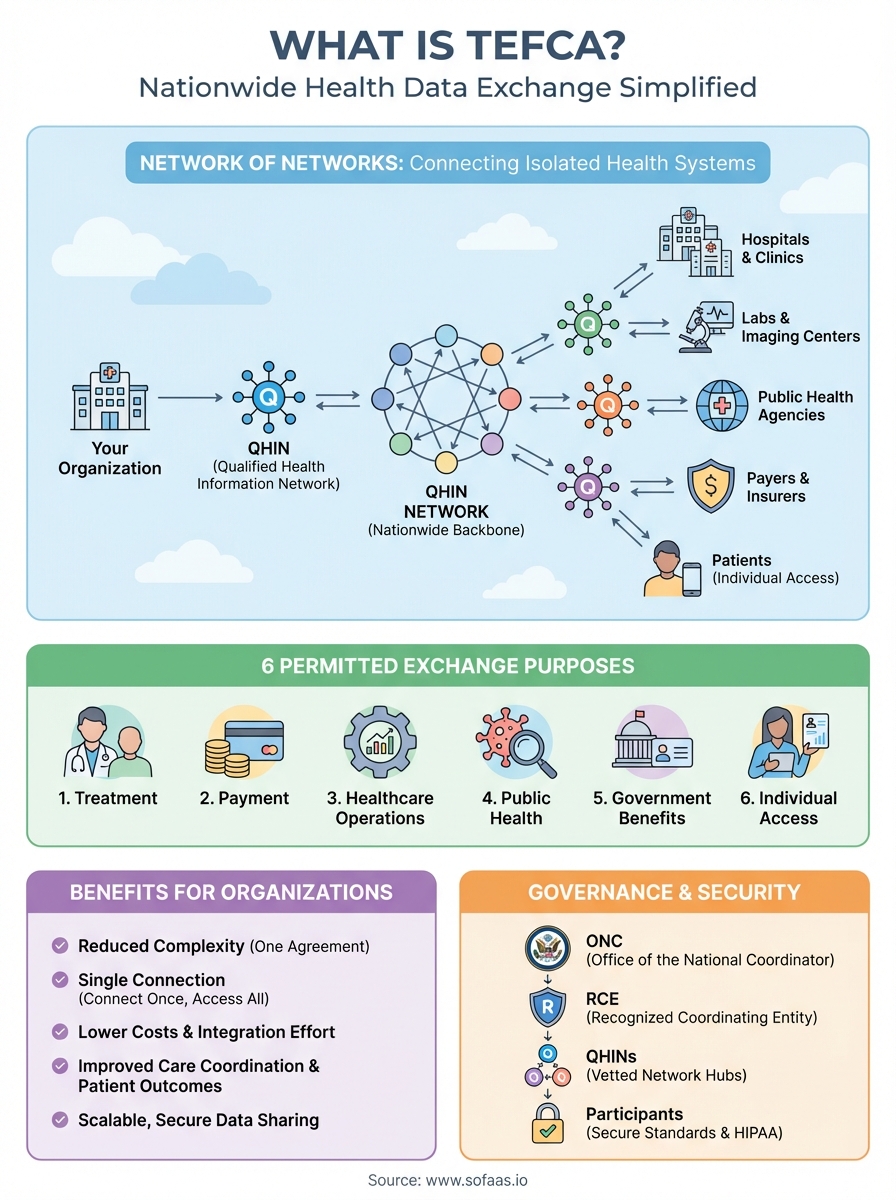
TEFCA operates as a network of networks rather than a single centralized database or exchange. The framework designates specific organizations as Qualified Health Information Networks (QHINs), which serve as on-ramps to the nationwide exchange infrastructure. Your organization connects to one QHIN, and that QHIN's agreements with other QHINs allow you to exchange data with participants across the entire network. This design means you avoid the expensive and time-consuming process of establishing point-to-point connections with dozens or hundreds of individual organizations.
The Common Agreement specifies the technical standards your systems must support, the permitted purposes for data exchange, and the security requirements you must meet. All participants agree to use standardized query formats, consistent patient-matching approaches, and specific data elements based on the United States Core Data for Interoperability (USCDI). This standardization allows a hospital in California to request patient records from a clinic in New York using the same technical approach it uses to query local providers.
What TEFCA is not
TEFCA is not a mandate that forces your organization to participate in nationwide exchange immediately. The framework creates an optional pathway for organizations that want to exchange data beyond their existing networks. You can continue using your current health information exchange relationships while evaluating whether TEFCA participation aligns with your strategic goals. However, future regulations may change this voluntary status for certain provider types or use cases.
TEFCA does not replace your existing data exchange agreements or technical infrastructure overnight.
TEFCA also does not guarantee that every healthcare organization in America will suddenly share data freely. Participants still must follow privacy laws, respect patient consent preferences, and exchange data only for permitted purposes outlined in the Common Agreement. The framework establishes the technical and legal foundation for exchange, but your organization retains control over what data you share, with whom, and under what circumstances. TEFCA removes barriers to connection, but it doesn't eliminate the clinical, legal, and operational decisions you make about each exchange request.
Why TEFCA matters for nationwide interoperability
Understanding what is TEFCA reveals why fragmented healthcare data exchange has cost the industry billions of dollars annually. Before TEFCA, each health information exchange operated independently, creating isolated data islands that forced providers to check multiple systems to locate patient information. When a patient arrived at your emergency department after receiving care elsewhere, your staff often couldn't access critical medical history because the originating facility used a different exchange network. This fragmentation led to duplicate tests, medication errors, and delayed treatment decisions that directly affected patient outcomes.
Breaking down data silos
Healthcare organizations have built impressive digital infrastructure within their own walls, but connecting across organizational boundaries has remained stubbornly difficult. Your hospital might exchange data seamlessly with affiliated clinics using a regional health information exchange, yet struggle to retrieve records from a specialist practice two states away that participates in a different network. TEFCA addresses this problem by requiring QHINs to connect with each other, transforming independent networks into an interconnected national system.
The framework eliminates the need for your organization to evaluate, negotiate with, and integrate every possible exchange partner individually. Instead of managing dozens of bilateral agreements with separate technical specifications, you connect to one QHIN and gain access to participants across the entire TEFCA network. This approach mirrors how the internet itself functions: individual networks agreeing to common protocols that enable universal connectivity without requiring direct relationships between every endpoint.
TEFCA transforms healthcare data exchange from a patchwork of isolated networks into a coordinated national infrastructure.
Reducing integration costs and complexity
Your IT team knows that each new data exchange connection requires technical development work, legal review, security assessments, and ongoing maintenance. Multiplying these costs across dozens of potential exchange partners makes comprehensive interoperability financially prohibitive for many organizations. TEFCA reduces this burden by standardizing the technical requirements and legal terms across all participants, allowing you to implement one connection that serves multiple exchange relationships simultaneously.
How TEFCA works: QHINs, participants, queries
Now that you understand what is TEFCA and why it matters, you need to grasp the operational mechanics that make nationwide exchange possible. The framework relies on a three-tier architecture where Qualified Health Information Networks (QHINs) serve as the backbone, participants connect through these networks, and standardized queries retrieve patient information across organizational boundaries. Your organization's role in this system determines both your technical requirements and the data you can access.

The role of QHINs in the network
QHINs function as the critical infrastructure layer that connects different parts of the healthcare system. These organizations undergo rigorous technical and security evaluations by the Recognized Coordinating Entity (RCE) before receiving designation. Once approved, each QHIN must establish direct connections with every other QHIN, creating a mesh network that enables universal data exchange. Your organization connects to one QHIN as either a participant or subparticipant, and that single connection grants you access to all participants across all other QHINs in the network.
The QHIN you choose handles the technical complexity of maintaining connections, routing queries, and ensuring security compliance. You sign a participation agreement with your QHIN rather than negotiating separate contracts with every potential exchange partner. This arrangement shifts the burden of network management from individual healthcare organizations to specialized infrastructure providers that can operate at scale.
How queries flow through the system
When your application needs patient data from another organization, you send a standardized query to your QHIN using FHIR-based protocols and specific patient identifiers. Your QHIN routes this query to other QHINs, which forward it to their participants that might hold relevant records. Organizations holding matching records respond directly through the same pathway, with your QHIN aggregating and delivering the results back to your system.
The query-response model ensures you only receive data that exists and meets your specified criteria, avoiding unnecessary data transfer.
Exchange purposes, data scope, and patient access
When you participate in TEFCA, you cannot request patient data for any reason you choose. The Common Agreement defines six permitted exchange purposes that limit when and why your organization can query the network for health information. These restrictions protect patient privacy while enabling legitimate clinical care, payment operations, and public health activities. Your organization must identify the specific purpose for each query, and receiving organizations can verify that purpose before releasing data. Understanding these boundaries helps you design applications that operate within TEFCA's legal framework while meeting your business objectives.
Permitted exchange purposes under TEFCA
The six approved purposes cover treatment, payment, healthcare operations, public health activities, government benefits determination, and individual access services. Treatment purposes include coordinating care, consulting with other providers, and making clinical decisions that require patient history from external sources. Payment operations encompass claims processing, eligibility verification, and billing coordination across multiple payers. Healthcare operations allow quality improvement activities, care coordination programs, and population health management within your organization.
Public health agencies can query TEFCA participants for disease surveillance, outbreak investigations, and mandatory reporting requirements. Government programs use the network to verify eligibility for benefits like Medicaid or disability services. The individual access purpose enables patients to retrieve their own health information through third-party applications they authorize, supporting the patient's right to direct where their data flows.
Your organization cannot use TEFCA for marketing, research without consent, or other purposes beyond the six permitted categories.
Patient consent and access rights
Patients maintain control over their health information even within TEFCA's framework. Your organization must respect patient opt-out requests that prohibit sharing specific data elements or entire records through the network. Some states require explicit patient consent before exchanging certain sensitive information categories, including substance abuse treatment records, mental health notes, or HIV status. TEFCA does not override these state privacy protections, meaning your technical implementation must accommodate varying consent requirements across different jurisdictions.
TEFCA governance, security, and the federal rule
Understanding what is TEFCA requires grasping the governance structure that enforces standards and resolves disputes across the network. The Office of the National Coordinator designated the Sequoia Project as the Recognized Coordinating Entity (RCE), giving this organization authority to designate QHINs, monitor compliance, and update the Common Agreement as healthcare technology evolves. Your organization operates within this governance framework regardless of which QHIN you connect through, because all participants agree to follow the same rules and enforcement mechanisms.
The RCE and QHIN oversight
The RCE evaluates QHIN applications using technical performance criteria, security standards, and operational requirements before granting designation. This vetting process ensures that only organizations with sufficient infrastructure capacity and security controls can serve as network hubs. Once designated, QHINs undergo continuous monitoring and annual assessments to maintain their status. The RCE can suspend or revoke a QHIN's designation if that organization fails to meet ongoing compliance requirements or violates the Common Agreement terms.
Your QHIN relationship includes dispute resolution procedures when disagreements arise about data exchange requests or technical implementation. The Common Agreement specifies escalation pathways from direct negotiation through formal arbitration, providing clear mechanisms for resolving conflicts without requiring expensive litigation.
Security and compliance requirements
TEFCA mandates that your organization implement technical safeguards including encryption for data in transit and at rest, audit logging of all exchange activities, and identity verification for users accessing the network. You must conduct regular security risk assessments and report any breaches affecting TEFCA data within specified timeframes. These requirements complement rather than replace your existing HIPAA obligations, adding network-specific security controls to your compliance program.
Your security implementation must meet both HIPAA standards and additional TEFCA-specific requirements to participate in the network.
The framework requires annual attestation that your organization maintains these security controls and follows permitted use restrictions for exchanged data.
What to do next
Now that you understand what is TEFCA and how it enables nationwide data exchange, you face practical decisions about your organization's participation strategy. Start by evaluating whether your current data exchange needs align with TEFCA's six permitted purposes and whether connecting through a QHIN offers advantages over your existing networks. Your IT team should assess the technical requirements for FHIR-based queries, patient matching standards, and security controls that TEFCA participation demands.
Building healthcare applications that integrate with EHRs and health information networks requires specialized infrastructure and compliance expertise. If you're developing Smart on FHIR applications that need to exchange data across organizational boundaries, launch your Smart on FHIR app with VectorCare's managed platform. SoFaaS handles the technical complexity of healthcare data integration, allowing you to focus on application development while we manage the connectivity, security, and compliance requirements that frameworks like TEFCA require.
The Future of Patient Logistics
Exploring the future of all things related to patient logistics, technology and how AI is going to re-shape the way we deliver care.
Thank you! Your submission has been received!
Oops! Something went wrong while submitting the form.