What Is A Capability Statement? Elements, Examples, Tips

What Is A Capability Statement? Elements, Examples, Tips
Whether you're pursuing government contracts or building B2B partnerships in healthcare, one document can make or break your first impression. Understanding what is a capability statement is essential for any healthcare supplier, technology company, or service provider looking to stand out in competitive procurement processes.
A capability statement is your company's professional resume, a concise, one-to-two page document that showcases your qualifications, experience, and unique value. For healthcare innovators working with EHR integrations, compliance certifications like HIPAA and SOC 2, and specialized technical capabilities, a well-crafted capability statement can open doors to government agencies, health systems, and enterprise partners. At SoFaaS, we've seen firsthand how healthcare suppliers, from DME providers to health tech startups, gain traction when they clearly articulate what sets them apart.
This guide covers everything you need to create an effective capability statement: the essential elements every document should include, real-world examples you can learn from, and practical tips to make yours stand out. By the end, you'll know exactly how to communicate your strengths to decision-makers who matter.
What a capability statement is and who uses it
A capability statement serves as your company's official introduction to procurement officers, contracting teams, and business development managers who evaluate potential partners. Think of it as a marketing document that combines credentials, past performance, and technical capabilities into a format designed for quick decision-making. Unlike lengthy proposals or websites, this document delivers your value proposition in a format that busy evaluators can review in under five minutes.
The core definition and purpose
When someone asks what is a capability statement, you can describe it as a single-page snapshot that proves your company can deliver specific products or services. The document typically includes your business codes (NAICS, DUNS, CAGE), certifications (woman-owned, minority-owned, veteran-owned), core competencies, past performance examples, and differentiators. You create this document to answer the first questions any procurement officer asks: Who are you? What can you do? Why should we consider you?
A capability statement eliminates guesswork by presenting verifiable facts that match your strengths to specific contract requirements.
Healthcare organizations use capability statements differently than traditional manufacturers. Your document might highlight HIPAA compliance, SOC 2 certifications, FHIR integration expertise, or specialized experience with health systems. These credentials matter because they directly address the risk concerns that healthcare buyers face when selecting technology or service partners.
Industries and companies that rely on capability statements
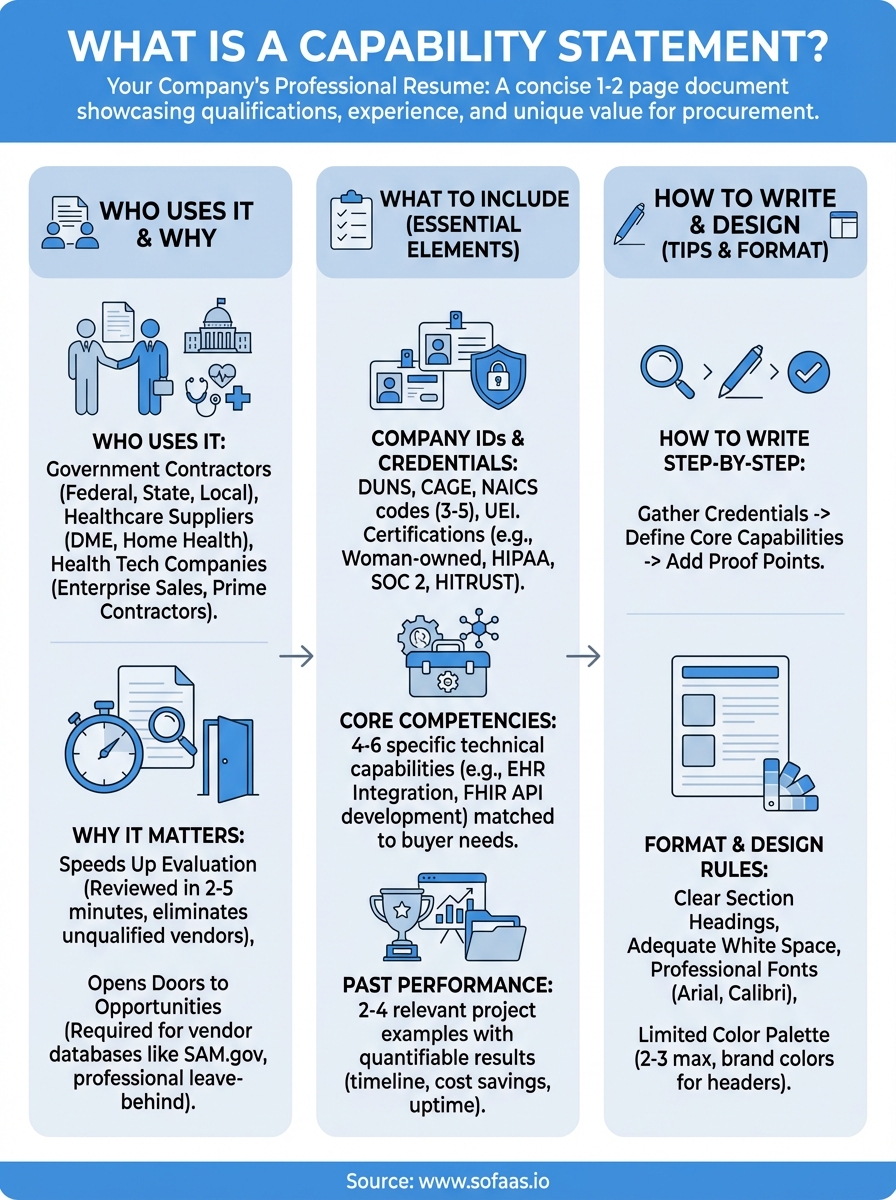
Government contractors depend on capability statements most heavily, particularly those pursuing federal contracts through agencies like the Department of Veterans Affairs, Department of Defense, or Health and Human Services. You'll find that state and local governments also request these documents during procurement processes for healthcare services, medical equipment, and IT solutions. The Small Business Administration actively encourages companies to maintain updated capability statements for federal contracting opportunities.
Beyond government work, healthcare suppliers including DME providers, home health agencies, ambulance services, and NEMT providers use capability statements when approaching hospital systems, ACOs, and payer networks. Health tech companies building applications, integration platforms, or compliance tools create these documents to speed up enterprise sales cycles. Prime contractors also request capability statements from potential subcontractors to verify qualifications before including them in team proposals.
Why a capability statement matters for bids and sales
Your capability statement functions as a gatekeeper document that determines whether you move forward in procurement processes or get overlooked entirely. Procurement officers and contracting teams face dozens or hundreds of potential vendors for each opportunity, and they use capability statements to quickly eliminate companies that don't meet minimum requirements. Without this document, you miss out on invitations to bid, requests for proposals, and opportunities to join contractor teams pursuing larger projects.
Speeds up the evaluation process
Decision-makers spend 2-5 minutes reviewing each capability statement during initial screening. You give them exactly what they need to make quick judgments: your business identifiers, relevant certifications, past performance proof, and technical capabilities. This efficiency matters because buyers often work under tight deadlines to complete vendor assessments and award contracts. Healthcare buyers particularly value statements that highlight compliance credentials like HIPAA, SOC 2, or HITRUST because these qualifications immediately address their primary risk concerns.
A well-organized capability statement moves you from unknown vendor to serious contender in minutes, not weeks.
Opens doors to contract opportunities
Many government agencies and enterprise healthcare organizations require capability statements before adding you to vendor databases or approved supplier lists. You need this document to register in SAM.gov for federal contracting, to respond to sources sought notices, and to introduce yourself to prime contractors building teams. Beyond formal requirements, your capability statement serves as a leave-behind after meetings, a response to partnership inquiries, and proof that you understand what is a capability statement and how professional procurement works.
What to include in a capability statement
Your capability statement must contain specific elements that procurement officers expect to find during their rapid evaluation process. You can't skip these components because buyers use them to verify qualifications, match your company to contract requirements, and assess whether you meet minimum standards for consideration. Understanding what is a capability statement means knowing that certain information appears in every effective document, regardless of industry or company size.

Company identification and credentials
You need to include your business identifiers at the top of your capability statement: DUNS number, CAGE code, NAICS codes (typically 3-5 that match your services), and UEI if pursuing federal contracts. Add your business classifications such as woman-owned, veteran-owned, small business, or minority-owned status because these designations qualify you for set-aside contracts and give you competitive advantages. Healthcare companies should prominently display certifications like HIPAA compliance, SOC 2 Type II, HITRUST, or state-specific healthcare licenses that address buyer concerns about security and regulatory adherence.
Core competencies and differentiators
Your core competencies section lists the specific services or products you deliver, focusing on 4-6 areas where you excel. You describe your technical capabilities using concrete terms that match procurement language: EHR integration expertise, FHIR API development, real-time data synchronization, or specialized healthcare workflows. This section answers what makes you different from competitors through measurable differentiators like 99.9% uptime guarantees, response times, or proprietary technology.
Clear differentiators transform your statement from a list of qualifications into compelling proof that you deliver superior value.
Past performance and proof points
You must include 2-4 relevant project examples that demonstrate successful delivery for similar clients or contracts. Each example should specify the customer type (federal agency, health system, enterprise), project scope, and quantifiable results.
How to write a capability statement step by step
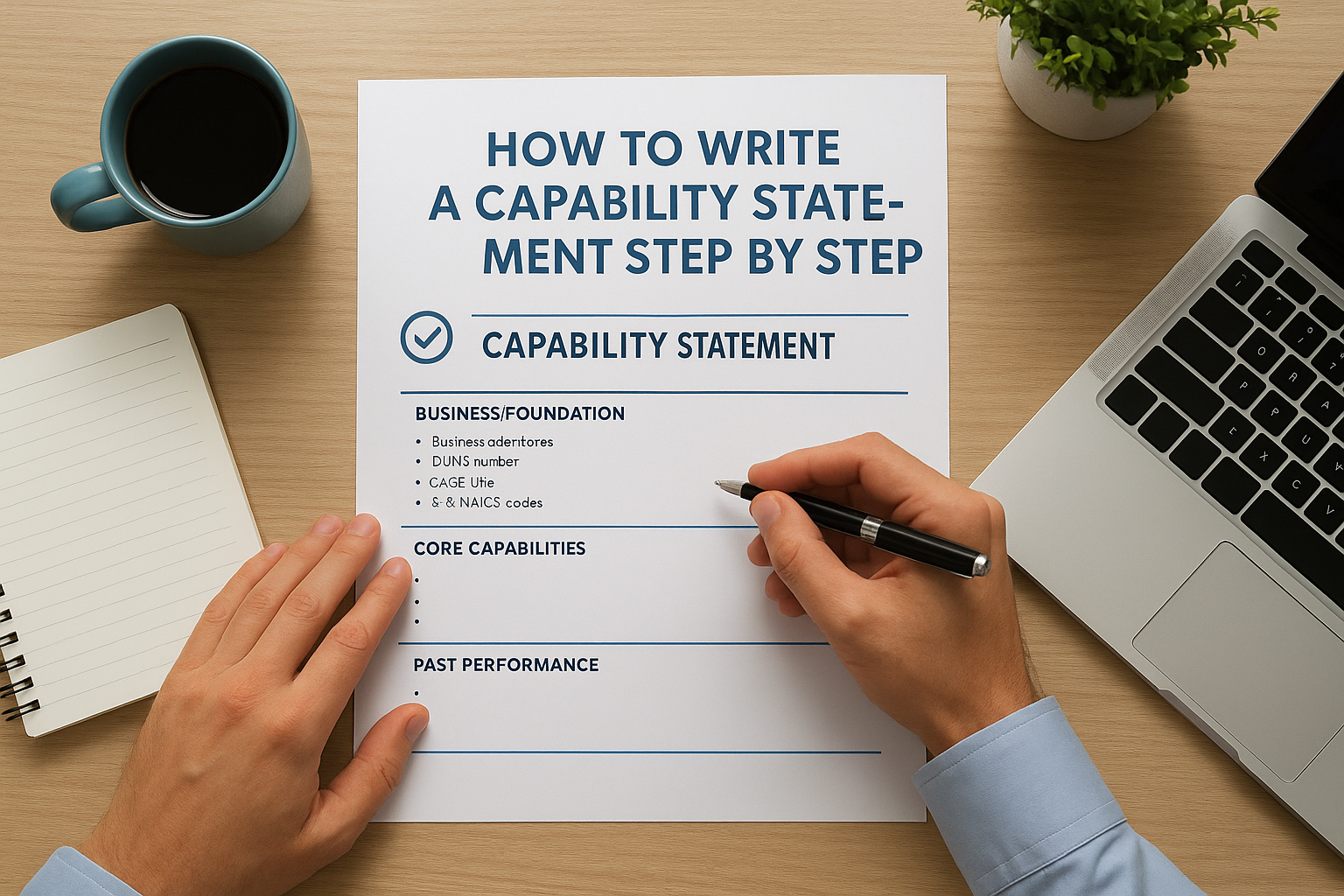
You build an effective capability statement by following a structured process that ensures you include all critical elements while keeping the document concise and scannable. Start by gathering your business credentials, collecting proof of past performance, and identifying the specific audiences you want to reach. This preparation prevents you from creating generic documents that fail to address what procurement officers actually need to see. Understanding what is a capability statement means recognizing that the writing process matters as much as the final content.
Start with your business foundation
You begin by compiling your business identifiers: DUNS number, CAGE code, UEI, and the 3-5 NAICS codes that best describe your services. Collect your certification documents including woman-owned, veteran-owned, or small business designations that qualify you for set-aside contracts. Healthcare companies should gather compliance certificates like HIPAA, SOC 2 Type II, or HITRUST at this stage. This foundation gives you the verifiable credentials that buyers check first during their evaluation process.
Define your core capabilities clearly
You select 4-6 core competencies that match the contracts or partnerships you pursue, avoiding vague descriptions in favor of specific technical capabilities. Healthcare technology companies might list EHR integration expertise, FHIR API development, real-time data synchronization, or automated compliance workflows. Each competency should connect directly to buyer needs rather than listing everything your company can do.
Your competencies section must answer what buyers care about, not showcase your entire service catalog.
Add proof through past performance
You choose 2-4 project examples that demonstrate successful delivery for similar clients, including measurable outcomes like implementation timelines, uptime percentages, or cost savings.
Format and design rules that make it readable
Your capability statement must follow strict formatting conventions that procurement officers expect when evaluating dozens of documents quickly. You create a readable document by balancing professional design with maximum information density, understanding that buyers scan rather than read every word. Knowing what is a capability statement includes recognizing that visual presentation directly impacts whether your content gets absorbed or ignored during the critical first review.
Visual hierarchy and white space
You structure your document using clear section headings that guide readers to specific information types: Company Information, Core Competencies, Past Performance, and Differentiators. Leave adequate white space between sections so buyers can distinguish one area from another without squinting or getting lost in dense text blocks. Use bullet points to break up paragraph-heavy sections, making your technical capabilities and certifications easier to scan. Single-page formats work best for most opportunities, though you can extend to two pages if you have extensive relevant experience that directly matches contract requirements.
Strategic white space transforms your capability statement from an overwhelming wall of text into a document that buyers actually want to read.
Text and font choices
You select professional fonts like Arial, Calibri, or Times New Roman in 10-12 point size for body text, avoiding decorative or script fonts that reduce readability. Keep your color palette limited to 2-3 colors maximum, using your company brand colors for headers while maintaining black text for body content. Bold key terms like certification names, business codes, and measurable achievements so they stand out during rapid scanning. Avoid italics, underlining, or all-caps text except for acronyms like HIPAA or SOC 2.
Conclusion section
You now understand what is a capability statement and how to create one that opens doors to government contracts and enterprise healthcare partnerships. Your document serves as your professional introduction to procurement officers, combining credentials, past performance, and technical capabilities into a format designed for rapid evaluation. Healthcare companies that present clear differentiators like HIPAA compliance, SOC 2 certifications, and specialized EHR integration expertise stand out from competitors who submit generic documents.
Creating your capability statement takes focused effort, but the investment pays dividends when you win contract opportunities and accelerate sales cycles. Healthcare innovators building applications that connect to EHRs face unique challenges in proving their technical capabilities and compliance readiness. If you're developing SMART on FHIR applications and need to demonstrate integration expertise in your capability statement, explore how VectorCare simplifies EHR connectivity so you can focus on building innovative solutions rather than managing complex infrastructure. Your capability statement becomes more compelling when backed by proven integration technology.
The Future of Patient Logistics
Exploring the future of all things related to patient logistics, technology and how AI is going to re-shape the way we deliver care.
Thank you! Your submission has been received!
Oops! Something went wrong while submitting the form.