SNOMED CT vs. ICD-10: Key Differences and How They Map

If you've ever pulled a patient record and seen two completely different codes describing what looks like the same condition, you've run into the snomed ct vs icd-10 question firsthand. One system was built to capture clinical detail at the point of care, the other was built to bill for it, and mixing them up creates real problems in your data pipeline.
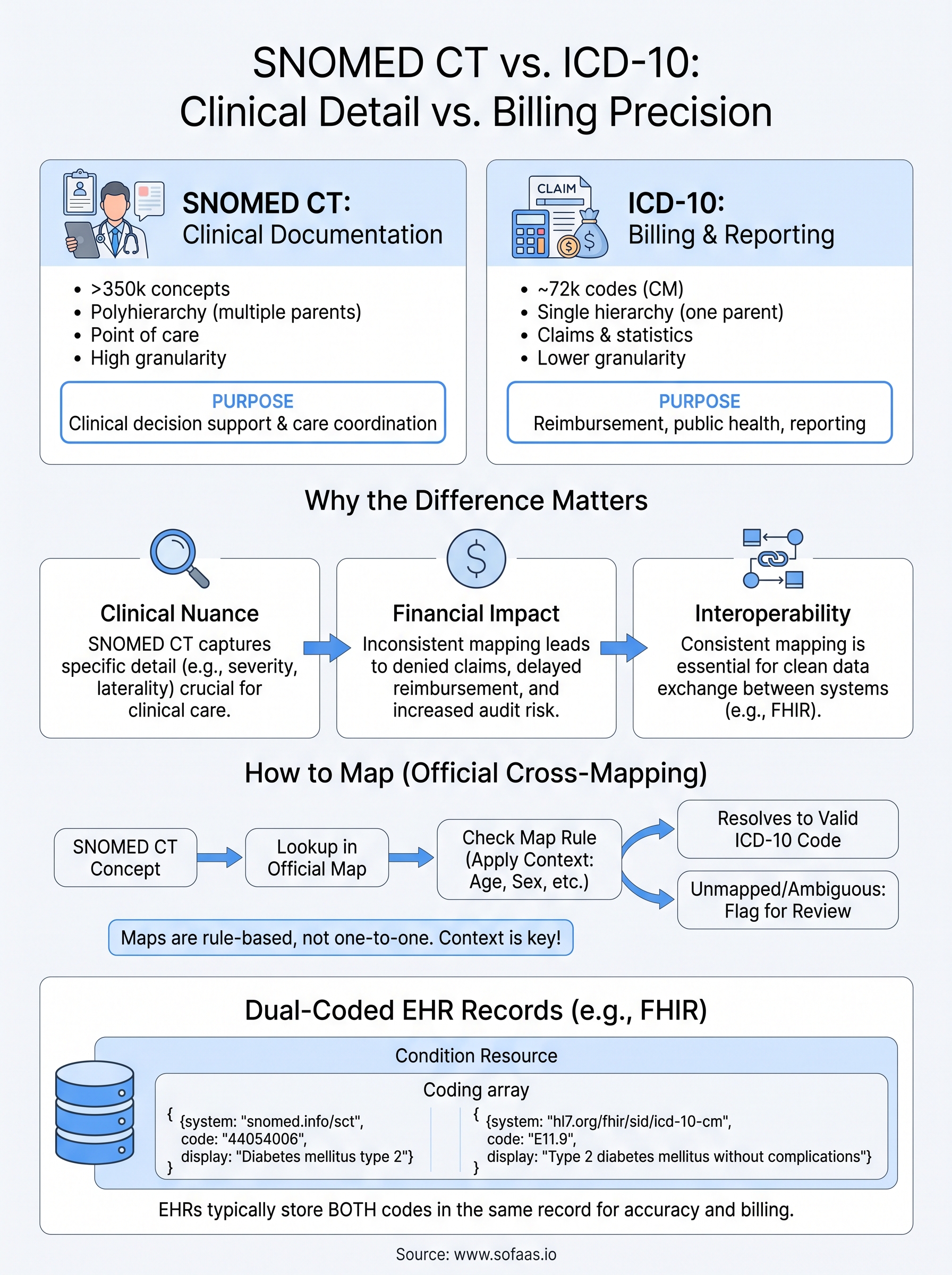
Here's the short answer: SNOMED CT is a clinical terminology with over 350,000 concepts designed for documenting diagnoses, symptoms, and procedures inside an EHR, while ICD-10 is a classification system used primarily for billing, reporting, and public health statistics. They serve different jobs, which is why most EHRs store both and rely on cross-mapping to keep them in sync.
In this article, we'll break down how each system is structured, where they're used in practice, and what actually happens when a SNOMED CT concept gets mapped to an ICD-10 code. If you're building or integrating an application that touches clinical data, understanding this mapping isn't optional. It's the difference between clean, interoperable data and a mess your team spends months untangling.
Why the difference matters for healthcare data
Getting the snomed ct vs icd-10 distinction wrong isn't an academic exercise. It shows up as denied claims, mismatched patient records, and analytics that don't add up. A clinician documents "acute viral pharyngitis" using a SNOMED CT concept because it captures the exact clinical picture. That same encounter needs an ICD-10 code before a claim can go out the door, because payers, CMS, and public health registries only speak that language. If the two don't line up cleanly, someone downstream has to fix it by hand.
Clean healthcare data isn't about picking the "better" code system. It's about making sure the two systems agree.
Clinical detail versus billing precision
SNOMED CT exists because clinicians need granularity that a billing code can't provide. A single ICD-10 code for "type 2 diabetes with diabetic nephropathy" might correspond to dozens of distinct SNOMED CT concepts describing severity, laterality, or specific complications. That precision matters for clinical decision support, quality measures, and care coordination between providers. Strip it out too early in your data pipeline, and you lose the nuance that made the original documentation useful in the first place.
The cost of inconsistent coding
Inconsistent mapping between the two systems has a direct financial impact. Payers reject claims that use outdated or incorrectly mapped ICD-10 codes, and that rejection rate climbs when an organization relies on manual translation instead of validated cross-mapping tables. Consider what's at stake for a typical mid-sized practice:
- Delayed reimbursement while staff manually reconcile mismatched codes
- Increased audit risk from imprecise or default-mapped diagnosis codes
- Skewed quality reporting when SNOMED CT detail doesn't survive the translation to ICD-10
- Duplicate documentation work for clinicians correcting downstream errors
Each of these traces back to the same root cause: treating SNOMED CT and ICD-10 as interchangeable when they're not.
Interoperability depends on consistent mapping
Moving patient data between systems, whether that's an EHR, a health information exchange, or a third-party application, only works if both sides agree on what a code means. The HL7 FHIR standard, which underlies SMART on FHIR integrations, expects diagnosis data to carry the correct coding system identifier alongside the code itself. Get the mapping wrong, and the receiving system either misinterprets the diagnosis or drops it entirely. That's a problem no application builder wants to discover after go-live, and it's exactly the kind of edge case that turns a straightforward integration project into a multi-month debugging exercise.
How to map SNOMED CT codes to ICD-10
Mapping isn't something you build from scratch. SNOMED International publishes an official SNOMED CT to ICD-10 map, and in the US, the National Library of Medicine distributes it through the UMLS Metathesaurus alongside the US-specific ICD-10-CM cross-reference tables. These maps are rule-based, not one-to-one, because a single SNOMED CT concept can point to different ICD-10 codes depending on context like laterality, severity, or an associated finding.
A good mapping table doesn't just translate a code, it preserves the clinical intent behind it.
The basic mapping workflow
When your system needs to convert a SNOMED CT concept into a billable ICD-10 code, the process generally follows this sequence:
- Look up the SNOMED CT concept in the official map file to find candidate ICD-10 targets.
- Check the map rule attached to that concept, since many entries require additional context (age, sex, associated diagnosis) before you can pick a single code.
- Apply the context from the patient's record to resolve ambiguous maps down to one valid ICD-10 code.
- Flag unmapped or ambiguous concepts for human review rather than defaulting to a generic code.
- Log the mapping decision so downstream audits can trace exactly how a diagnosis code was derived.
Where teams get this wrong
The most common mistake is treating the map as a simple lookup table and skipping step three. A SNOMED CT concept for "fracture of femur" might map to five or six different ICD-10-CM codes depending on which part of the bone and whether it's an initial encounter. Grab the first match without checking the rule, and you'll generate technically valid but clinically inaccurate claims. Refreshing your local copy of the map matters too. SNOMED International and the NLM update these files regularly, and a stale map produces silent errors that only surface months later during a payer audit.
Key structural differences at a glance
Side by side, the architectural gap between these two systems becomes obvious fast. SNOMED CT is built as a polyhierarchy, meaning a single concept can have multiple parent concepts based on different clinical relationships, while ICD-10 follows a strict single-parent tree designed for statistical grouping. That structural choice isn't cosmetic. It's why SNOMED CT can express nuanced clinical relationships that a flat classification system simply can't hold.
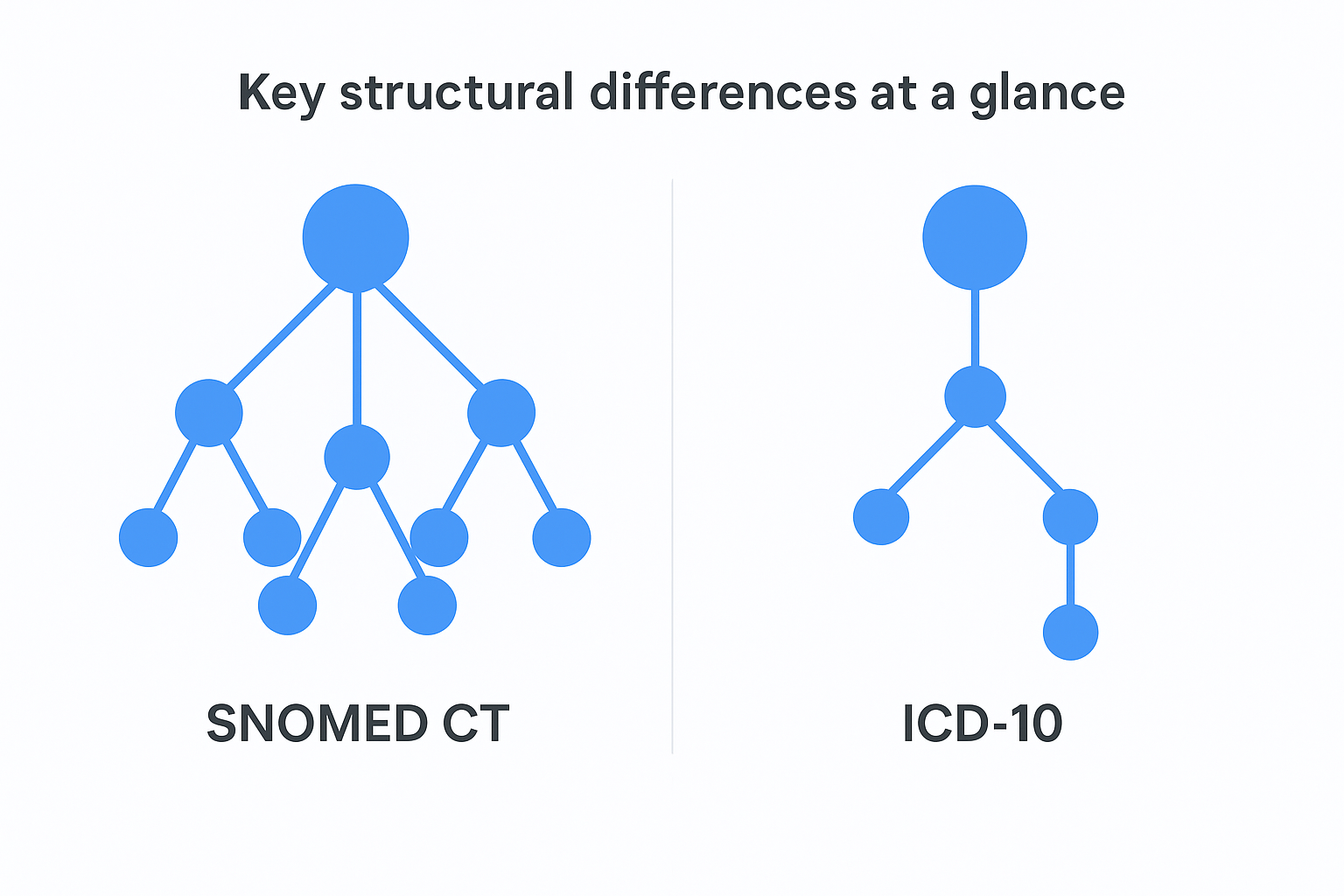
If ICD-10 is a filing cabinet, SNOMED CT is a network of everything that cabinet is filing.
Comparing the two systems
The table below breaks down the core differences you'll run into when working with either system in a data pipeline.
| Attribute | SNOMED CT | ICD-10 |
|---|---|---|
| Primary purpose | Clinical documentation | Billing and statistical classification |
| Structure | Polyhierarchy (multiple parents) | Single hierarchy (one parent per code) |
| Concept count | 350,000+ concepts | ~72,000 codes (ICD-10-CM, US) |
| Granularity | High, captures severity, laterality, context | Lower, grouped for reporting |
| Governed by | SNOMED International | WHO, adapted by CMS/NCHS in the US |
| Update cycle | Continuous, twice-yearly releases | Annual updates |
| Typical use in EHR | Problem list, clinical notes | Claims, quality reporting |
Why the numbering conventions matter
Beyond hierarchy, the two systems also encode information differently at the code level. SNOMED CT concepts are numeric identifiers with no embedded meaning, so the code itself tells you nothing without a lookup. ICD-10 codes, by contrast, embed category and specificity directly into the alphanumeric string, which is part of why billing software can validate them without a full terminology server. Recognizing this difference early saves you from building validation logic that assumes ICD-10's structure applies to SNOMED CT data, a mistake that trips up more integration projects than it should.
Using both systems together in EHR integrations
Most EHR integrations don't force you to pick one system over the other, they require both. When you pull a patient's problem list through a FHIR API, the Condition resource typically carries a SNOMED CT code for clinical accuracy and an ICD-10 code for billing, sitting side by side in the same coding array. Your application needs to recognize which system each code belongs to and route it correctly, rather than assuming every diagnosis follows the same format.
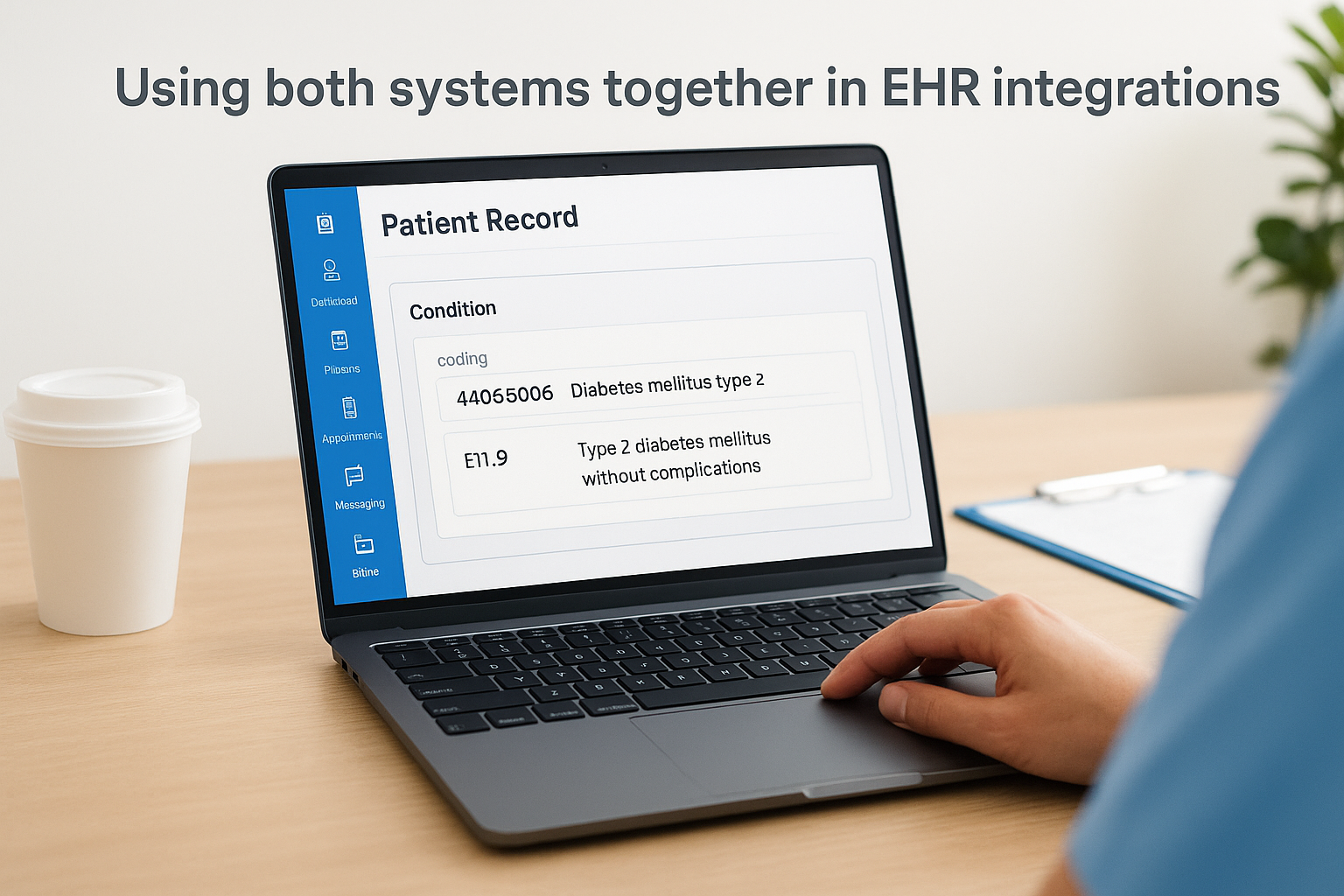
What a dual-coded Condition resource looks like
Picture a Condition resource for a patient with type 2 diabetes. The FHIR payload lists two entries in the same coding array, one tagged with the SNOMED CT system URI and one with ICD-10-CM. Parsing logic that assumes a single code per condition will silently drop half the clinical picture.
"code": {
  "coding": [
    { "system": "http://snomed.info/sct", "code": "44054006", "display": "Diabetes mellitus type 2" },
    { "system": "http://hl7.org/fhir/sid/icd-10-cm", "code": "E11.9", "display": "Type 2 diabetes mellitus without complications" }
  ]
}
Handling both code systems well means never assuming a diagnosis has just one identity.
Building integration logic that expects both
Vendors like Epic, Cerner, and Allscripts don't always populate this coding array the same way, so logic that works fine against one EHR's sandbox can break the moment you connect to another. Some vendors nest the SNOMED CT concept under a different extension entirely, and others omit one code system altogether depending on how the encounter was documented. Normalizing that inconsistency by hand across every EHR you support turns into its own ongoing project, separate from whatever your application is actually supposed to do. This is exactly the kind of work a managed SMART on FHIR platform like SoFaaS handles for you, delivering a single, consistent representation of both SNOMED CT and ICD-10 codes regardless of which EHR sits on the other end, so your team can build features instead of chasing vendor-specific coding quirks.
Putting SNOMED CT and ICD-10 to work
Understanding snomed ct vs icd-10 comes down to recognizing that each system solves a different problem. SNOMED CT captures the clinical story with the detail a provider actually documented, while ICD-10 translates that story into the language payers and public health agencies require. Neither one replaces the other, and any application touching patient data needs to handle both correctly, not just tolerate their coexistence.
Getting there means investing in validated cross-mapping, building parsing logic that expects dual-coded records, and testing against the quirks each EHR vendor introduces. That's a lot of specialized work for a team whose real job is building healthcare features, not maintaining terminology infrastructure. If you'd rather skip months of mapping edge cases and vendor-specific formatting, launch your SMART on FHIR app in a couple of steps and let a platform built for this handle the coding complexity for you.
The Future of Patient Logistics
Exploring the future of all things related to patient logistics, technology and how AI is going to re-shape the way we deliver care.
Thank you! Your submission has been received!
Oops! Something went wrong while submitting the form.