5 Revenue Cycle Management Best Practices for 2026

Denials are climbing, staff are stretched thin, and patients expect billing to feel as easy as everything else in their digital lives. If your team is still chasing down eligibility issues after the visit or manually keying data between systems, you're leaking revenue every single month. Revenue cycle management best practices for 2026 look different than they did even two years ago, because the tools available to fix these problems have matured fast.
This article gives you five practices you can act on now, not vague theory about "optimizing workflows." You'll get specifics on where clean patient data at registration prevents downstream denials, and why real-time EHR connectivity matters more than batch updates ever did.
We built SoFaaS to solve exactly this kind of integration problem for healthcare suppliers and app builders, so we've seen firsthand where revenue cycles break down and what actually fixes them. Expect practical steps on automated eligibility checks, tightening claims accuracy before submission, and using synchronized EHR data to cut days off your reimbursement timeline. Each practice below includes what to implement first and why it moves the needle.
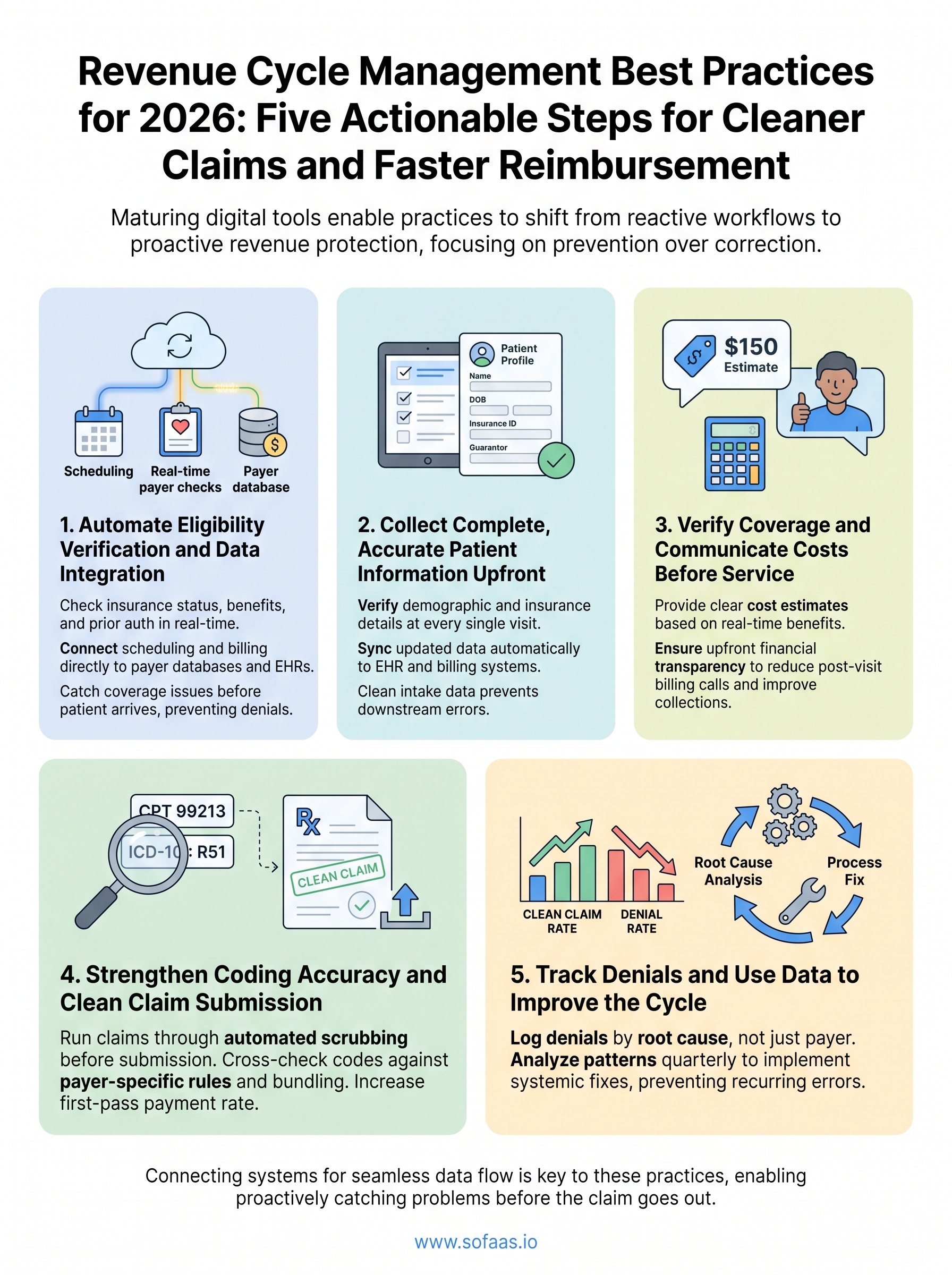
1. Automate eligibility verification and data integration
What it involves

Automating eligibility verification means your systems check a patient's insurance status, benefits, and prior authorization requirements the moment an appointment is scheduled, not the day before or the morning of. This isn't just a faster version of manual lookups. It means connecting your practice management system directly to payer databases and the patient's EHR record, so real-time eligibility data flows into your workflow without a staff member logging into five different payer portals. Real integration also means your scheduling, billing, and clinical systems share the same patient record instead of three disconnected versions of it.
Why it matters
Manual eligibility checks are the single biggest source of preventable denials in most practices we've worked with. A staff member misses an expired policy, a plan change goes unnoticed, or a prior auth requirement gets discovered after the claim is already denied. Every one of those mistakes costs you a resubmission cycle, and resubmissions can add 30 to 45 days to your payment timeline. Automated data integration closes that gap by catching coverage problems before the patient even walks in.
Eligibility problems caught before service are free; the same problems caught after service cost you a resubmission cycle.
How to implement it
Start by auditing where your current eligibility checks happen manually, then prioritize automating the connections causing the most denials.
- Connect your scheduling system to real-time payer eligibility feeds, not batch files
- Integrate your EHR with your billing platform so demographic and coverage data sync automatically
- Use a unified API rather than building separate point-to-point connections for each EHR you work with
- Set alerts for coverage gaps or auth requirements at least 48 hours before the appointment
This is exactly the kind of infrastructure problem SoFaaS was built to solve, since connecting to Epic, Cerner, or Allscripts individually is where most integration timelines stall out.
2. Collect complete, accurate patient information upfront
What it involves
Getting accurate patient information at the front desk means more than spelling names correctly. It means verifying date of birth, current address, insurance ID, guarantor details, and employer information every single visit, not just at the first encounter. Returning patients change jobs, switch plans, and move, and stale records are one of the quietest ways claims get kicked back weeks later.
Why it matters
Small data errors cause an outsized share of denials. A transposed digit in a member ID or an outdated group number sends a clean claim straight to rejection, and someone on your team has to track down the fix, resubmit, and wait again. Clean intake data is the foundation everything downstream depends on, including eligibility checks, coding, and claims submission.
A claim built on bad intake data is already halfway to denial before a provider sees the patient.
How to implement it
Build a standard intake checklist your front desk follows for every visit, not just new patients:
- Re-verify insurance ID and group number at each visit, not just annually
- Confirm guarantor and employer details against the payer's records
- Use digital intake forms that flag missing required fields before submission
- Sync updated demographic data automatically to your EHR and billing system so every downstream team sees the same record
3. Verify coverage and communicate costs before service
What it involves
Verifying coverage before service means confirming exactly what a patient's plan pays for the specific procedure or visit, then giving that patient a cost estimate before they sit in the exam room. This goes beyond a basic eligibility check. It requires pulling deductible status, copay amounts, and coinsurance details, then translating that into a number the patient can actually understand.
Why it matters
Patients who get surprised by a bill are far more likely to delay payment or dispute the charge entirely, which stalls your collections. Upfront cost transparency also reduces the volume of billing calls your staff fields after the fact, since the patient already knows what to expect. This is one of the most overlooked pieces of revenue cycle management best practices, because teams focus on payer-side accuracy and forget the patient owes a growing share of the bill.
A patient who knows the price before service pays faster than one who finds out after.
How to implement it
Build cost estimation into your check-in workflow, not as a separate manual step:
- Calculate patient responsibility using real-time benefit data, not last year's plan details
- Present the estimate verbally and in writing before the appointment
- Offer payment plan options at the point of estimate, not after the invoice arrives
- Document the conversation in the patient's record for billing follow-up
4. Strengthen coding accuracy and clean claim submission
What it involves

Clean claim submission means every claim leaves your office with correct codes, complete documentation, and no mismatched modifiers the first time it's sent. Coding accuracy depends on coders having the full clinical picture, current CPT and ICD-10 references, and payer-specific rules baked into the workflow before a claim ever gets transmitted, not caught in a post-submission audit.
Why it matters
Even a single wrong modifier or outdated code can flip a payable claim into a denial, and denial rework often costs more than the original claim was worth. Practices with strong claims accuracy processes routinely hit clean claim rates above 95%, while those relying on manual review after the fact often sit well below 85%. That gap translates directly into cash flow, since clean claims get paid in days instead of weeks.
A claim rejected for a coding error costs more to fix than it would have cost to get right the first time.
How to implement it
Build these checks into your submission workflow, not as an afterthought:
- Run claims through automated scrubbing software before submission
- Cross-check codes against payer-specific edits and bundling rules
- Train coders on updates quarterly, not just at year-end
- Flag claims missing required documentation before they leave your system
5. Track denials and use data to improve the cycle
What it involves
Tracking denials means logging every rejection by payer, reason code, and dollar amount, then reviewing that data monthly instead of letting it pile up in a spreadsheet nobody opens. Denial tracking only works if it feeds back into the earlier steps in this list, closing the loop between what went wrong and what you fix next.
Why it matters
Most practices treat denials as one-off problems to resolve and move past, but the same three or four root causes usually drive 80% of rejections. Without denial analytics, you keep fixing the same mistake claim by claim instead of once at the source. Teams that review denial patterns quarterly typically cut their overall denial rate within two cycles, simply because they stop repeating avoidable errors.
If you're not tracking why claims get denied, you're solving the same problem over and over instead of once.
How to implement it
Set up a denial review process that runs on a fixed schedule, not an ad hoc one:
- Categorize every denial by root cause, not just payer
- Route recurring issues back to registration, coding, or eligibility teams
- Report denial trends monthly to leadership, not just billing staff
- Set a target denial rate and measure progress against it each quarter
Putting these practices into action
None of these five practices work in isolation. Automated eligibility checks feed clean intake data, clean intake data supports accurate coding, and denial tracking tells you which of the other four steps needs attention next. Revenue cycle management best practices in 2026 come down to one idea: catch problems before the claim goes out, not after it bounces back.
Quick wins first: pick the practice causing your biggest denial category and fix that connection before tackling the rest. Most teams start with eligibility automation because it prevents downstream errors in the other four steps.
Getting real-time data flowing between your scheduling, billing, and EHR systems is the hardest part of this list, and it's the piece most teams underestimate. If you're building or improving a healthcare application that needs reliable EHR connectivity without months of integration work, launch your SMART on FHIR app with VectorCare and skip the infrastructure headache entirely.
The Future of Patient Logistics
Exploring the future of all things related to patient logistics, technology and how AI is going to re-shape the way we deliver care.
Thank you! Your submission has been received!
Oops! Something went wrong while submitting the form.