HIPAA Compliance ChatGPT: Is It Safe, and What Are the Risks?

You typed a patient question into ChatGPT to save time drafting a note, and now you're wondering if you just broke federal law. You're not alone. The question of hipaa compliance chatgpt comes up constantly in clinics, health tech startups, and hospital IT departments, and the short answer is that standard ChatGPT is not HIPAA compliant out of the box.
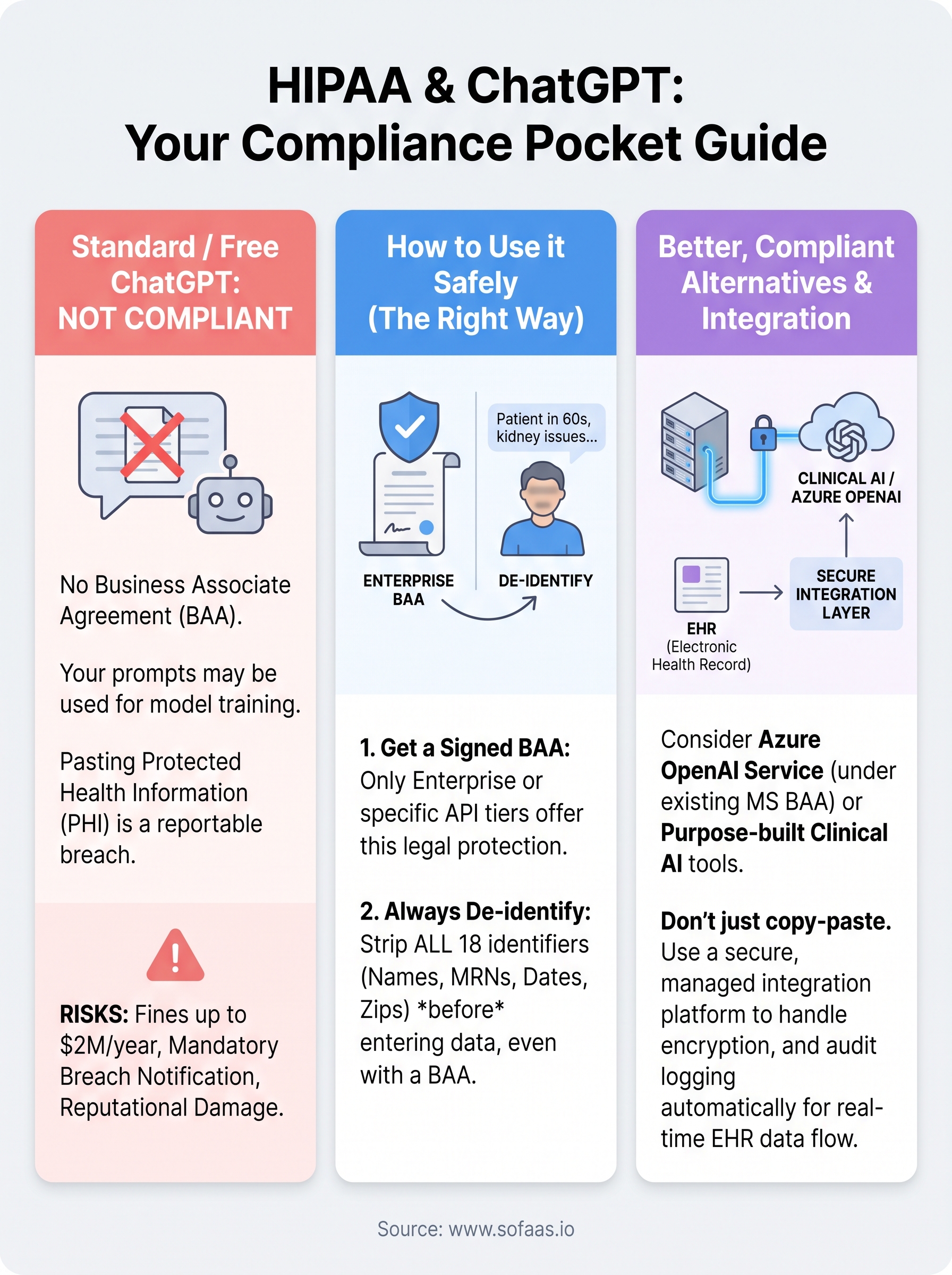
OpenAI does not sign a Business Associate Agreement for consumer ChatGPT accounts, which means any protected health information you enter creates real exposure to breach penalties and patient harm. There are enterprise paths that change this equation, but most people using the free or Plus version have no idea they're operating outside compliance boundaries.
This article breaks down exactly where ChatGPT fails HIPAA requirements, what configurations or enterprise agreements can close the gap, and what the actual risks look like if you skip that step. If you're building a healthcare application that needs to touch patient data safely, understanding this distinction matters just as much as secure EHR integration, and it's the kind of groundwork that determines whether your product survives an audit.
Why HIPAA compliance matters when using ChatGPT
HIPAA exists to protect one thing: patient trust. Every time you paste a symptom description, a lab value, or even a scheduling note into a chatbot, you're testing whether that trust holds up. HIPAA compliance isn't a checkbox exercise for lawyers, it's the mechanism that keeps a patient's mental health history, HIV status, or substance use records from ending up in a dataset nobody consented to. When you ask whether ChatGPT is HIPAA compliant, you're really asking whether a general-purpose consumer product was ever built to carry that weight. It wasn't.
The three things HIPAA actually requires
A covered entity or business associate has to satisfy the Security Rule, the Privacy Rule, and sign a Business Associate Agreement with anyone who touches protected health information on its behalf. The HHS Security Rule spells out administrative, physical, and technical safeguards, things like access controls, encryption, and audit logging. None of that is optional, and none of it appears in a standard ChatGPT account. Without a signed BAA, there's no legal basis for treating a vendor as trustworthy with patient data, no matter how good its intentions are.
What counts as PHI in a casual prompt
Most people underestimate how easily a prompt becomes a HIPAA event. You don't need a full medical record to trigger exposure. Protected health information includes any of the eighteen identifiers HHS lists, combined with health data, and that list is broader than most clinicians assume:
- Patient name or initials
- Date of birth or age over 89
- Medical record number
- Zip code paired with a rare diagnosis
- Any device identifier or IP address tied to a patient
Type "my 67-year-old patient with stage 3 CKD in zip code 30301 asked about dialysis" into ChatGPT, and you've just created a disclosure. It doesn't matter that the intent was harmless.
If a prompt can identify a real patient, treating it as PHI isn't optional, it's the law.
Why OpenAI's default terms leave you exposed
Enterprise agreements exist, but the free and Plus tiers most people actually use don't include a BAA. OpenAI's own usage policies confirm that standard consumer accounts fall outside their enterprise data protection terms, which means data retention and potential use in model improvement follow consumer rules, not healthcare ones. Even if you never intend for a prompt to be used for training data, the contractual protection simply isn't there unless you've moved to a specific enterprise or API configuration with the right agreements signed.
The stakes for healthcare teams specifically
Organizations get comfortable with ChatGPT because it feels like a private conversation. It isn't. Skipping this distinction turns a documentation shortcut into a reportable breach, and reportable breaches trigger OCR investigations, patient notification requirements, and reputational damage that outlasts any efficiency gained. That's the real reason this question deserves more attention than a quick Google search before you copy and paste your next clinical note.
How to use ChatGPT without violating HIPAA
Getting hipaa compliance chatgpt right isn't about avoiding the tool entirely, it's about matching the account type to the data you're handling. OpenAI does offer a path that includes a signed Business Associate Agreement, but it only kicks in once you move to ChatGPT Enterprise or the API under a specific data processing agreement. If your team hasn't signed one, treat every prompt window as public.
Confirm the BAA before anyone touches PHI
Before a single clinician or developer pastes patient data into a chat window, someone in your organization needs to confirm the BAA is signed and covers the specific product tier you're using. OpenAI's enterprise offering restricts data retention and excludes prompts from model training, but only under that contract, never under a personal login. Skipping this step is the single most common way teams end up out of compliance without realizing it.
No BAA means no legal cover, regardless of how careful your prompts are.
De-identify before you type anything
Stripping identifiers is the fastest safeguard available, and it works even inside a compliant account because minimizing exposure is always good practice. Replace names with role descriptions, swap exact ages for ranges, and drop zip codes or dates that could narrow a patient down to one person. "A patient in their 60s with advanced kidney disease asked about dialysis options" carries the same clinical value as the identifiable version without the liability.
Set workflow rules your team will actually follow
Rules only work if they're simple enough to remember during a busy shift. A short, enforced checklist beats a long policy nobody reads:
- Use only the enterprise or BAA-covered account for anything touching patient data
- Never paste full names, MRNs, or exact birthdates into any prompt
- Route structured EHR data through a compliant integration layer instead of manual copy-paste
- Log every AI-assisted note for audit purposes
- Review outputs before they enter the patient record
Handled this way, ChatGPT becomes one tool in a compliant workflow instead of a shortcut that quietly creates risk.
The real risks of noncompliant AI use in healthcare
Getting caught unprepared with noncompliant AI use isn't a theoretical risk, it's a documented pattern that OCR investigators see every year. Feeding patient data into a consumer chatbot doesn't just violate a policy, it exposes your organization to fines, lawsuits, and the kind of breach notification process that follows you for years. Understanding the actual dollar amounts and legal exposure helps turn an abstract compliance conversation into something a budget committee takes seriously.
Fines scale with how much you knew
HHS structures civil monetary penalties in tiers based on whether the violation was unknowing, due to reasonable cause, or the result of willful neglect. A single uncorrected willful neglect violation can reach the annual cap fast, and regulators don't care that the tool felt private.
| Violation Category | Penalty per Violation | Annual Cap |
|---|---|---|
| Unknowing | $137 to $68,928 | $2,067,813 |
| Reasonable Cause | $1,379 to $68,928 | $2,067,813 |
| Willful Neglect, Corrected | $13,785 to $68,928 | $2,067,813 |
| Willful Neglect, Not Corrected | $68,928 minimum | $2,067,813 |
Figures reflect HHS OCR's published penalty tiers under the HIPAA enforcement framework.
A single unencrypted prompt can cost more than the entire software budget that created it.
Breach notification drags on for months
Beyond fines, a confirmed breach triggers mandatory notification to every affected patient, HHS, and in larger cases, the media. Notification obligations force your team to document exactly what was disclosed, when, and to whom, which is nearly impossible when the disclosure happened inside a third-party chat log you don't control.
Trust damage outlasts the penalty
Losing patient trust rarely shows up on a balance sheet immediately, but it shows up in patients who withhold information from clinicians because they no longer believe their records stay private. Reputational damage compounds when a breach makes local news, and referring providers start asking pointed questions about your data practices before sending patients your way.
Vendor relationships get harder
Downstream, EHR vendors and payer partners increasingly ask for proof of compliant AI handling before signing new agreements, so a known lapse can quietly close doors long after the initial incident fades from headlines.
ChatGPT for Healthcare vs. other compliant AI options
Once you accept that standard ChatGPT can't touch patient data, the real decision becomes which compliant path actually fits how your team works. ChatGPT Enterprise with a signed BAA is one option, but it's not the only one, and it's often not the fastest to deploy for a healthcare application that needs to plug directly into clinical workflows rather than a chat window.

Enterprise ChatGPT vs Azure OpenAI vs healthcare-specific tools
Microsoft's Azure OpenAI Service is the option most enterprise IT teams already trust, since it runs under the same Microsoft compliance offerings that cover Office 365 and Azure Health Data Services, and it slots into infrastructure hospitals already have BAAs for. Purpose-built clinical AI tools go further still, layering documentation or coding assistance directly onto EHR data with compliance baked in from the start instead of bolted on.
| Option | BAA Available | Best Fit |
|---|---|---|
| ChatGPT Enterprise | Yes, with contract | General drafting, internal knowledge work |
| Azure OpenAI Service | Yes, via Microsoft | Teams already inside Microsoft's compliance stack |
| Purpose-built clinical AI | Yes, native | Direct EHR-connected documentation or coding tools |
The safest AI option is rarely the most familiar one, it's the one built for your actual data flow.
Where the integration layer actually matters
Selecting a compliant AI vendor solves half the problem. The other half is how patient data reaches that AI tool in the first place, and that's where most teams underestimate the work involved. Getting structured, consented data out of Epic, Cerner, or Allscripts and into any AI workflow, compliant or not, requires the same OAuth handling, audit logging, and encrypted transport that HIPAA demands everywhere else. Handling that yourself means building and maintaining SMART on FHIR connections for every EHR your customers run, which is exactly the burden a managed healthcare data integration platform like SoFaaS removes, so your AI features connect to real patient records without your team becoming EHR integration specialists first.
Building HIPAA-ready AI workflows around your EHR data
Knowing which AI vendor to trust only gets you partway. The harder engineering problem is designing the pipeline that moves data from the EHR to the AI tool and back, without ever creating a gap where PHI sits unencrypted or unaudited. HIPAA-ready AI workflows treat every hop in that chain, not just the final chat interface, as a place where compliance has to be enforced.
Map every place PHI moves
Start by tracing the actual path a piece of patient data takes: from the EHR, through an integration layer, into the AI model, and back into a note or dashboard. Each hop needs its own safeguard, and skipping one undermines the whole chain:
- Extraction: pull data via a SMART on FHIR connection with scoped OAuth tokens, not a manual export
- Transit: encrypt everything in transit and at rest, matching the Security Rule's technical safeguards
- Processing: send only the minimum data needed to a BAA-covered AI endpoint
- Storage: log what was sent, when, and to which system, for audit purposes
- Return: route AI output back into the chart through an authenticated, logged channel
A compliant AI tool sitting behind a non-compliant data pipeline is still a breach waiting to happen.
Automate consent and access controls
Manual consent tracking breaks down fast once you're pulling data from more than one EHR. Automating patient authorization at the integration layer means every AI request carries proof that the patient consented to that specific use, which matters enormously if OCR ever asks you to reconstruct a data flow after the fact. Building that consent logic from scratch for Epic, Cerner, and Allscripts separately is months of work most product teams don't have.
Let the integration layer carry the compliance burden
Teams that try to build this pipeline themselves usually discover the AI integration was the easy part. SMART on FHIR connections, token refresh, and audit logging across multiple EHR vendors take specialized expertise that most engineering teams don't have in-house and shouldn't have to build. That's the exact gap SoFaaS closes: a managed FHIR integration platform that handles the OAuth flows, encryption, and audit trail between your EHR sources and whatever AI tool sits downstream, so your team can focus on the application logic instead of rebuilding compliance infrastructure for every new health system you connect to.
Where this leaves healthcare teams using AI
ChatGPT can absolutely help your team draft notes, summarize research, or speed up documentation, but only inside an account with a signed BAA and only after you've stripped out anything that identifies a patient. Standard consumer accounts remain off limits for real patient data, no matter how convenient the shortcut feels at 4pm on a busy shift. The bigger lesson here isn't really about ChatGPT specifically. It's that any AI feature you bolt onto a healthcare product is only as compliant as the data pipeline feeding it, and that pipeline has to handle OAuth, encryption, and audit logging correctly for every EHR you touch.
Building that infrastructure yourself is months of specialized work most teams don't have. If you're ready to connect patient data to your application the right way, launch your SMART on FHIR app in a couple of steps instead of building the compliance layer from scratch.
The Future of Patient Logistics
Exploring the future of all things related to patient logistics, technology and how AI is going to re-shape the way we deliver care.
Thank you! Your submission has been received!
Oops! Something went wrong while submitting the form.