HIPAA Compliance AI: What It Means and How to Achieve It

AI tools are showing up everywhere in healthcare, from clinical documentation assistants to chatbots that triage patient questions. But the moment an AI system touches protected health information, HIPAA compliance AI stops being a nice-to-have and becomes a legal requirement. Most teams don't realize how many ways an AI vendor can put PHI at risk, whether that's through training data, third-party API calls, or logs nobody thought to encrypt.
This article breaks down what HIPAA compliance actually demands when AI enters the picture, and how to tell a compliant tool from one that just claims to be. You'll get a clear picture of PHI safeguards, the role of Business Associate Agreements, and the specific risks that come with feeding patient data into machine learning models.
We'll also cover practical steps for evaluating vendors, securing data pipelines, and building audit-ready infrastructure around your AI deployments. If you're building or buying healthcare software that relies on AI, this is the checklist you need before connecting it to real patient records, especially if that data is flowing in from EHR systems where integration security matters just as much as the AI layer itself.
Why HIPAA compliance matters when adopting AI
Healthcare teams often treat AI adoption like any other software rollout, but PHI changes the math entirely. The HIPAA Privacy Rule and Security Rule apply to any system that creates, receives, maintains, or transmits protected health information, and that includes the large language model summarizing a discharge note or the chatbot answering a patient's medication question. Once patient data touches an AI pipeline, every input, output, and log becomes subject to the same legal obligations as a traditional EHR. Ignoring this doesn't make the requirement disappear. It just means you find out the hard way, usually during an audit or after a breach.
The legal stakes of PHI in AI systems
Regulators haven't carved out a special exception for machine learning. The Department of Health and Human Services has made clear that AI vendors handling PHI on behalf of a covered entity are business associates, full stop, and must sign a Business Associate Agreement before any data flows. You can read the government's own framing of this on the HHS Office for Civil Rights HIPAA page, which spells out how the same rules that govern billing software and lab systems apply to newer technology categories too. Skipping this step isn't a paperwork oversight, it's a direct violation that puts both the vendor and the covered entity on the hook.
If an AI tool touches patient data without a signed BAA, you're already out of compliance, no matter how good the model is.
Where AI amplifies traditional compliance risks
General-purpose AI tools introduce risks that older healthcare software simply didn't have. Models trained on user inputs can inadvertently memorize and later expose PHI fragments. Third-party API calls to cloud-hosted models can route patient data through servers with no BAA in place. Vector databases used for retrieval-augmented generation often store embeddings of clinical notes with far less oversight than a traditional database would get. None of these risks are hypothetical: security researchers have repeatedly demonstrated that language models can leak snippets of training data when prompted the right way.

Here's a quick comparison of how traditional healthcare IT risk differs from AI-specific risk:
| Risk Area | Traditional Systems | AI-Powered Systems |
|---|---|---|
| Data storage | Structured databases with access logs | Embeddings, prompts, and model outputs often unlogged |
| Data exposure | Breach via stolen credentials or misconfigured servers | Breach via prompt injection, model memorization, or unsecured API calls |
| Vendor oversight | Single system, clear data flow | Multiple sub-processors (model host, vector store, logging service) |
| Audit trail | Centralized logging | Fragmented across AI pipeline stages |
The cost of getting it wrong
Penalties for HIPAA violations scale with negligence, and AI-related breaches tend to land on the higher end because they often involve large volumes of data processed automatically. Fines can reach into the millions, and that's before accounting for reputational damage, patient trust erosion, and the cost of remediation. Organizations that build compliant infrastructure from day one, rather than retrofitting it after a near-miss, save themselves both money and legal exposure down the road.
Moving fast with AI doesn't have to mean moving carelessly. Teams that build on infrastructure designed for healthcare data integration, like SoFaaS, get HIPAA-compliant data handling baked into the connection layer instead of bolting it on after the fact. That distinction matters more once AI enters the picture, because every additional system touching PHI is another point where compliance can quietly fail.
How to achieve HIPAA compliance with AI tools
Getting to HIPAA compliance AI isn't a single certification you buy off a shelf. It's a set of technical, administrative, and contractual controls that have to work together, and most teams underestimate how many pieces need to line up before an AI tool can safely touch patient data. Start by treating the AI system the same way you'd treat any new business associate: map exactly what data flows in, what happens to it, and where it ends up.
Map every place PHI touches AI
Before signing any vendor contract, document every point where protected health information enters or leaves the AI pipeline. That includes prompts sent to a model, embeddings stored in a vector database, logs kept for debugging, and any cached outputs. Teams that skip this mapping step almost always discover gaps later, usually the kind that show up during a breach investigation instead of a planned audit.
You can't secure PHI you haven't mapped, so data flow diagrams come before vendor contracts, not after.
Build compliance into the pipeline, not after it
Baking HIPAA compliant AI tools into your architecture from the start beats retrofitting security controls onto a system already in production. That means encrypting data at rest and in transit, enforcing role-based access to any interface that touches PHI, and setting retention limits so patient data doesn't linger in logs indefinitely. It also means picking infrastructure partners who already handle the compliance layer, so your engineering team isn't reinventing encryption standards and audit logging from scratch every time you add a new AI feature.
Follow a repeatable evaluation process
Use a consistent checklist every time you evaluate a new AI tool or feature for PHI exposure:
- Confirm the vendor will sign a Business Associate Agreement before any data flows.
- Verify data encryption standards for both storage and transmission.
- Ask whether patient data is used to train or fine-tune shared models.
- Check retention and deletion policies for prompts, outputs, and logs.
- Confirm audit logging exists for every access point, not just the main application.
- Review sub-processor lists to see who else touches the data downstream.
Running this process consistently, rather than case by case, keeps compliance from becoming an afterthought every time someone on the team wants to try a new AI feature.
Common HIPAA risks unique to AI systems
Shadow AI creates one of the fastest-growing compliance gaps in healthcare organizations today. Clinicians and staff paste patient notes into consumer chatbots to save time on documentation, often without realizing that free-tier tools have no Business Associate Agreement and may retain every prompt they receive. This kind of unsanctioned use bypasses IT entirely, so the compliance team often has no idea PHI left the building until a vendor security review or an incident forces the question.
Model memorization introduces a risk that traditional software never had to worry about. Large language models trained or fine-tuned on real patient records can reproduce fragments of that data when prompted in certain ways, even months after training ended. Researchers have documented this behavior across commercial models, which is why any vendor offering to fine-tune a model on your data needs to explain exactly how memorization is prevented, not just promise that it is.
The biggest AI-specific HIPAA risk isn't a hacker breaking in, it's PHI leaking out through a model that was never designed to forget.
Hallucinated outputs create a quieter but still serious problem. An AI system that fabricates a diagnosis, medication, or patient detail isn't just a clinical accuracy issue, it can also mean the system is generating and storing content tied to a real patient identity without proper safeguards around that output. Teams evaluating AI compliance risks need to treat generated content with the same scrutiny as raw input data, since both can carry PHI.
A few other risk patterns show up consistently across AI deployments handling patient data:
- Prompt injection, where malicious or malformed input tricks a model into exposing data it shouldn't
- Unsecured vector stores, where embeddings of clinical notes sit outside normal database access controls
- Sub-processor sprawl, where a single AI feature quietly relies on three or four downstream vendors, each a potential compliance gap
- Insufficient de-identification, where data assumed to be anonymized still contains re-identifiable details once combined with other fields
Each of these risks maps back to the same root cause: AI systems move and transform data in ways that don't fit neatly into the audit trails built for traditional healthcare software. Recognizing that gap early is what separates teams that catch problems in a security review from teams that catch them in a breach notification letter.
What to look for in an AI vendor's BAA
Signing a Business Associate Agreement with an AI vendor isn't the finish line, it's the starting point for figuring out whether that agreement actually covers what the AI system does with patient data. Standard BAA templates were written for billing systems and fax servers, not for models that transform, store, and sometimes retrain on the data they touch. A vendor handing you a boilerplate BAA without AI-specific language is telling you they haven't thought through how their product actually processes PHI.
Standard clauses that don't go far enough
Every BAA needs the basics: breach notification timelines, permitted uses of PHI, and a commitment to implement appropriate safeguards under the Security Rule. But those baseline clauses say nothing about whether your prompts get logged indefinitely, whether outputs get cached for model improvement, or whether a sub-processor three layers down has access to raw clinical text. Reading a BAA and stopping at the standard language gives you false confidence.
A generic BAA tells you the vendor knows the law exists, not that their AI product actually follows it.
AI-specific terms to demand before signing
Push for explicit language covering how the AI pipeline handles data, not just how the company handles data in the abstract. Look for these terms specifically:
- No training on your data without separate, explicit, revocable consent
- Defined retention limits for prompts, model outputs, and any cached responses
- Named sub-processors, including the model host, vector database provider, and any logging or analytics service
- Breach notification timelines that account for automated systems, where exposure can scale faster than a traditional data breach
- Deletion guarantees confirming PHI is actually purged from backups and embeddings, not just the primary database
- Audit rights letting you review how the vendor's AI pipeline actually processes data, not just their written policies
The Office for Civil Rights outlines the minimum requirements for any Business Associate Agreement on its BAA guidance page, which is a useful baseline before you start negotiating AI-specific additions.
Vendors that resist adding these terms usually can't answer the underlying question: where does patient data actually go once it enters the model? If a company can't map its own sub-processor chain or explain retention policy in plain language, that's a signal to keep looking, no matter how polished the product demo looked.
Are popular AI tools like ChatGPT HIPAA compliant
Search "ChatGPT HIPAA compliant" and you'll find a mess of conflicting answers, mostly because the question itself is incomplete. The free, consumer-facing version of ChatGPT is not HIPAA compliant and OpenAI won't sign a Business Associate Agreement for it. Nothing you type into that interface should include patient names, dates of birth, medical record numbers, or anything else that could identify a real person. That said, OpenAI does offer a BAA for its enterprise API and certain business tiers, which changes the equation entirely once the right contract and configuration are in place.
A tool being HIPAA compliant on paper means nothing if your team is using the wrong version of it.
Consumer apps versus enterprise agreements
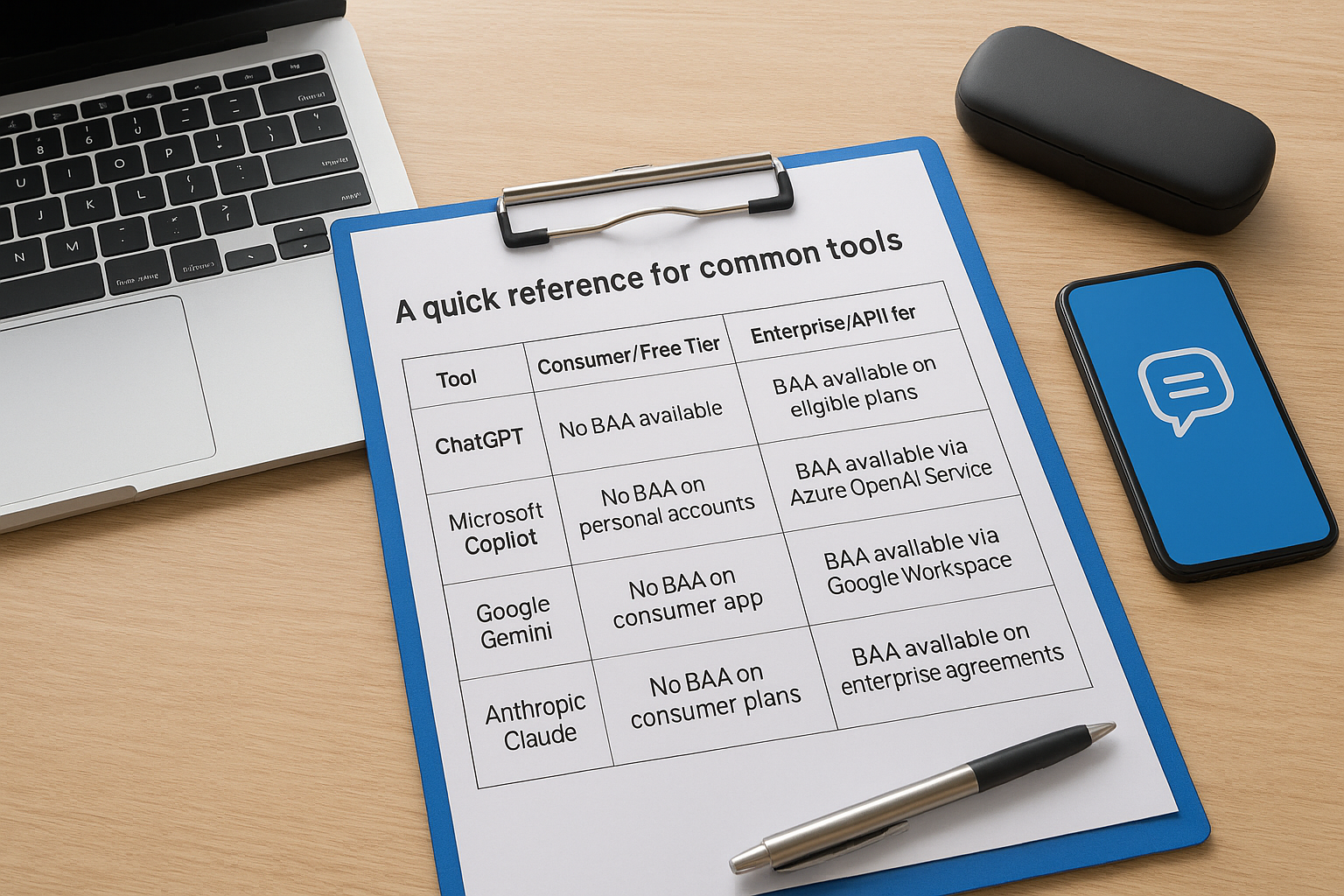
This distinction between consumer and enterprise tiers applies across nearly every major AI vendor, not just OpenAI. Microsoft offers BAA coverage for Azure OpenAI Service when configured correctly, but the free Copilot app most employees already have on their laptop isn't automatically covered. Google's enterprise Gemini offerings through Workspace can fall under an existing BAA, while the consumer Gemini app does not. The pattern holds everywhere: enterprise API access with a signed BAA and specific data handling settings can be compliant, while the free or personal version of the same underlying model almost never is.
A quick reference for common tools
Before giving any team access to an AI tool, confirm which tier they're actually using:
| Tool | Consumer/Free Tier | Enterprise/API Tier |
|---|---|---|
| ChatGPT (OpenAI) | No BAA available | BAA available on eligible plans |
| Microsoft Copilot | No BAA on personal accounts | BAA available via Azure OpenAI Service |
| Google Gemini | No BAA on consumer app | BAA available via Google Workspace |
| Anthropic Claude | No BAA on consumer plans | BAA available on enterprise agreements |
Organizations that skip this check often end up with shadow AI use, where staff assume the tool their company pays for is automatically safe, without realizing the compliant version requires a separate contract and a different login. Verifying the tier in use, confirming the BAA covers the specific product being deployed, and locking down access so employees can't quietly slide back into the free version are the three steps that keep HIPAA compliance AI decisions from unraveling after the fact. None of this is exotic, it just requires someone on the compliance or IT team to actually check before rollout instead of assuming the brand name implies the protection.
A practical checklist before deploying AI with PHI
Rolling out an AI feature that touches protected health information deserves the same rigor as launching a new EHR integration, not a quick sign-off from whoever owns the product roadmap. Treat this checklist as the last gate before PHI flows into any model, and don't let a tight deadline talk you into skipping a step.
Technical readiness checks
Confirm these items on the infrastructure side before any patient data reaches the AI system:
- Encryption is enforced at rest and in transit, with no exceptions for internal traffic
- Access controls limit who can view prompts, outputs, and logs to people with a documented need
- Retention limits are configured so prompts and outputs don't persist longer than necessary
- Audit logging captures every access point in the pipeline, not just the main application
- De-identification methods are tested against re-identification risk, not just assumed to work
Skipping any of these leaves a gap that shows up eventually, usually at the worst possible time.
Contractual and administrative checks
Beyond the technical layer, verify the paperwork actually matches how the system behaves in production:
- The Business Associate Agreement explicitly covers the AI features being deployed, not just the vendor's core product
- Sub-processors are named and reviewed, including model hosts and vector database providers
- Staff training covers what counts as PHI and why pasting it into unapproved tools creates risk
- An incident response plan names who gets notified if the AI system exposes data unexpectedly
A checklist only protects you if someone actually checks it before launch, not after an incident forces the question.
Sign-off before launch
Nothing on this list should be optional for a genuine HIPAA compliance AI rollout, and no single team should be able to approve deployment alone. Compliance, engineering, and whoever owns the vendor relationship each need to confirm their piece before PHI touches the system. Organizations that skip this joint review tend to discover the gaps through a breach report instead of a planning meeting, and by then the cost of fixing it has multiplied well beyond what a proper review would have taken.
Running through this list every single time, even for tools that seem low-risk, keeps compliance consistent instead of dependent on whoever happens to be paying attention that week.
Putting compliant AI into practice
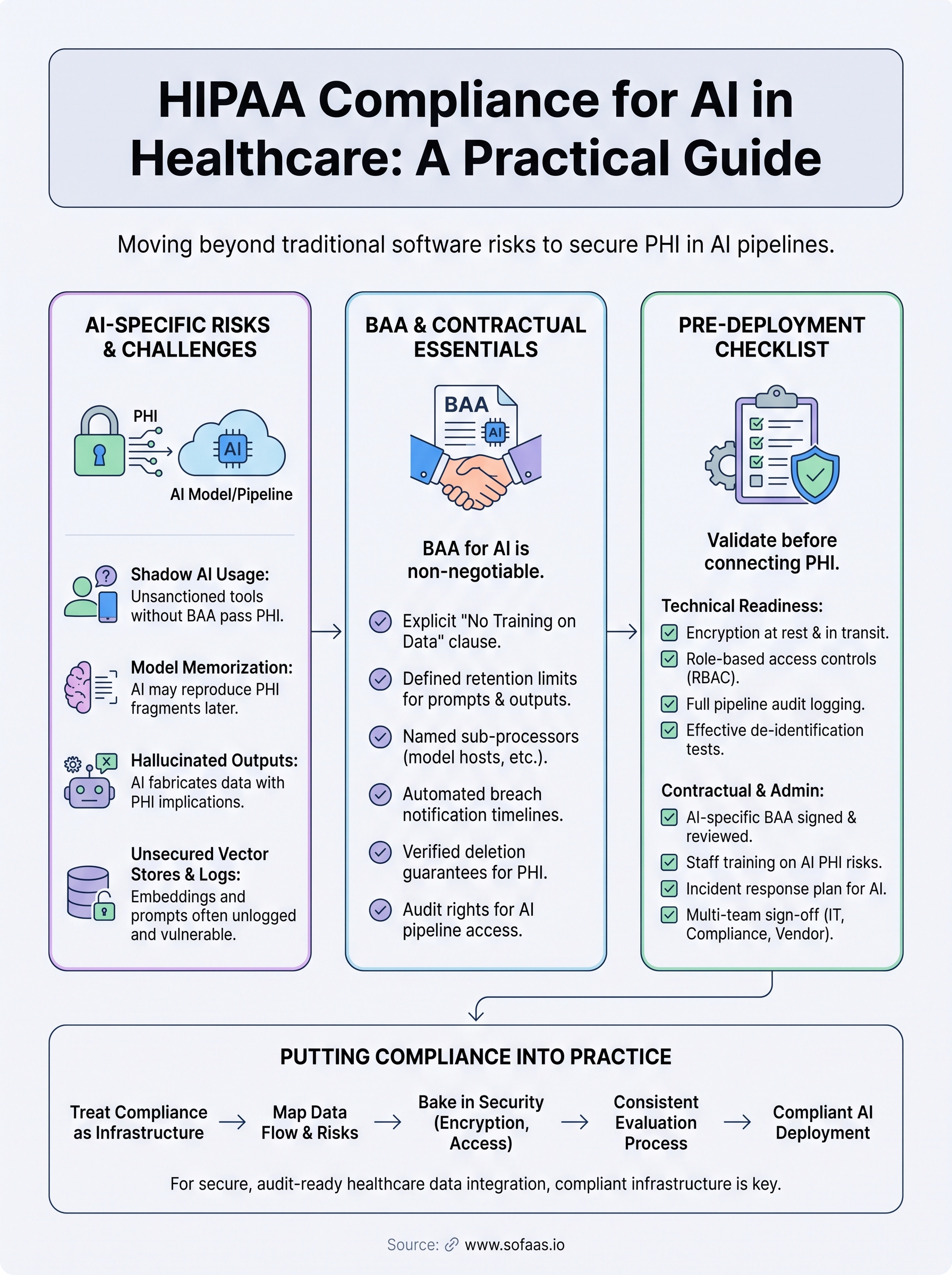
HIPAA compliance AI isn't a checkbox you tick once and forget. It's a discipline you apply every time a new model, vendor, or feature touches patient data, from the BAA you sign to the retention limits you enforce on logs nobody usually thinks about. Teams that treat compliance as infrastructure, not paperwork, move faster in the long run because they're not scrambling to explain a data flow after a breach notice arrives.
Getting this right gets harder when your AI tools sit on top of shaky EHR integrations that were never built with audit trails or encryption in mind. If you're building a SMART on FHIR app and want the compliance layer handled at the connection point instead of bolted on later, launch your SMART on FHIR app in a couple of steps with infrastructure designed for exactly this problem.
The Future of Patient Logistics
Exploring the future of all things related to patient logistics, technology and how AI is going to re-shape the way we deliver care.
Thank you! Your submission has been received!
Oops! Something went wrong while submitting the form.